
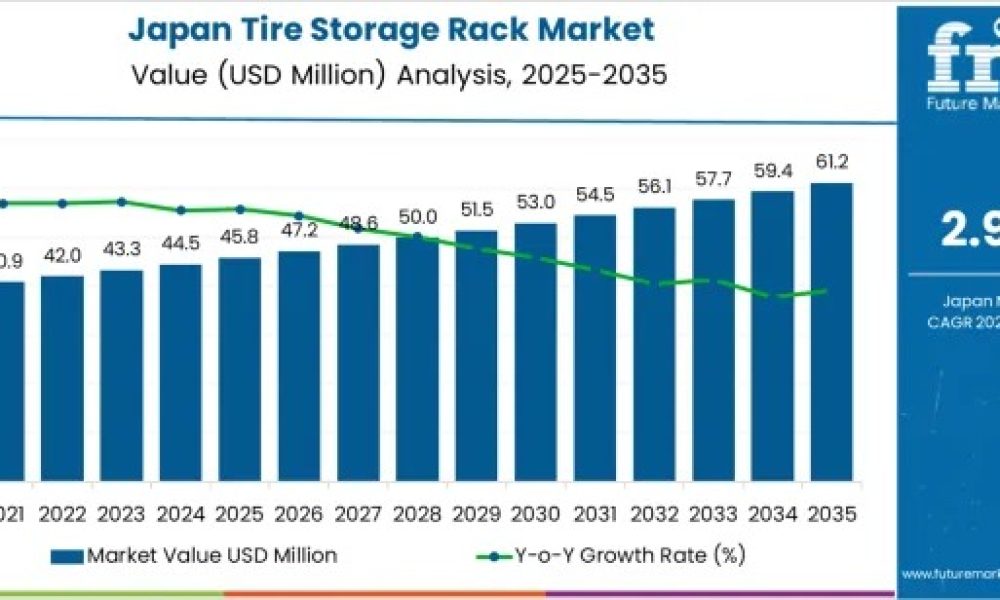
The demand for tire storage racks in Japan is projected to grow steadily over the next decade, reflecting the structural importance of efficient storage infrastructure within the country’s automotive ecosystem. According to the latest market assessment, the Japan tire storage rack market is valued at USD 45.8 million in 2025 and is forecast to reach USD 61.2 million by 2035, registering a compound annual growth rate (CAGR) of 2.9% during the forecast period. This sustained growth trajectory highlights the role of storage solutions as a foundational element supporting automotive retail, tire dealerships, service centers, and associated aftermarket operations.
Japan’s automotive landscape continues to evolve under the combined influence of rising vehicle ownership, expanding aftermarket services, and a deeply embedded seasonal tire replacement culture. These factors collectively drive consistent demand for organized, accessible, and safe tire storage systems. As tire inventories grow in both volume and complexity—driven by a wider range of vehicle models, tire specifications, and customer service requirements—businesses are increasingly prioritizing structured storage solutions to enhance space utilization, improve workflow efficiency, and maintain inventory integrity.
Get access to comprehensive data tables and detailed market insights – request your sample report today!
Market Growth Accelerates in the Second Half of the Forecast Period
Between 2025 and 2030, demand for tire storage racks in Japan is expected to increase from USD 45.8 million to approximately USD 53.0 million, adding USD 7.2 million in incremental value. This phase reflects moderate yet consistent growth, driven primarily by tire dealers and automotive service centers upgrading basic storage infrastructure to improve safety standards and operational efficiency. During this period, adoption is supported by incremental technological improvements in rack design, materials, and load-bearing capabilities, without a dramatic shift in procurement behavior.
From 2030 to 2035, the market enters a more accelerated growth phase, with demand rising from USD 53.0 million to USD 61.2 million, adding USD 8.2 million. This acceleration is expected to be fueled by broader adoption of advanced and space-saving storage systems across a wider spectrum of users, including smaller service outlets and mixed-use retail operations. As the automotive aftermarket matures, companies increasingly view storage infrastructure as a strategic investment rather than a purely functional asset. The integration of modular layouts, higher-density storage formats, and early-stage smart storage concepts is expected to strengthen demand during this later phase.
Operational Efficiency and Space Constraints Drive Adoption
One of the primary forces shaping demand for tire storage racks in Japan is the need to optimize limited space, particularly in dense urban environments. Automotive workshops and tire retailers often operate within constrained footprints, where efficient vertical and horizontal storage solutions directly influence throughput and service quality. Storage racks enable businesses to manage growing inventories while ensuring ease of access, reduced handling time, and compliance with safety expectations.
The growth of e-commerce and online tire sales further reinforces this trend. As inventory turnover accelerates, businesses require storage systems that support fast sorting, retrieval, and restocking. Tire storage racks designed for durability, stability, and adaptability are increasingly favored as essential components of modern inventory management strategies.
Mid-Capacity, Horizontal, and Stationary Racks Dominate Demand
From a segmentation perspective, tire storage racks with a capacity of 50–150 tires account for approximately 38% of total demand, making them the leading capacity category in Japan. These racks strike a balance between space efficiency and storage volume, making them particularly suitable for medium-sized tire dealers, automotive service centers, and regional distributors. Their flexibility in accommodating multiple tire sizes further supports widespread adoption.
By orientation, horizontal storage racks dominate the market with a 60% share. Horizontal designs are preferred for their stability, ease of access, and suitability for high-turnover environments where frequent handling is required. This configuration supports bulk storage while minimizing operational friction in busy service settings.
In terms of design, stationary racks represent about 70% of demand. These systems are valued for their structural robustness, long service life, and ability to support continuous, heavy-duty use. Fixed installations are particularly common in service centers, warehouses, and retail facilities where tire turnover is consistent and long-term storage reliability is critical.
Tailor Your Solution: Request Customization for Your Unique Needs!
Regional Demand Anchored in Industrial and Urban Hubs
Demand growth is evident across all regions of Japan, though rates vary based on vehicle density, urbanization, and automotive activity. Kyushu & Okinawa lead the market with a CAGR of 3.7%, supported by rising vehicle ownership, growing automotive services, and climate-related needs for tire protection. Kanto follows at 3.4% CAGR, driven by dense population centers, high vehicle concentration, and strong demand for space-efficient storage solutions in urban settings. Kinki records a CAGR of 3.0%, underpinned by its automotive manufacturing base and expanding aftermarket services.
Other regions, including Chubu, Tohoku, and the Rest of Japan, exhibit moderate but stable growth, supported by steady increases in vehicle ownership, regional service networks, and routine tire replacement cycles.
Competitive Landscape Reflects Focus on Durability and Space Optimization
The competitive environment in Japan’s tire storage rack market is shaped by a group of established international suppliers offering engineered storage solutions tailored to demanding operational conditions. FEMCO Holdings, LLC holds a leading position with an estimated 30% market share, supported by its portfolio of heavy-duty and customizable rack systems. Other notable participants include Steel King Industries, Inc., Martins Industries, Meiser GmbH, and Tier-Rack Corporation, each bringing expertise in durable materials, modular configurations, and safety-focused designs.
Competition increasingly centers on material quality, load capacity, adaptability to constrained spaces, and lifecycle reliability. While raw-material price volatility and installation complexity present challenges, the overall market outlook remains positive, supported by Japan’s strong automotive aftermarket fundamentals and ongoing emphasis on operational efficiency.
Outlook Remains Structurally Strong Through 2035
The Japan tire storage rack market represents a stable, infrastructure-oriented segment characterized by predictable demand patterns and long-term relevance. As automotive businesses continue to modernize operations and manage increasingly complex inventories, investment in efficient storage systems is expected to remain a priority. The full market report provides a comprehensive breakdown of demand by capacity, orientation, design, tire type, material, and region, offering deeper insight into the structural drivers shaping this essential segment of Japan’s automotive ecosystem.
Why Choose FMI: Empowering Decisions that Drive Real-World Outcomes: https://www.futuremarketinsights.com/why-fmi
About Future Market Insights (FMI)
Future Market Insights, Inc. (FMI) is an ESOMAR-certified, ISO 9001:2015 market research and consulting organization, trusted by Fortune 500 clients and global enterprises. With operations in the U.S., UK, India, and Dubai, FMI provides data-backed insights and strategic intelligence across 30+ industries and 1200 markets worldwide.



