
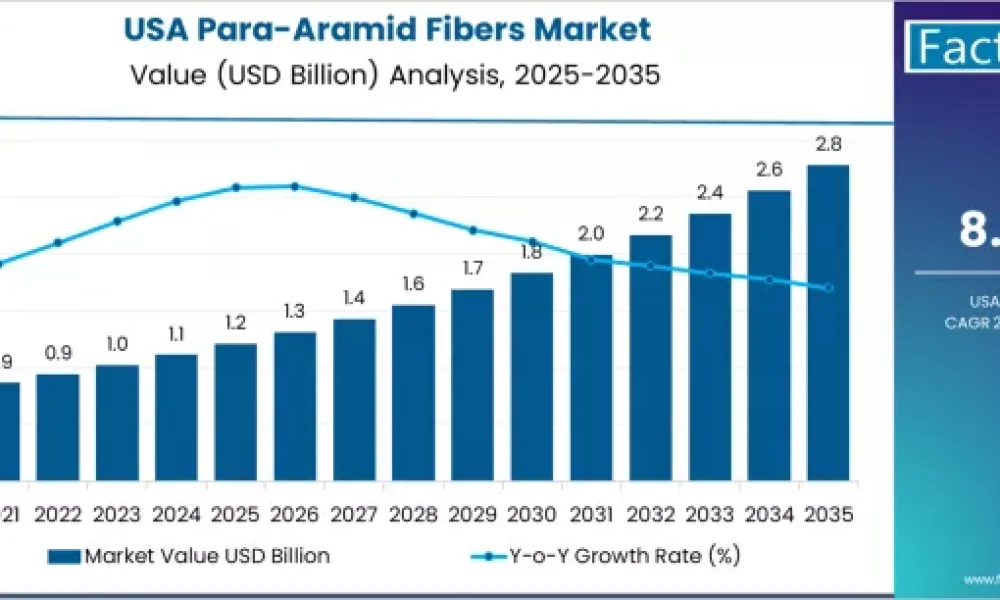
The USA’s demand for para-aramid fibers is expected to expand by USD 1.57 billion over the course of the projection period, from USD 1.21 billion in 2025 to over USD 2.78 billion by 2035. Demand is expected to grow at a compound annual growth rate (CAGR) of 8.70% between 2025 and 2035, translating into a total growth of 129.8%.
As industries increasingly prioritize material efficiency, durability, and worker protection, para-aramid fibers are becoming a strategic material choice in the U.S. manufacturing and defense ecosystem.
Quick Market Overview (2025–2035)
- USA Para-Aramid Fibers Sales Value (2025): USD 1.21 billion
- USA Para-Aramid Fibers Forecast Value (2035): USD 2.78 billion
- USA Para-Aramid Fibers Forecast CAGR: 8.70%
- Leading Application in USA Para-Aramid Fibers Industry: Security & Protection (39.2%)
- Key Growth Regions in USA Para-Aramid Fibers Industry: West, Northeast, South, Midwest
- Regional Leadership: West holds the leading position in demand
- Key Players in USA Para-Aramid Fibers Industry: Teijin Limited, E. I. du Pont de Nemours and Company, Kolon Industries Incorporated, HYOSUNG Advanced Materials, TAEKWANG Industrial Company Limited, Davy Textiles Limited, Artec, Kermel, Huvis Corporation, Bluestar Chengrand Company Limited
To access the complete data tables and in-depth insights, request a Discount On The Report here: https://www.factmr.com/connectus/sample?flag=S&rep_id=12632
Market Overview
Para-aramid fibers are synthetic fibers characterized by rigid polymer chains that provide exceptional mechanical strength and resistance to heat and chemicals. In the U.S., these fibers are widely used in protective apparel, ballistic armor, fiber-reinforced composites, friction materials, cables, and high-performance industrial components.
The shift toward lightweight materials that do not compromise strength has significantly increased para-aramid adoption. Compared with traditional materials such as steel or fiberglass, para-aramid fibers offer superior strength-to-weight ratios, supporting efficiency and performance across multiple industries.
Key Market Drivers
1. Strong Demand from Defense and Homeland Security
Defense remains a primary demand driver in the U.S.
Use in bulletproof vests, helmets, and armored vehicles
Rising focus on soldier safety and survivability
Continuous modernization of defense equipment
Para-aramid fibers are critical in ballistic protection due to their high energy absorption and impact resistance.
2. Expansion of Aerospace Applications
The aerospace sector increasingly relies on advanced fibers.
Lightweight composites for aircraft structures
Improved fuel efficiency through weight reduction
High resistance to heat and fatigue
Para-aramid fibers support both commercial and military aerospace manufacturing requirements.
3. Growth in Automotive and Transportation Uses
Automakers are adopting para-aramid fibers to enhance performance.
Reinforcement in tires, hoses, belts, and gaskets
Lightweight materials for electric and fuel-efficient vehicles
Improved durability and safety components
The push toward electric vehicles further supports demand for high-performance lightweight materials.
4. Rising Emphasis on Industrial Safety
Worker protection standards are becoming more stringent.
Use in flame-resistant clothing and gloves
Cut-resistant and heat-resistant protective gear
Compliance with workplace safety regulations
Industrial safety equipment is a major and growing application segment for para-aramid fibers.
Market Segmentation Analysis
By Application
Ballistic Protection:
Body armor, helmets, and vehicle protection systems represent the largest demand segment.Aerospace Components:
Structural composites and insulation materials.Automotive and Transportation:
Tire reinforcement, friction materials, and lightweight components.Industrial and Protective Equipment:
Safety apparel, cables, and high-stress industrial parts.
By Form
Filament yarns
Staple fibers
Pulp and chopped fibers
Filament yarns dominate due to their use in high-strength woven and composite applications.
By End User
Defense and military organizations
Aerospace manufacturers
Automotive OEMs and suppliers
Industrial safety equipment manufacturers
Defense and aerospace remain the largest consumers in the U.S. market.
Regional Demand Trends within the USA
West Coast:
Strong aerospace and defense manufacturing presence.Southern States:
Growing automotive production and defense facilities.Midwest:
Industrial manufacturing and automotive supply chains.Northeast:
Demand from advanced materials research and safety equipment manufacturers.
Demand is geographically diversified, reflecting the broad industrial base of the U.S.
Challenges and Market Restraints
1. High Production and Material Costs
Complex manufacturing processes
Higher costs compared to conventional fibers
2. Competition from Alternative High-Performance Fibers
Carbon fibers and ultra-high-molecular-weight polyethylene
Material selection depends on application-specific needs
3. Recycling and Sustainability Concerns
Limited recyclability of para-aramid fibers
Growing pressure for sustainable material solutions
Emerging Trends and Opportunities
1. Development of Hybrid Composite Materials
Combining para-aramid fibers with carbon or glass fibers to optimize performance.
2. Increased Use in Electric Vehicles
Lightweight reinforcement materials support battery efficiency and safety.
3. Advancements in Fiber Processing Technologies
Improved manufacturing efficiency and performance consistency.
4. Growing Demand for High-Performance Industrial Cables and Ropes
Expansion in infrastructure, energy, and marine applications.
Competitive Landscape Highlights
Market participants are focusing on:
Expanding production capacity in North America
Product innovation for enhanced strength and durability
Long-term supply contracts with defense and aerospace customers
R&D investment to improve sustainability and processing efficiency
Future Outlook
The U.S. para-aramid fibers market is expected to maintain robust growth through 2035, supported by defense modernization, aerospace expansion, automotive lightweighting, and rising industrial safety standards. As industries demand materials that combine strength, heat resistance, and low weight, para-aramid fibers will continue to play a vital role.
Manufacturers that emphasize innovation, supply reliability, and application-specific performance will be best positioned to capture future growth. Para-aramid fibers are set to remain a cornerstone material in the United States’ high-performance and safety-critical industries.
Have specific requirements or need assistance on report pricing or have a limited budget? Please contact [email protected]
About Fact.MR:
Fact.MR is a global market research and consulting firm, trusted by Fortune 500 companies and emerging businesses for reliable insights and strategic intelligence. With a presence across the U.S., UK, India, and Dubai, we deliver data-driven research and tailored consulting solutions across 30+ industries and 1,000+ markets. Backed by deep expertise and advanced analytics, Fact.MR helps organizations uncover opportunities, reduce risks, and make informed decisions for sustainable growth.



