
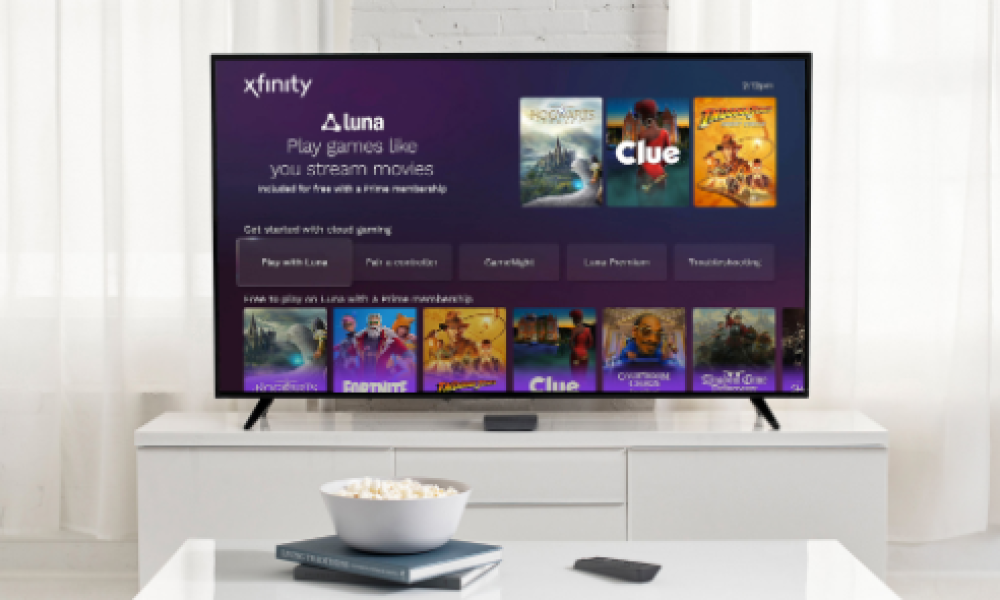
A strategic alliance seeks to capitalize on cloud gaming growth by integrating the Amazon Luna service into the vast installed base of Xfinity entertainment devices.
The landscape of home entertainment is undergoing an accelerating transformation, and two of the most influential giants in the United States, Comcast and Amazon, have formalized an alliance to redefine access to high-end video games. The announcement of the launch of the Amazon Luna cloud gaming service on Comcast’s Xfinity TV and streaming platform represents a strategic move that could democratize console gaming by eliminating the need for dedicated hardware and the friction of downloads. This development is not simply an addition of content, but a deep integration that leverages Comcast’s market penetration and Amazon’s cloud and content infrastructure.
The Strategic Movement Behind the Alliance
The collaboration between Comcast and Amazon is a convergence of complementary assets. Comcast, through its Xfinity division, not only controls one of the most extensive broadband networks in the country, but has also developed Entertainment OS, a television platform that seamlessly brings together streaming content, live television, and now, cloud gaming. This platform has already demonstrated its ability to scale to tens of millions of devices, both in the US and through global partners such as Sky in Europe and Rogers. The integration of Luna directly into existing devices like the X1 or Xfinity Xumo Stream Box instantly capitalizes on this immense installed base.
For its part, Amazon Luna has been perfecting its cloud gaming model, offering attractive access to a library of premium titles and family experiences, including more than fifty games at no additional cost for Prime members. For Amazon, the partnership with Comcast is a massive conduit to overcome the main barrier to cloud gaming adoption: accessibility. Amazon Luna General Manager, Jeff Gattis, stressed that Comcast’s reach and versatility make it the ideal partner to expand the service to more homes and players, highlighting Amazon’s focus on making video games more accessible to its customers.
Comcast and the Network Priority for Gaming
A crucial element supporting the viability of this initiative is Comcast’s network infrastructure. Cloud gaming is exceptionally sensitive to latency and speed, demanding ultra-fast and reliable connectivity for the experience to be fluid and uninterrupted. The company has invested significantly in its Xfinity network to deliver multigigabit speeds and ultra-low latency, elements that are essential for responsive gaming.
Comcast’s Global Chief Product Officer, Fraser Stirling, noted that combining the company’s superior broadband with its first-class entertainment platform is redefining the big-screen gaming experience. Furthermore, Comcast has been an industry pioneer in implementing new network technologies aimed specifically at reducing latency for gamers. This proactive approach is justified by usage metrics: gaming-related traffic on the Xfinity network grew by 30% in the last year alone, and is expected to double every three years. This growth trend is part of a broader streaming entertainment category that already accounts for more than 70% of the network’s total traffic, underscoring the importance of gaming as a dominant form of digital entertainment.
The User Experience: Console Eliminated
The true value proposition for the consumer lies in the elimination of expensive intermediary hardware and the simplicity of access. Xfinity customers can now access Luna’s vast library, which includes high-profile games such as Hogwarts Legacy and Indiana Jones and the Great Circle, simply by saying “Luna” into their voice remote and using an Amazon Prime or Luna Premium subscription.
The gameplay does not require downloading voluminous files, which eliminates the barrier of storage space and waiting time. In addition, the service has been redesigned to cater to gamers of all levels, including GameNight experiences optimized for group play in the living room without the need for a traditional controller, allowing players to join via their mobile phones using a QR code. This particular feature positions Luna as a social and family service, differentiating it from traditional consoles focused on a single player or experiences with dedicated controllers.
The Long-Term Vision of Entertainment OS
The underlying engine of this integration is Entertainment OS, Comcast’s global entertainment platform. This technology not only unifies cloud gaming, television, and streaming, but also offers advanced features such as voice search and fluid personalization. The flexibility and scalability of Entertainment OS are key to Comcast’s growth strategy, enabling the company and its partners, such as Rogers, to offer cutting-edge entertainment experiences.
The availability of Luna on Rogers devices with Entertainment OS, which was announced simultaneously, indicates a broader expansion plan. Comcast has stated its intention to expand Luna’s availability to other Entertainment OS-powered devices in the future, working with its partners to extend innovative cloud gaming experiences to a global audience. This approach positions Comcast not only as a connectivity provider, but as an enabler of convergent entertainment experiences, a model that aligns with Amazon’s vision of being a company intensely focused on the customer and on innovation.
Ultimately, the move by Comcast and Amazon transforms the television, traditionally a center for passive video content, into a powerful, interactive gaming platform, all supported by a low-latency network infrastructure. Cloud gaming, in this context, ceases to be an incipient technology to become an integral part of the home entertainment ecosystem for millions of users. For more details about the company and its strategic initiatives, one can visit comcastcorporation.com.



