
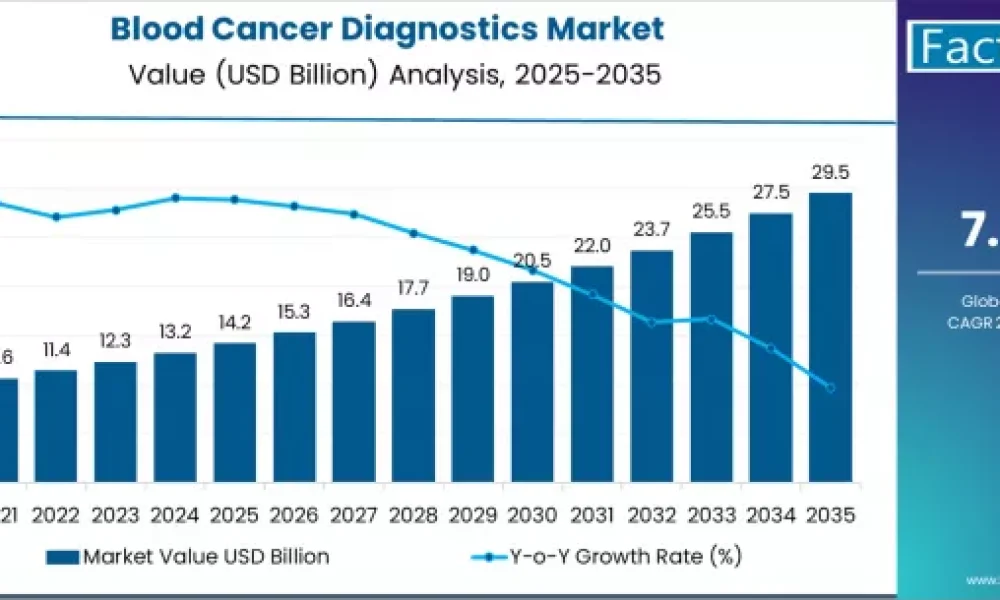
The U.S. blood cancer diagnostics market is poised for strong and sustained growth between 2025 and 2035, driven by increasing cancer prevalence, advancements in molecular diagnostics, and rising adoption of personalized and precision oncology. Blood cancer diagnostics—including technologies such as flow cytometry, immunohistochemistry (IHC), polymerase chain reaction (PCR), next-generation sequencing (NGS), cytogenetic testing, biopsy analysis, and associated consumables—play a crucial role in early detection, classification, and therapeutic decision-making for conditions such as leukemia, lymphoma, and multiple myeloma. This report outlines the U.S. market size outlook, key growth trends, technology innovations, competitive dynamics, and strategic insights for stakeholders.
Market Size and Growth Outlook
The U.S. blood cancer diagnostics market is expected to expand from approximately USD 3.1 billion in 2025 to around USD 5.4 billion by 2035, reflecting a CAGR of about 5.7%. This growth trajectory highlights the increasing emphasis on early detection, precision diagnostics, and the adoption of advanced testing modalities in oncology. Demand is further supported by expanding screening programs, strong reimbursement structures for cancer diagnostics, and rising integration of AI-enabled diagnostic platforms.
With blood cancers accounting for nearly 10% of all cancer diagnoses in the U.S., the need for rapid, accurate, and minimally invasive diagnostic tools continues to intensify across both hospital settings and specialized oncology centers.
To access the complete data tables and in-depth insights, request a Discount On The Report here: https://www.factmr.com/connectus/sample?flag=S&rep_id=47
Key Growth Drivers
- Rising Incidence of Blood Cancers
Increasing rates of leukemia, non-Hodgkin lymphoma (NHL), Hodgkin lymphoma, and multiple myeloma are elevating diagnostic volumes. The aging U.S. population—particularly individuals over 60—represents a key demographic contributing to market expansion.
- Rapid Advancements in Molecular and Genomic Technologies
The U.S. continues to lead in adoption of NGS, PCR-based assays, and high-throughput sequencing. These tools enable precise cancer subtyping, treatment planning, and monitoring of measurable residual disease (MRD), significantly improving patient outcomes.
- Expansion of Precision Medicine and Immuno-Oncology
Personalized therapies including CAR-T treatments and targeted agents necessitate comprehensive diagnostic profiling. This is increasing demand for molecular biomarker testing, cytogenetics, companion diagnostics, and mutation-specific panels.
- Strong Reimbursement and Clinical Infrastructure
The U.S. healthcare system provides structured reimbursement pathways for diagnostic tests, particularly molecular assays used in oncology. Widespread availability of accredited cancer centers strengthens adoption across states.
Technology Trends and Competitive Landscape
The U.S. blood cancer diagnostics market is highly innovative and competitive, characterized by a mix of global diagnostics companies, biotechnology firms, and research-driven molecular labs. Key technology trends shaping the market include:
- NGS-based mutation testing and whole-genome sequencing for deeper cancer profiling
- AI-driven diagnostic platforms improving detection accuracy and workflow efficiency
- Liquid biopsy technologies enabling non-invasive detection and real-time treatment monitoring
- Automation and digital pathology accelerating turnaround times
- Integrated testing platforms combining genomics, proteomics, and cytogenetics
These innovations support value-based care models, enhance diagnostic precision, and reduce clinical variability across testing facilities.
Challenges
Despite promising growth, the market faces several challenges:
- High cost of advanced diagnostic instruments and genomic testing
- Shortage of skilled pathologists and molecular technicians
- Variability in adoption rates between major cancer centers and smaller diagnostic labs
- Data management complexity in multi-omic testing environments
- Evolving regulatory pathways for novel companion diagnostics and genomic tools
Manufacturers must balance innovation with affordability while ensuring compliance with evolving clinical and regulatory standards.
Strategic Implications
For Manufacturers and Diagnostics Providers
Develop scalable, cost-effective diagnostic platforms and expand AI-integrated tools. Growth can be accelerated by focusing on MRD detection, liquid biopsy portfolios, and automated cytogenetic systems.
For Healthcare Providers and Oncology Centers
Strengthen adoption of molecular diagnostics, improve laboratory interoperability, and integrate advanced testing into personalized oncology pathways.
For Investors
The U.S. blood cancer diagnostics market offers strong long-term investment potential driven by sustained R&D activity, expanding precision medicine infrastructure, and consistent demand across clinical settings.
Outlook Summary
From 2025 to 2035, the U.S. blood cancer diagnostics market is set to achieve steady and significant growth, fueled by expanding cancer incidence, rapid technological progress, and increasing reliance on precision diagnostics. While cost and workforce challenges persist, the sector continues to provide substantial opportunities for diagnostic companies, healthcare providers, and investors dedicated to advancing cancer detection and patient outcomes.
Have a specific Requirements and Need Assistant on Report Pricing or Limited Budget please contact us – [email protected]
About Fact.MR
Fact.MR is a global market research and consulting firm, trusted by Fortune 500 companies and emerging businesses for reliable insights and strategic intelligence. With a presence across the U.S., UK, India, and Dubai, we deliver data-driven research and tailored consulting solutions across 30+ industries and 1,000+ markets. Backed by deep expertise and advanced analytics, Fact.MR helps organizations uncover opportunities, reduce risks, and make informed decisions for sustainable growth.



