
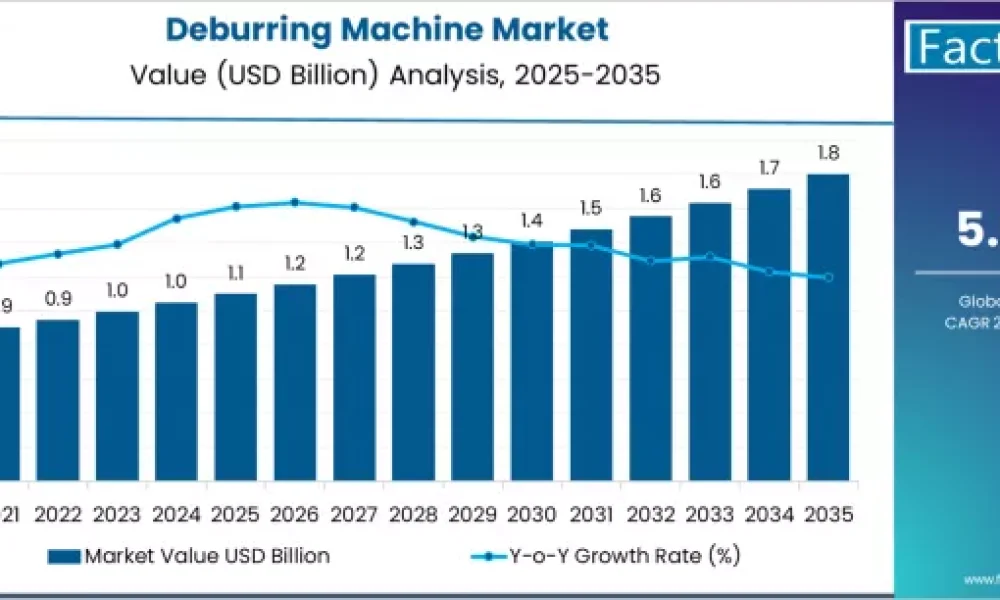
The global deburring machine market is poised for steady expansion over the next decade, driven by rising expectations for precision manufacturing, tighter dimensional tolerances, and higher product-quality standards across automotive, aerospace, industrial machinery, electronics, and metal fabrication sectors. Deburring machines—used to remove sharp edges, burrs, and surface imperfections from metal and plastic components—are essential for ensuring safety, functionality, and compliance with OEM standards. As automation, robotics, and digitally controlled manufacturing become mainstream, the adoption of advanced deburring technologies is accelerating.
Quick Stats (2025–2035)
Market Value 2025: USD 845.0 million
Forecast Market Value 2035: USD 1,452.3 million
Absolute Growth (2025–2035): USD 607.3 million
Forecast CAGR (2025–2035): ~6.1%
Dominant Machine Type (2025): Automated deburring machines (~54% share)
Leading End-Use Sector (2025): Automotive & transportation (~41% share)
To access the complete data tables and in-depth insights, request a Discount On The Report here: https://www.factmr.com/connectus/sample?flag=S&rep_id=12400
Key Market Drivers
1. Automotive Lightweighting & High-Precision Components
Automotive OEMs increasingly rely on aluminum, precision-cast parts, and complex geometries.
High-quality deburring ensures surface consistency, structural reliability, and better fit/assembly capabilities.
EV components—from battery housings to drive-system parts—require consistent deburring to meet strict tolerances.
2. Growth of Aerospace & Defense Manufacturing
Aircraft components require impeccable finishing, uniformity, and burr-free edges to ensure safety and reduce fatigue risks.
Deburring is critical for machined parts, turbine components, landing system elements, and high-stress assemblies.
3. Increased Automation in Manufacturing
Industry 4.0 and smart factories rely on automated deburring machines to reduce cycle time, improve accuracy, and ensure repeatable quality.
Robotic deburring systems are gaining importance as manufacturers seek consistency and labor savings.
4. Expansion of Electronics & Micro-Component Production
Precision electronic parts, semiconductor housings, and miniature metal/plastic components require delicate and highly controlled deburring.
Growth of consumer electronics, EV electronics, and automation equipment fuels demand for micro-deburring solutions.
5. Stricter Quality Standards & Safety Requirements
Industrial regulations and OEM specifications increasingly require burr-free edges to prevent failures, leakages, vibration, or assembly issues.
Manufacturers adopt advanced deburring equipment to meet certification requirements and reduce rework.
Market Structure & Segment Insights
By Machine Type
Automated Deburring Machines:
Leading the market due to speed, precision, low labor dependence, and integration with robotic & CNC systems.Manual Deburring Machines:
Used by smaller workshops and for low-volume or specialized parts.Robotic Deburring Cells:
Fastest-growing category, driven by adoption in automotive, aerospace, and heavy machinery manufacturing.Vibratory & Tumble Deburring Machines:
Widely used for batch processing of metal parts, cast components, and stamped pieces.
By Operation Mode
Dry Deburring Machines: Suitable for general-purpose finishing and edge removal in standard metalworking.
Wet Deburring Machines: Preferred for high-precision finishing, heat reduction, and dust-free operations.
By End-Use Industry
Automotive & Transportation:
Highest adoption due to mass production of high-precision components, engine parts, EV housings, and structural pieces.Aerospace & Defense:
Demands consistent, high-quality burr removal to meet stringent airworthiness standards.Industrial Machinery:
Essential for gears, shafts, cast parts, and more.Electronics & Electrical:
Micro-deburring needed for sensitive parts and assemblies.Metal Fabrication & General Engineering:
Broad usage in workshops, tool rooms, and metalworking units.
By Region
Asia-Pacific:
Dominant market, supported by large-scale automotive production, metal fabrication, and machinery output.North America:
Strong adoption of robotic deburring and automated finishing.Europe:
High focus on precision engineering and aerospace demand.Middle East, Latin America, Africa:
Emerging markets driven by industrialization and manufacturing expansion.
Challenges & Restraints
High Cost of Automation:
Advanced robotic or CNC-integrated deburring systems require substantial investment.Skilled Labor Constraints:
Precision deburring for aerospace and electronics requires trained operators.Complexity of Multi-Geometry Parts:
Highly irregular or custom components can be difficult to deburr consistently.Maintenance & Consumable Costs:
Abrasives, brushes, fixtures, and tool heads add recurring costs.
Opportunities & Strategic Directions
1. Robotic & AI-Integrated Deburring Cells
Manufacturers are developing intelligent deburring systems that automatically identify burr locations and adapt processing parameters for optimal results.
2. Growth in EV Component Manufacturing
EV platforms rely heavily on aluminum die-cast parts, battery cases, thermal management components, and powertrain assemblies—all requiring high-precision burr removal.
3. Adoption of Hybrid Finishing Systems
Combining abrasive flow machining, ultrasonic deburring, and vibratory finishing creates opportunities for specialized applications.
4. Predictive Maintenance & IoT Upgrades
Smart sensors and connected machinery help optimize tool life, reduce downtime, and ensure predictable performance.
5. Customized Deburring for 3D Printed Parts
Additive manufacturing produces unique surface textures and post-processing needs, opening a new frontier for deburring innovation.
Outlook
From USD 845.0 million in 2025 to USD 1,452.3 million by 2035, the deburring machine market is set to grow at a healthy ~6.1% CAGR, fueled by precision manufacturing, advanced automation, EV production, aerospace expansion, and rising global quality standards. As manufacturers increasingly demand burr-free, high-tolerance components, investment in automated, robotic, and high-precision deburring systems will accelerate. Companies that focus on intelligent automation, customized solutions, energy-efficient systems, and integration with digital manufacturing will be well-positioned to lead the next decade of growth.
Have specific requirements or need assistance on report pricing or have a limited budget? Please contact [email protected]
About Fact.MR:
Fact.MR is a global market research and consulting firm, trusted by Fortune 500 companies and emerging businesses for reliable insights and strategic intelligence. With a presence across the U.S., UK, India, and Dubai, we deliver data-driven research and tailored consulting solutions across 30+ industries and 1,000+ markets. Backed by deep expertise and advanced analytics, Fact.MR helps organizations uncover opportunities, reduce risks, and make informed decisions for sustainable growth.



