
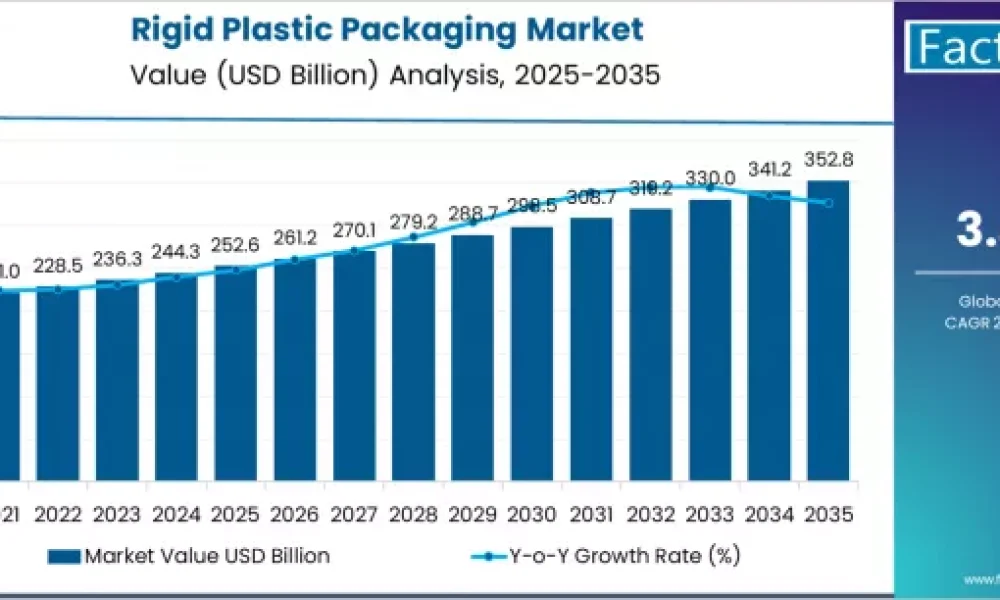
The U.S. rigid plastic packaging industry is entering a transformative decade marked by steady growth, accelerating sustainability mandates, and major shifts in both consumer expectations and manufacturing capabilities. From 2025 through 2035, the market is expected to advance at a moderate but reliable pace as brands prioritize durable, lightweight, and circular packaging solutions designed to meet regulatory requirements and performance demands across food, beverage, healthcare, household, and industrial sectors.
Market Overview
Industry modeling points to continued expansion of the U.S. rigid plastic packaging market as manufacturers balance three critical pressures: cost competitiveness, resin availability, and sustainability performance. Market size is projected to increase incrementally each year through 2035, supported by robust demand in food and beverage, pharmaceuticals, personal care, and e-commerce—all categories where rigid plastics remain essential due to their durability, sterilizability, and product-protection advantages.
While growth rates are expected to remain within the low-to-mid single digits, the decade ahead will be defined not just by scale, but by structural change. Companies will be compelled to shift toward mono-material formats, invest in recycled-content integration, and redesign legacy systems to meet new environmental standards without compromising barrier performance.
To access the complete data tables and in-depth insights, request a Discount On The Report here: https://www.factmr.com/connectus/sample?flag=S&rep_id=12186
Key Growth Drivers
1. Strong Demand in Food & Beverage
Food and beverage is set to remain the dominant growth engine. Rigid plastics—especially PET and HDPE—continue to outperform alternatives due to their balance of clarity, strength, and recyclability. Beverage bottles, dairy containers, sauce and condiment packaging, and ready-meal solutions are expected to maintain steady volume growth as consumer behavior trends favor portability, safety, and longer shelf life.
Growing interest in single-serve and convenience foods will further support demand for jars, tubs, cups, and other rigid formats compatible with refrigeration, microwaving, and tamper-evident sealing.
2. Healthcare and Pharmaceutical Expansion
The pharmaceutical sector is entering a period of heightened activity driven by population aging, growth in chronic disease treatments, and the rise of home healthcare. Rigid plastics play a critical role in delivering sterile, child-resistant, and impact-safe packaging for medicines, medical devices, and diagnostic kits. High-value components—such as specialty closures, dropper systems, and precise dosing containers—will add to overall market value.
3. Sustainability and Recycled Content Adoption
Sustainability may be the defining force of the next decade. U.S. states are adopting ambitious recycling targets, extended producer responsibility (EPR) programs, and minimum recycled-content requirements for specific packaging types. As a result, demand for both mechanically recycled and chemically recycled resins is accelerating.
Brands are increasingly re-engineering packaging to incorporate post-consumer resin (PCR), adopt mono-material constructions, and improve end-of-life outcomes—all trends that support capital investment across the supply chain.
4. Growth of E-Commerce and Direct-to-Consumer Brands
E-commerce continues to reshape packaging needs. Rigid plastic packaging benefits from superior durability during shipping, reduced breakage risk, and cost-efficient weight profiles. Personal care items, nutraceuticals, vitamins, household supplies, and specialty foods sold through direct-to-consumer channels rely heavily on sturdy rigid formats that protect both product quality and brand presentation.
Key Market Restraints
1. Resin and Feedstock Price Volatility
Volatility in petrochemical feedstocks continues to challenge cost predictability for manufacturers. Companies with secure supply agreements, vertically integrated resin production, or access to high-quality recycled resin will fare better in managing long-term margin pressure.
2. Increasing Regulatory and Compliance Costs
The next decade will likely bring a complex landscape of recycling mandates, labeling requirements, and design-for-recyclability legislation. While these changes support long-term sustainability, they also create short-term cost burdens for companies needing to redesign components, qualify new materials, and adjust manufacturing processes.
3. Competition from Flexible Packaging Alternatives
Lightweight flexible packaging continues to compete for market share in snacks, pet food, and personal care. Nonetheless, rigid formats retain a strong advantage in structural integrity, reuse potential, and compatibility with advanced recycling technologies.
Segment Outlook, 2025–2035
Bottles and Jars
Bottles and jars will remain the largest and most profitable segment, driven by beverages, sauces, condiments, syrups, personal care liquids, and nutraceuticals. Advancements in lightweighting and barrier coatings will add value while reducing material use.
Tubs, Cups, and Pots
This segment will experience strong momentum as consumers shift toward ready-to-eat and single-serve meals. Microwaveable and retort-compatible rigid formats will continue to gain market share, particularly in urban centers where convenience-oriented consumption is rising.
Rigid Industrial Packaging
Industrial pails, drums, and intermediate bulk containers (IBCs) remain stable, supported by chemicals, lubricants, agricultural products, and manufacturing supply chains. Regulations governing hazardous material transport help sustain rigid plastic adoption in these sectors.
Closures and Caps
Advanced closures—such as tamper-evident designs, dosing mechanisms, and ergonomic sports caps—offer high-margin opportunities. Growth will track closely with beverage innovation, premium personal care, and pharmaceutical expansions.
Strategic Opportunities for Industry Leaders
1. Mono-Material Packaging Redesign
Transitioning from multi-layer or multi-polymer packaging to single-polymer formats enhances recyclability and simplifies recovery. Companies investing early in design-for-recycling will gain a competitive edge as regulations tighten.
2. High-Quality PCR Procurement
Demand for certified PCR far exceeds supply. Companies that secure reliable access to food-grade recycled PET or HDPE will benefit from both compliance readiness and improved ESG performance.
3. Partnerships in Advanced Recycling
Chemical recycling technologies are scaling, offering the potential to convert hard-to-recycle plastics back into high-quality feedstock. Strategic investment in these technologies could position companies as leaders in closed-loop systems.
4. Smart Manufacturing and Automation
Automation and digitalization—such as energy-efficient molding systems, real-time quality monitoring, and predictive maintenance—will help manufacturers offset labor shortages and rising operational costs.
Market Outlook Through 2035
Overall, the U.S. rigid plastic packaging market is poised for consistent, sustainable growth through 2035. While expansion rates will remain moderate, the real story lies in value transformation: the shift toward recyclable materials, the integration of recycled content, and the modernization of packaging to meet higher sustainability expectations.
Companies that prioritize circularity, embrace innovative materials, and navigate regulatory complexity with agility will capture the most value over the next decade.
Have a specific Requirements and Need Assistant on Report Pricing or Limited Budget please contact us – [email protected]
To View Related Report :
Reclosable Rigid Containers Market
About Fact.MR
Fact.MR is a global market research and consulting firm, trusted by Fortune 500 companies and emerging businesses for reliable insights and strategic intelligence. With a presence across the U.S., UK, India, and Dubai, we deliver data-driven research and tailored consulting solutions across 30+ industries and 1,000+ markets. Backed by deep expertise and advanced analytics, Fact.MR helps organizations uncover opportunities, reduce risks, and make informed decisions for sustainable growth.



