
E-Bike Market Overview:
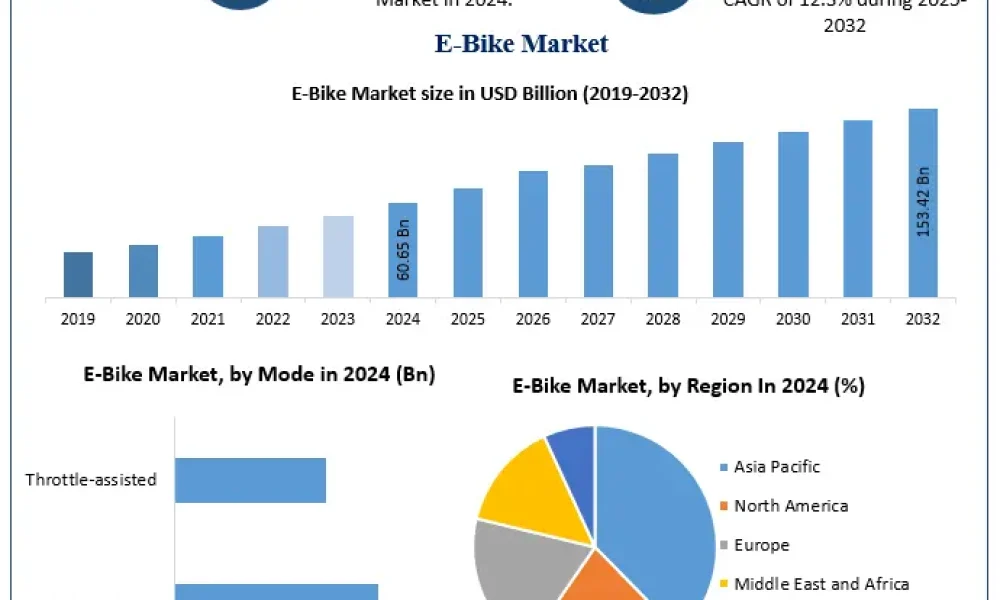
E-Bike Market is rapidly expanding as consumers, cities, and policymakers embrace sustainable mobility, health-focused commuting, and cost-effective transport solutions. The market was valued at USD 60.65 billion in 2024 and is projected to reach USD 153.42 billion by 2032, growing at a CAGR of 12.3% during 2025–2032. Asia Pacific leads the market, anchored by China’s massive production base and rising demand across India, Japan, and Southeast Asia.
Key Highlights & Insights
The e-bike market size is forecast to grow from USD 60.65 billion in 2024 to USD 153.42 billion by 2032 at a CAGR of 12.3%.
Asia Pacific is the dominating region, accounting for the largest share of global volume and revenue, driven by China’s role as the primary manufacturing and consumption hub and strong uptake in India, Japan, and other regional markets.
Lithium-ion battery-based e-bikes represent the leading battery segment and are expected to grow at around 12.4% CAGR, supported by higher energy density, lower weight, and longer cycle life.
Pedal‑assist (pedelec) mode leads by propulsion, due to better battery life, lower maintenance, and a more natural riding experience, while throttle-assisted models are growing in markets favoring low-effort commuting.
Key growth drivers include rising environmental awareness, supportive policies, urban congestion, and advancements in battery and motor technologies.
► Get a sample of the report:https://www.maximizemarketresearch.com/request-sample/36655/
Recent Developments
In 2024–2025, manufacturers across China and Europe expanded production capacity to meet growing export demand for city/urban and trekking e-bikes, targeting both commuting and leisure segments.
Policy incentives such as purchase subsidies, tax benefits, and infrastructure investments for cycling in the EU and Asia are accelerating e‑bike adoption as a mainstream mobility solution.
North America has seen strong growth in throttle‑assist and cargo e-bikes, with new models launched for delivery services and shared mobility fleets.
Continuous R&D investment is improving lithium‑ion battery performance, range, and charging time, while integrating connectivity, GPS, and smart app features into e‑bike platforms.
Market Dynamics
Rising environmental concerns, stricter emission norms, and the need for decongesting urban transport corridors are at the core of e‑bike market expansion. E‑bikes offer an affordable, low-emission alternative to cars and two‑wheelers, appealing to commuters, recreational cyclists, and logistics operators.
Key demand drivers include fuel price volatility, growing health and fitness awareness, and expanding cycling infrastructure. At the same time, high upfront costs compared with conventional bicycles, safety regulations, and the need for standardized classification (by speed and class) remain important challenges in certain markets.
Regional Analysis
Asia Pacific holds the leading position, with over 40–50%+ share depending on metric, primarily due to China’s dominance in both production and domestic sales, as well as strong growth in India, Japan, South Korea, and Southeast Asia.
Europe accounts for roughly one‑fifth of the global market, led by Germany, France, Italy, and the Netherlands, where high-quality trekking and city e‑bikes, supportive cycling policies, and a strong leisure culture drive adoption.
North America is a fast-growing region, propelled by increasing acceptance of e‑bikes for commuting, recreation, and delivery work, especially in the U.S. and Canada. Throttle‑assist models feature more prominently here, reflecting user preference for convenience and low-effort operation.
Other regions, including Latin America and the Middle East & Africa, are at an earlier stage but benefit from urbanization, growing middle-class consumers, and pilot programs for micro‑mobility.
Product Segmentation
By Type: City/urban e‑bikes, trekking e‑bikes, cargo e‑bikes, and others, with city/urban and trekking bikes forming the core of commuter and leisure demand.
By Mode:
Pedal‑assisted (dominant share due to efficiency, battery life, and regulatory acceptance).
Throttle‑assisted (growing segment favored for ease of use and in delivery and off‑road applications).
By Battery Type:
Lithium‑ion (largest and fastest‑growing segment).
Lead‑acid and other chemistries, used mainly in price‑sensitive markets.
By Region: North America, Europe, Asia Pacific (dominating), South America, and Middle East & Africa.
Key Trends
Major trends include the shift to lighter, higher‑capacity lithium‑ion batteries; growth in connected and smart e‑bikes with integrated apps, GPS, and anti‑theft features; and expanding use of e‑cargo bikes in last‑mile logistics.
There is also a strong move toward policy‑backed micro‑mobility ecosystems, integration with public transport, and the emergence of subscription and sharing models using e‑bikes in dense urban centers. In parallel, OEMs are segmenting products by performance, class, and use case—commuter, trekking, mountain, cargo—to address diverse customer needs.
Frequently Asked Questions (FAQs)
What is the forecast size of the global e‑bike market by 2032?
The market is expected to reach approximately USD 153.42 billion by 2032.Which region dominates the global e‑bike market?
Asia Pacific is the dominant region, led by China as the largest producer and consumer, with substantial contributions from India, Japan, and other countries.Which battery type leads the market?
Lithium‑ion batteries hold the largest share and are expected to grow fastest owing to superior performance and declining costs.Which propulsion mode is most popular?
Pedal‑assist is the leading mode globally, while throttle‑assist is gaining ground in specific markets such as North America.
Quote
“E‑bikes are redefining personal mobility worldwide, combining sustainability, health, and convenience in a single solution. With Asia Pacific at the forefront of production and innovation, and strong policy and consumer support across all major regions, the global e‑bike market is on track for sustained double‑digit growth.”
Conclusion
The e‑bike market is entering a high‑growth phase, underpinned by environmental imperatives, urban mobility challenges, and rapid technological progress in batteries and drive systems. Asia Pacific’s dominance, Europe’s policy-driven adoption, and North America’s expanding use cases together create a robust global ecosystem. As product innovation, supporting infrastructure, and regulatory clarity continue to advance, e‑bikes are set to become a central pillar of the future transportation landscape.
◉ Get Market Research Latest Trends
♦ Road Assistance Insurance Market
♦ Maximize Market Research is launching a subscription model for data and analysis in the MMR Statistics
Contact Maximize Market Research:
3rd Floor, Navale IT Park, Phase 2
Pune Bangalore Highway, Narhe,
Pune, Maharashtra 411041, India
[email protected]
+91 96071 95908, +91 9607365656
About Maximize Market Research:
Maximize Market Research is a multifaceted market research and consulting company with professionals from several industries. Some of the industries we cover include medical devices, pharmaceutical manufacturers, science and engineering, electronic components, industrial equipment, technology and communication, cars and automobiles, chemical products and substances, general merchandise, beverages, personal care, and automated systems. To mention a few, we provide market-verified industry estimations, technical trend analysis, crucial market research, strategic advice, competition analysis, production and demand analysis, and client impact studies.




