
The global anisotropic conductive liquid paste market is entering a decade of resilient, technology-driven expansion as manufacturers intensify their focus on precision interconnection materials, miniaturization, and high-reliability assembly. Valued at USD 178.9 million in 2025, the market is projected to scale to USD 314.5 million by 2035, advancing at a CAGR of 5.8%. Growth is driven by the rapid evolution of display manufacturing, the rise of automotive electronics, and expanded adoption across aerospace, wearables, and advanced flexible electronics applications.
A Decade of Transformation: Electronics Assembly Enters the Fine-Pitch Era
Between 2025 and 2030, the market is set to add USD 58.3 million, fueled by high-volume electronics production and the shift toward automated dispensing and miniaturization-ready bonding solutions. By 2030–2035, as advanced materials become standard in consumer electronics and automotive systems, an additional USD 77.3 million in value is expected to be generated—representing 57% of total decade growth.
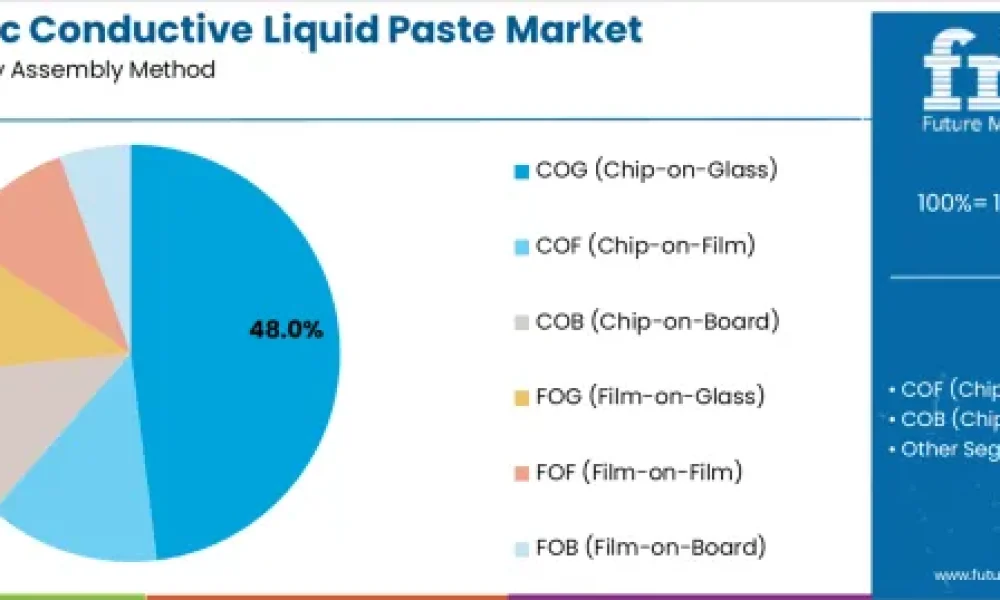
The transition from basic bonding to fine-pitch interconnection is evident across global production lines. The industry’s leading assembly technology, COG (Chip-on-Glass), continues to dominate with 48% share, supported by demand from display panel manufacturers prioritizing reliability, thermal stability, and electrical precision. COF (26%), COB (16%), and FOG/FOF/FOB segments collectively support diverse needs in flexible electronics, automotive systems, and specialized industrial-grade assemblies.
Subscribe for Year-Round Insights → Stay ahead with quarterly and annual data updates: https://www.futuremarketinsights.com/reports/sample/rep-gb-27931
Demand Centers: Displays Lead With 40% Share, Automotive & Aerospace Continue Rising
Display manufacturers represent the largest application segment with 40% market share, boosted by OLED, flexible screens, and mini-LED technologies. Increasing screen density, shrinking pixel pitch, and expanding smartphone and tablet production are further accelerating adoption.
Automotive electronics, now accounting for 25% of global demand, are undergoing rapid transformation driven by digital cockpits, ADAS sensor clusters, and EV control modules. Meanwhile, aerospace applications—which demand the highest reliability—represent 20% market share, driven by mission-critical avionics, cockpit displays, and rugged electronic modules.
Revenue Evolution: More Value Shifts Toward Advanced Systems & Process Integration
Today’s revenue distribution (2025):
- 52% – New material sales (COG/COF/COB)
- 24% – Specialty formulations
- 14% – Technical support
- 10% – Testing & validation
Future distribution (2030–2035) shifts toward service-enhanced, digitally enabled materials:
- 46–50% – Advanced fine-pitch and miniaturization materials
- 18–22% – Process integration & automated dispensing support
- 16–20% – Custom formulations
- 10–14% – Technical consulting and yield optimization
- 6–10% – Quality assurance
- 4–6% – Data services (process analytics & yield benchmarking)
This shift signals the emergence of hybrid business models that merge material innovation with process intelligence, validation support, and digital manufacturing workflows.
Regional Growth Leaders: APAC Dominates, Europe Strengthens, USA Innovates, Saudi Arabia Expands
APAC (China, India, Japan, South Korea)
APAC remains the world’s strongest growth engine:
- China leads globally with 7.8% CAGR, supported by large-scale electronics clusters in Shenzhen, Guangzhou, and Shanghai.
- India, at 7.3% CAGR, is rapidly integrating conductive paste into smartphone and display supply chains across Bangalore, Chennai, and Mumbai.
- Japan (4.4%) maintains its reputation for precision manufacturing and high-purity materials.
- South Korea continues to dominate OLED and flexible display production.
APAC accounts for the majority of new capacity additions and serves as the global hub for miniaturized electronics and display technology.
Europe (Germany, UK, France, Italy, Spain)
Europe is projected to grow from USD 62.0 million (2025) to USD 99.2 million (2035) with a CAGR of 4.8%.
- Germany, with 38.4% share, strengthens its automotive electronics leadership driven by sensor modules and advanced dashboard systems.
- UK and France focus on display modernization and aerospace electronics.
- Italy, Spain, and Nordic regions expand through manufacturing modernization and increased electronics output.
United States
The U.S. market grows at 5.5% CAGR, benefiting from advanced manufacturing programs and strong demand in consumer electronics, EVs, and aerospace. Innovation centers in California, Massachusetts, and Texas lead adoption of fine-pitch materials and automated dispensing systems.
Saudi Arabia & GCC
Saudi Arabia is emerging as a noteworthy growth region driven by digital transformation under national industrialization programs, strategic manufacturing diversification, and adoption of high-reliability materials for electronics, energy, and aerospace technologies across NEOM and broader GCC industrial corridors.
Need tailored insights? Request report customization to match your specific business objectives: https://www.futuremarketinsights.com/customization-available/rep-gb-27931
Market Drivers, Challenges & Trends
Key Drivers
- Flexible displays & OLED penetration
- Automotive electronics expansion
- 5G & IoT wearables requiring compact assemblies
Challenges
- High material cost vs. conventional adhesives
- Limited shelf-life & storage constraints
- Process complexity in fine-pitch formats
Trends shaping 2030 and beyond
- Automation & precision dispensing (core value driver)
- Low-temperature curing for heat-sensitive substrates
- Integrated digital workflows (MES connectivity, real-time viscosity monitoring)
Competitive Landscape: Innovation & Reliability Define Leadership
The market is moderately consolidated, with top 5–7 companies holding 62–68% share.
Key players include 3M, Resonac, Dexerials, H&S Hightech, SEKISUI CHEMICAL, Henkel, Tesa Tape, DELO, SunRay Scientific, and several emerging nanoparticle-focused innovators.
Competitive advantages now hinge on:
- Fine-pitch capability and advanced particle technology
- Low-temperature curing efficiency
- Automotive- and aerospace-grade validation
- Integration with automated dispensing and quality-tracking platforms
Outlook: A Market Poised for Intelligent, High-Precision Electronics
With the global expansion of display manufacturing, EV electronics, smart devices, and aerospace systems, the anisotropic conductive liquid paste market is positioned as a foundational enabler of next-generation electronics. As APAC leads capacity growth, Europe strengthens automotive-grade demand, the U.S. advances technological adoption, and Saudi Arabia scales industrial modernization, the market’s decade-long trajectory signals a shift toward smarter, more reliable, and digitally integrated bonding solutions across global production landscapes.
About Future Market Insights (FMI)
Future Market Insights, Inc. (FMI) is an ESOMAR-certified, ISO 9001:2015 market research and consulting organization, trusted by Fortune 500 clients and global enterprises. With operations in the U.S., UK, India, and Dubai, FMI provides data-backed insights and strategic intelligence across 30+ industries and 1200 markets worldwide.
Why Choose FMI: Empowering Decisions that Drive Real-World Outcomes: https://www.futuremarketinsights.com/why-fmi



