
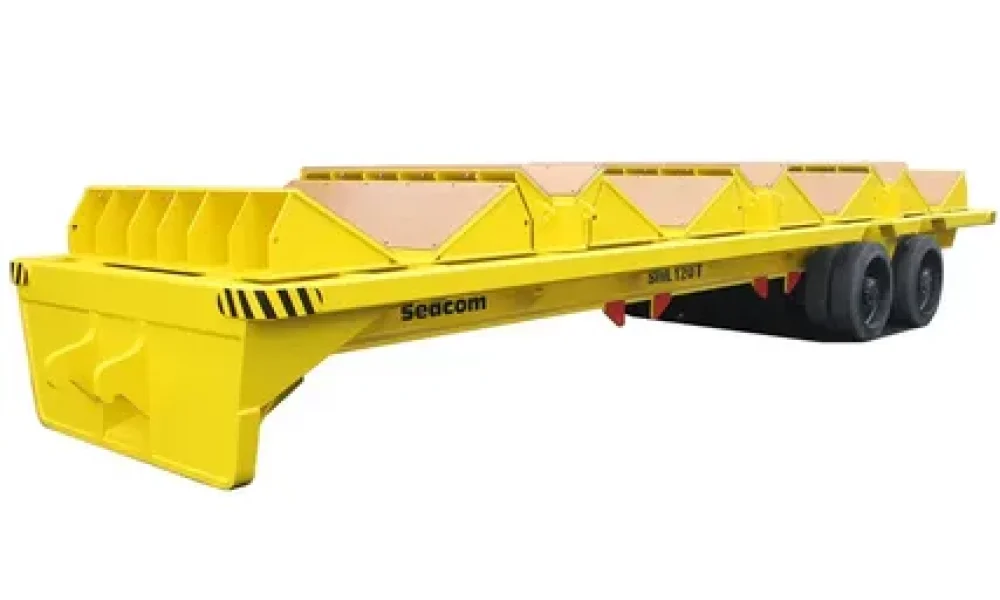
The global roll trailer market is projected to expand from USD 23.2 billion in 2025 to USD 32.8 billion by 2035, reflecting a CAGR of 3.5% over the forecast period. The market is being propelled by robust growth in logistics, construction, and industrial shipping sectors, where modular trailer platforms are increasingly relied upon for intermodal cargo handling, heavy equipment mobility, and containerized operations.
Product Innovations and Technological Advancements
Leading manufacturers are introducing specialized and modular trailer solutions designed to enhance operational efficiency across multiple sectors. In late 2024, America Made Dumpsters launched a roll-off trailer tailored for roofing contractors, compatible with 10- to 15-yard dumpsters. The product enhances maneuverability on residential and commercial sites, reducing dependence on larger dump trucks.
Similarly, Joloda Hydraroll introduced its Modular Rollerbed System with Powered Cargo Rollers, enabling retrofit installation on existing trailers in under a day without frame modifications. This system is particularly suited for air cargo pallets and ULDs, supporting rapid, flexible handling in both road and air freight logistics.
Roll trailer configurations increasingly incorporate tilt-bed, flatbed, and roller-deck designs, reducing material handling time and minimizing cargo damage. Structural enhancements such as reinforced steel chassis, integrated tie-down points, hydraulic assists, and pneumatic deck systems have expanded usage to mining, temporary manufacturing modules, and container repositioning at coastal and rail terminals.
Maintenance practices are evolving with powder-coated surfaces, sealed components, and retrofit kits for hydraulic and flooring systems, extending the service life of fleets exposed to outdoor and corrosive environments.
Subscribe for Year-Round Insights → Stay ahead with quarterly and annual data updates
https://www.futuremarketinsights.com/reports/sample/rep-gb-10704
Market Segmentation and Investment Insights
By Type: 30-50 Ton Systems Dominate
In 2025, 30-50 ton lifting systems accounted for 41% of the global market, with a projected CAGR of 3.6% through 2035. Their versatility, operational efficiency, and cost-effectiveness make them preferred for dockside cargo handling, mid-rise construction, prefabricated structure assembly, and heavy equipment transportation. Manufacturers focus on hydraulic precision, safety locking mechanisms, and durable frames to meet regulatory and operational requirements. Strong adoption persists in Asia-Pacific and the Middle East, where infrastructure growth drives demand.
By Application: Shipping Industry Leads
The shipping sector dominates the roll trailer market, representing 58% of global lifting system adoption in 2025, with a CAGR of 3.7% projected through 2035. Roll trailers support containerized cargo handling, vessel maintenance, and portside operations, with specifications prioritizing corrosion resistance, compact design, and load stability. Demand is concentrated in global maritime hubs such as Singapore, Rotterdam, Shanghai, and Los Angeles. Manufacturers are integrating telematics, load monitoring, and automation to meet evolving safety and efficiency standards.
Challenges and Opportunities
Challenges
- High Capital and Maintenance Costs: Roll trailers require substantial upfront investment and ongoing maintenance, particularly in corrosive port environments. Smaller logistics firms in emerging economies face adoption barriers despite efforts to extend equipment lifespan.
- Global Trade Volatility: Market demand is closely tied to international trade volumes. Geopolitical tensions, tariff fluctuations, and economic downturns create uncertainty, complicating strategic planning for manufacturers and operators.
Opportunities
- Port Infrastructure Expansion: Mega-port development and smart port initiatives in Asia-Pacific and the Middle East are increasing demand for high-capacity, durable roll trailers. Investment in free trade zones and enhanced customs facilities reinforces opportunities for advanced trailer fleets.
- Intermodal Transportation Growth: The emphasis on seamless cargo transfers between ships, trucks, and trains is driving demand for customizable and resilient roll trailers, particularly in logistics hubs prioritizing efficiency and reduced handling times.
Country-wise Outlook
- USA (CAGR 3.6%): Growth is driven by port logistics, heavy machinery transport, and intermodal operations. Innovations focus on strength, corrosion resistance, and energy-efficient designs.
- UK (CAGR 3.4%): Expansion in containerized shipping and automation, combined with sustainability initiatives, supports adoption of technologically advanced trailers.
- European Union (CAGR 3.5%): Intra-European trade, RoRo shipping, and strict safety regulations drive demand, led by Germany, Netherlands, and Belgium. Lightweight yet robust designs and port digitalization projects further propel growth.
- Japan (CAGR 3.3%): Sophisticated port operations and smart logistics adoption maintain demand, with a focus on telematics, fleet management, and material advancements.
- South Korea (CAGR 3.5%): Expansion of shipbuilding, steel exports, and containerized cargo, coupled with smart port and green logistics initiatives, supports roll trailer adoption.
Competitive Landscape
The market remains moderately fragmented, featuring a mix of multinational leaders and regional specialists:
- CIMC Vehicles Group Co., Ltd. – Expanding roll trailer product range and global logistics support.
- Buiscar Cargo Solutions – Heavy-duty, customized solutions for ports, industrial plants, and mining.
- TII Group (Scheuerle, Kamag, Nicolas) – Known for heavy-load trailers and specialized transport innovations.
- Briggs Equipment UK Ltd. – Rentals, sales, and servicing of material handling equipment targeting industrial and port sectors.
- Other Independent Manufacturers – Niche players delivering tailored regional solutions, increasing market diversity.
Manufacturers are leveraging material innovations, including lightweight high-strength steels and corrosion-resistant coatings, along with automation and telematics, to enhance trailer durability and operational efficiency. Emerging markets, driven by port modernization and logistics infrastructure investment, are expected to sustain market expansion over the next decade.
Personalize Your Experience: Ask for Customization to Meet Your Requirements
https://www.futuremarketinsights.com/customization-available/rep-gb-10704
Outlook
With projected growth to USD 32.8 billion by 2035, the roll trailer market is set for steady expansion, underpinned by logistics sector growth, construction demand, and industrial shipping needs. Continued technological advancements, modular design integration, and intermodal adoption position roll trailers as critical assets for efficient cargo handling and heavy-load transport worldwide.
Why Choose FMI: Empowering Decisions that Drive Real-World Outcomes: https://www.futuremarketinsights.com/why-fmi
About Future Market Insights (FMI)
Future Market Insights, Inc. (FMI) is an ESOMAR-certified, ISO 9001:2015 market research and consulting organization, trusted by Fortune 500 clients and global enterprises. With operations in the U.S., UK, India, and Dubai, FMI provides data-backed insights and strategic intelligence across 30+ industries and 1200 markets worldwide.



