
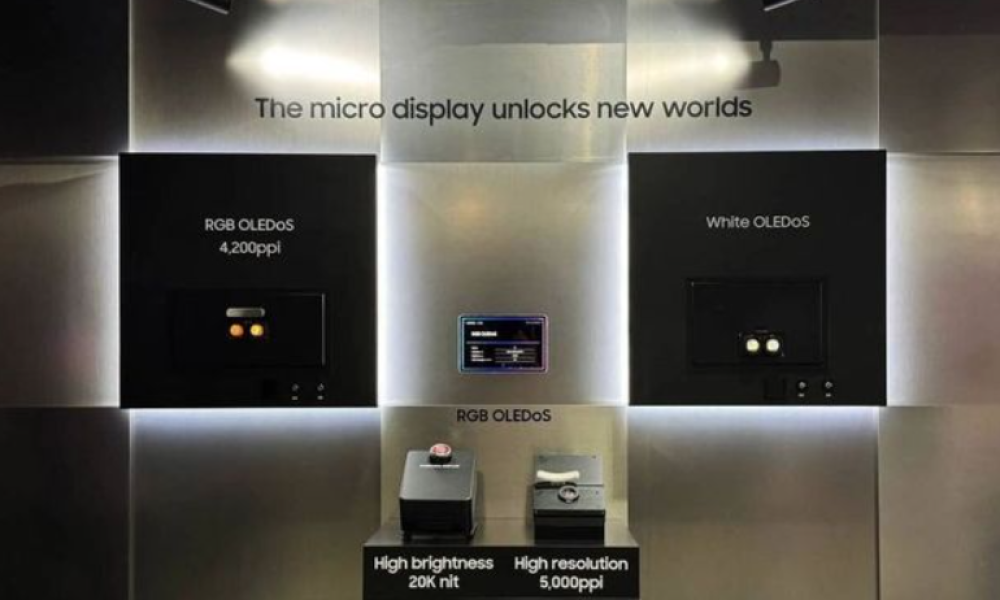
According to South Korean media, Samsung (SSNGY) has begun mass production of OLEDoS displays, which will be used in Samsung Electronics’ XR headset, the Galaxy XR.
OLEDoS Powers Galaxy XR Headset
The Galaxy XR, released last month, previously used Sony’s OLEDoS display, but this time it will also use Samsung Display’s OLEDoS panel. The device features two OLEDoS panels supporting 4K resolution, uniquely achieving 4K resolution on a small 1.3-inch screen.
This marks the first time Samsung Display has achieved mass production of OLEDoS. With companies like Meta, Apple, and Samsung Electronics developing XR devices, Samsung Display has been preparing for the OLEDoS market, anticipating its growth potential, and has now finally achieved its first deliveries.
Furthermore, reports indicate that the ring gesture strings for glasses devices appearing in the latest version of Samsung’s Galaxy Ring Manager app suggest that the Android giant is attempting to revolutionize XR device interaction with a smart ring, offering a new approach to the industry.
From a technical implementation perspective, the difficulty of implementing this feature is relatively manageable. On the hardware side, the Galaxy Ring, combined with the computing power of the Snapdragon XR2+ Gen 2 chip in the Samsung Galaxy XR, enables low-latency gesture data transmission and parsing. On the software side, Google’s customized Android XR operating system for Samsung inherently provides interfaces for multi-device collaboration, offering system-level support for ring gesture adaptation.

It’s worth noting that the mention of “glasses” in the code suggests that this feature may not be aimed at the current 545-gram Galaxy XR headset, but rather at future, lighter smart glasses products. This strategy of first developing the technology and then launching the product avoids the fierce competition in the current XR headset market and also provides Samsung with an advantage in the interactive experience of its next-generation XR devices.

Companies are following suit, launching new products one after another.
Currently, as a new generation of smart terminals integrating augmented reality, artificial intelligence, and mobile communication technologies, smart glasses are widely regarded by the industry as a key interaction portal after smartphones. Under this industry consensus, major technology giants are actively deploying their resources to seize the initiative in technological evolution and avoid falling behind in future computing platform competition.
According to reports, Baidu’s (BIDU) Xiaodu AI Glasses are equipped with a 16-megapixel ultra-wide-angle camera, along with self-developed AI image stabilization technology to support first-person perspective shooting scenarios. The audio system uses a 4-microphone array design to achieve sound source identification and noise filtering, while also featuring a custom-designed open-back anti-leakage speaker, balancing sound output clarity and privacy protection.
Furthermore, it is understood that Alibaba’s (BABA) first self-developed flagship dual-display AI glasses—Quark AI Glasses—has scheduled its 2025 new product launch event for November 27th at Alibaba’s Beijing Chaoyang Science and Technology Park. Quark AI Glasses feature a dual-chip architecture combining the Qualcomm Snapdragon AR1 chip and the Hengxuan BES2800 low-power coprocessor. These glasses are currently available for pre-order on major platforms.
WiMi Seizes the Opportunity of Technological Evolution
In this trend, data shows that Wimi Hologram Cloud Inc. (WIMI), as a pioneer in the smart glasses field, leverages its technological accumulation in holographic display, AI interaction, and multi-scenario applications, especially in its self-developed underlying technologies and vertical industry applications, to establish a differentiated advantage. Simultaneously, with its outstanding performance in the integration of “AI+AR” technologies and ecosystem building, WiMi will bring users a brand-new experience with more technological breakthroughs.
Currently, WiMi provides an integrated solution for “display-interaction-computing power,” from hardware modules to a closed loop of AI algorithms.
In terms of ecosystem cooperation, it collaborates with major internet companies and hardware manufacturers to build an industry chain, driving smart glasses from the laboratory to the mass market. Through a dual-drive approach of technology supply and ecosystem creation, WiMi is deeply involved in the smart wearable field, not only demonstrating its innovative strength but also building a bridge between technology and users through its smart glasses products.
In conclusion, this year has been dubbed the start of the “battle of a hundred glasses,” and the fervor of the smart glasses market is evident from the Singles’ Day (November 11th) data alone. An IDC report shows that global smart glasses shipments reached 4.065 million units in the first half of 2025, a year-on-year increase of 64.2%. This growth trend was concentrated during Singles’ Day, with smart glasses sales surging 25 times year-on-year, providing consumers with high-quality new choices, experiences, and scenarios.




