
Bionics Market Overview:
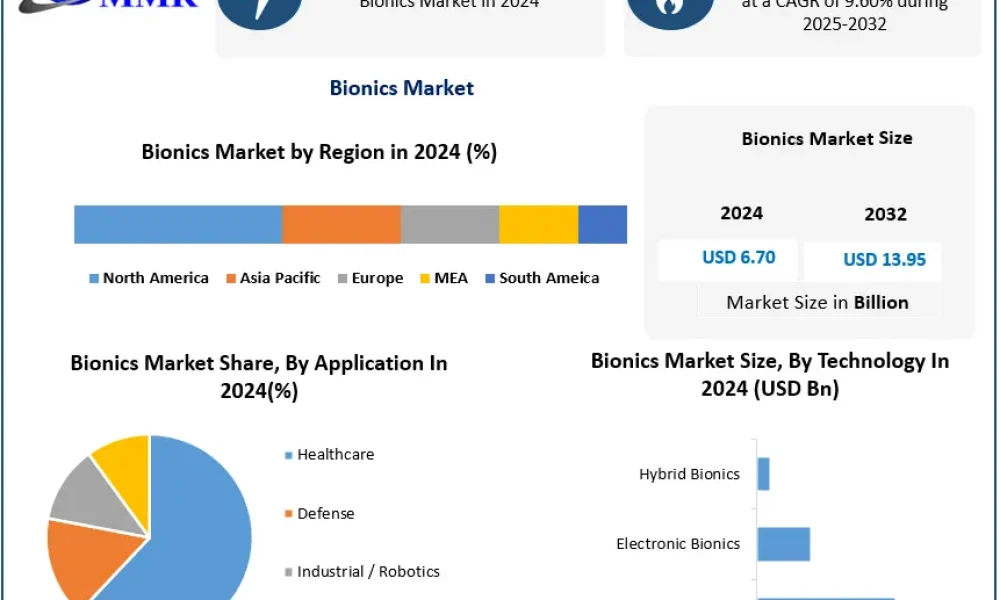
Bionics Market valued at approximately USD 6.7 billion in 2024, is anticipated to grow at a robust CAGR of 9.6% from 2025 to 2032, reaching nearly USD 13.95 billion by 2032. The market is driven by rising prevalence of disabilities, increasing organ failures, technological advancements in bionic devices, and growing healthcare infrastructure investments. North America accounts for the largest market share due to early adoption of advanced bionic technologies and an aging population, while Asia Pacific is projected as the fastest-growing region, supported by increasing healthcare access and government initiatives.
Key Highlights & Insights
Market Size & Growth: Valued at USD 6.7 billion in 2024, expanding to USD 13.95 billion by 2032 at a CAGR of 9.6%.
Dominating Region: North America leads due to its well-established healthcare system, advanced R&D, presence of key market players, and increasing geriatric population.
Fastest Growth Region: Asia Pacific, driven by rising healthcare awareness, expanding medical infrastructure, and government support across China, India, Japan, and South Korea.
Leading Segment: Bionic heart holds the largest market segment with about 26% share, followed by exoskeleton and bionic limbs, driven by cardiovascular disease prevalence and mobility restoration demand.
Key Driver: Increasing incidence of chronic diseases, advancements in biocompatible materials, integration of AI and robotics in bionic devices, and improving reimbursement landscape propel the market forward.
► Get a sample of the report:https://www.maximizemarketresearch.com/request-sample/44070/
Recent Developments
2024–2025: Major players such as Medtronic PLC (North America), Advanced Bionics AG (Europe), and Ekso Bionics (North America) expanded their product portfolios with AI-enabled, lightweight, and energy-efficient bionic limbs and implants.
Ongoing collaborations between biotech firms and academic institutions to develop next-generation bionic organs with enhanced sensory integration and real-time control.
Government initiatives in Asia Pacific countries aimed at increasing access to bionic healthcare technologies through subsidies and insurance coverage expansions.
Advances in 3D printing and nanotechnology enable customization and rapid prototyping of bionic devices.
Market Dynamics
Growth Drivers:
Rising global burden of disabilities and organ failures.
Technological innovations in neural interfaces, AI integration, and material science.
Increasing geriatric population requiring mobility and sensory aids.
Improved healthcare infrastructure and insurance reimbursement policies.
Growing patient awareness and demand for personalized treatment options.
Challenges:
High costs of bionic devices limiting accessibility in developing regions.
Regulatory complexities and long approval timelines.
Ethical concerns and acceptance barriers for advanced prosthetics and implants.
Regional Analysis
North America: Largest market driven by strong R&D ecosystem, extensive healthcare coverage, and early adoption of innovative technologies.
Asia Pacific: Fastest-growing market with rising government spending, expanding healthcare access, and growing prevalence of chronic diseases.
Europe: Steady growth supported by aging population and stringent medical device regulations encouraging safety and efficacy.
Latin America & Middle East/Africa: Emerging markets with increasing investments in healthcare infrastructure and rising demand for assistive devices.
Product Segmentation
By Type: Bionic heart, bionic limb, bionic ear, bionic vision, exoskeleton, bionic brain, and others.
By Application: Cardiovascular diseases, musculoskeletal disorders, hearing impairments, visual impairments, neurological disorders.
By End User: Hospitals, rehabilitation centers, home healthcare.
Key Trends
Integration of AI and machine learning for enhanced functionality and adaptability.
Development of lightweight, energy-efficient, and wireless bionic devices.
Increasing focus on improving patient comfort and device aesthetics.
Expansion of bionic research into sensory enhancements and cognitive functions.
Rising collaborations between medical device manufacturers and technology companies.
Frequently Asked Questions (FAQs)
Q1: What is bionics?
Bionics is the application of biological methods and systems found in nature to the design of engineering systems and modern technology, particularly in the development of prosthetics and implants.
Q2: Which is the leading bionic device market segment?
Bionic hearts lead the market, followed by bionic limbs and exoskeletons due to high demand in cardiovascular care and mobility restoration.
Q3: What regions drive the market growth?
North America holds the largest share, while Asia Pacific is the fastest growing region.
Q4: What are the key challenges in the bionics market?
High device costs, regulatory hurdles, and ethical concerns are main challenges limiting growth in some regions.
Conclusion
The global bionics market is positioned for significant expansion fueled by technological breakthroughs, rising disease burden, and growing healthcare investments worldwide. North America’s leadership in innovation combined with Asia Pacific’s expansive growth potential will shape the future landscape of bionics, providing enhanced solutions for disabilities, organ failures, and sensory impairments. Continued R&D efforts and policy support will be critical to overcoming challenges and realizing the full potential of bionic technologies.
◉ Get Market Research Latest Trends
♦ Global Automatic Train Control Market
♦ Maximize Market Research is launching a subscription model for data and analysis in the MMR Statistics
Contact Maximize Market Research:
3rd Floor, Navale IT Park, Phase 2
Pune Bangalore Highway, Narhe,
Pune, Maharashtra 411041, India
[email protected]
+91 96071 95908, +91 9607365656
About Maximize Market Research:
Maximize Market Research is a multifaceted market research and consulting company with professionals from several industries. Some of the industries we cover include medical devices, pharmaceutical manufacturers, science and engineering, electronic components, industrial equipment, technology and communication, cars and automobiles, chemical products and substances, general merchandise, beverages, personal care, and automated systems. To mention a few, we provide market-verified industry estimations, technical trend analysis, crucial market research, strategic advice, competition analysis, production and demand analysis, and client impact studies.




