
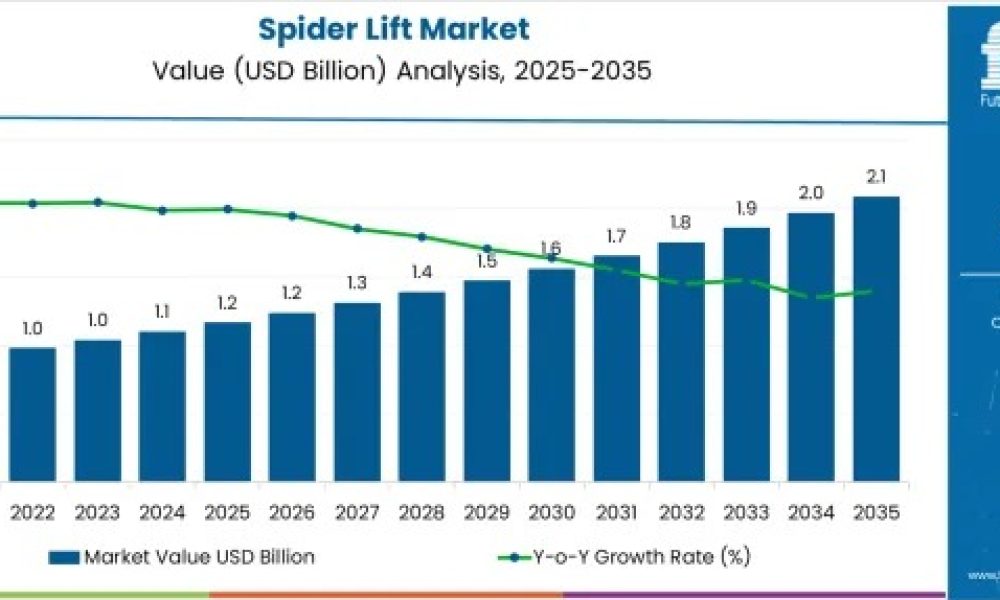
The global Spider Lift Market is entering a decade of steady and opportunity-rich expansion, projected to rise from USD 1.2 billion in 2025 to USD 2.1 billion by 2035 at a 6.0% CAGR. This growth trajectory signals operational maturity rather than volatile spikes, making spider lifts a high-value asset class for leasing companies, rental partners, and OEMs building recurring-revenue service models. As industries navigate increasingly complex infrastructure layouts, spider lifts are emerging as indispensable tools for safe, compact, and terrain-flexible access.
Subscribe for Year-Round Insights → Stay ahead with quarterly and annual data updates:
https://www.futuremarketinsights.com/reports/sample/rep-gb-22539
Growth patterns indicate a strong incremental opportunity of USD 0.5 billion between 2025 and 2030, expanding further to USD 0.7 billion from 2031 to 2035—a 58% cumulative advantage during the latter half of the forecast window. This reflects deepening integration of spider lifts into facility management, telecom, arboriculture, façade maintenance, and infrastructure modernization activities. OEMs are shifting towards predictive maintenance, telematics intelligence, and hybrid or electric variants, building competitive differentiation beyond hardware and into lifecycle service ecosystems.
Market Forces Driving Expansion
The demand for spider lifts is anchored in their ability to deliver safe elevation in narrow or uneven terrains where traditional aerial work platforms fall short. Their compact chassis, tracked mobility, and minimal ground pressure have made them essential for both indoor and outdoor operations across commercial buildings, industrial facilities, utility corridors, and cultural heritage sites.
A noticeable shift toward electrification is reshaping product pipelines. Lithium-ion powertrains, bi-energy systems, and low-noise electric units are increasingly preferred, especially in Europe and the United Kingdom, where emission-sensitive regulations and indoor operational norms are accelerating adoption.
Urban infrastructure development in Asia-Pacific—particularly China and India—is another growth engine. High-rise façades, metro networks, utility corridors, and complex maintenance environments are driving adoption of telescopic and mid-height spider lifts. These systems provide superior reach and stability with minimal repositioning, enabling faster project cycles and improved worker safety.
Key Segment Insights
Telescopic spider lifts, projected to hold 29.1% of the 2025 product share, continue to dominate due to their long horizontal outreach and high lifting capacity. Their design is ideal for façade work, complex maintenance tasks, and constrained access areas, making them a valuable asset for rental fleets and end users alike.
The 10–20 meter platform height category—contributing 36.4% of 2025 revenue—remains the market’s backbone. Its balanced reach, mobility, and affordability support broad adoption across industrial sites, medium-rise buildings, and routine facility operations, reinforcing its position as the most commercially viable height range globally.
Telecommunications and utility applications lead the end-use segment, capturing 23.7% of 2025 revenue. From roadside power lines to telecom tower retrofits, spider lifts enable operators to navigate rough terrain and confined access points without compromising stability—an essential capability in modern infrastructure networks.
Regional Growth Outlook
China, India, Germany, France, and the United Kingdom represent the strongest demand hubs through 2035.
- China (8.1% CAGR): Growth driven by solar facility maintenance, public infrastructure retrofits, metro systems, and indoor low-emission mandates that accelerate electric lift adoption.
- India (7.5% CAGR): Expansion of urban infrastructure, aviation maintenance, and telecom networks strengthens demand for narrow-access spider lifts.
- Germany (6.9% CAGR): Compliance-driven usage in heritage preservation, bridge inspection, and rental fleet upgrades favors CE-certified hybrid units.
- France (6.3% CAGR): Strong use in landscaping, rail depots, and monument restoration, with high interest in bi-energy platforms.
- United Kingdom (5.7% CAGR): Electric spider lifts gain traction amid emission-focused regulations and modernization of telecom, stadium, and municipal facilities.
Competitive Landscape
Leading companies—including Cela, CTE SpA, Dinolift, Platform Basket, Niftylift, Imer, Terex, Oshkosh Corporation, and others—are accelerating development of lightweight frames, hybrid powertrains, remote diagnostics, and predictive maintenance systems. Manufacturers serving emerging markets are focusing on cost-efficient models bundled with operator training, strengthening adoption across rental partners and municipal agencies.
As spider lifts become vital for operational safety and efficiency, competitive advantage will increasingly hinge on telematics integration, automation, and lifecycle services rather than equipment hardware alone.
Get data that aligns with your strategic priorities — ask for report customization today:
https://www.futuremarketinsights.com/customization-available/rep-gb-22539
Have a specific Requirements and Need Assistant on Report Pricing or Limited Budget please contact us – [email protected]
About Future Market Insights (FMI)
Future Market Insights, Inc. (FMI) is an ESOMAR-certified, ISO 9001:2015 market research and consulting organization, trusted by Fortune 500 clients and global enterprises. With operations in the U.S., UK, India, and Dubai, FMI provides data-backed insights and strategic intelligence across 30+ industries and 1200 markets worldwide.
Contact Us:
Future Market Insights Inc.
Christiana Corporate, 200 Continental Drive,
Suite 401, Newark, Delaware – 19713, USA
T: +1-347-918-3531



