
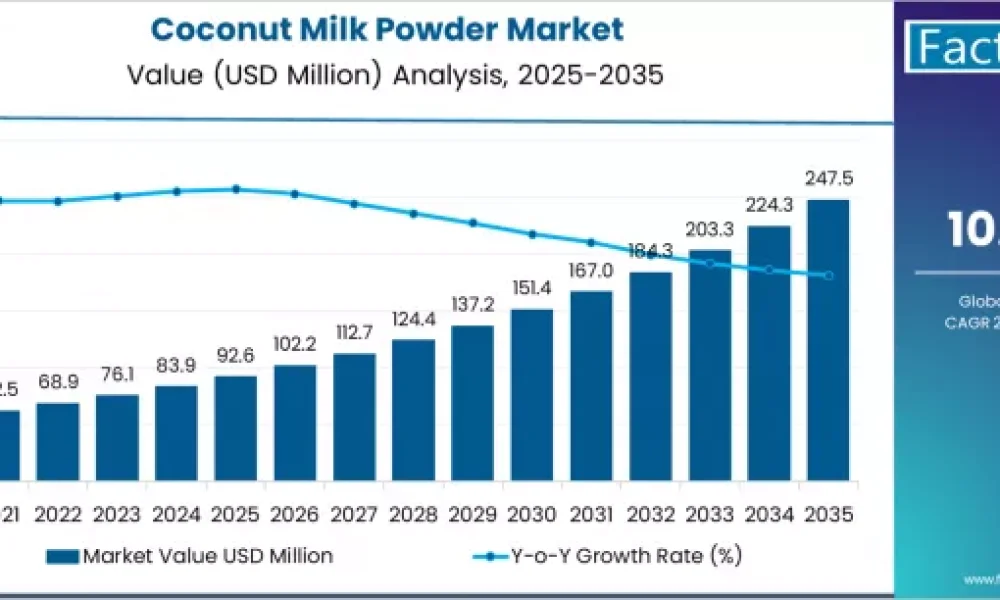
The global coconut milk powder market is on a strong upward trajectory from 2025 to 2035, fueled by rising plant-based dietary transformations, growing lactose intolerance awareness, and accelerating demand across the foodservice and packaged food industries.
Coconut milk powder widely used in beverages, bakery, confectionery, curries, ready meals, dairy alternatives, and nutritional formulations—offers superior shelf stability, cost efficiency, and operational ease compared to liquid coconut milk. This PR highlights the market size, growth drivers, regional insights, innovation trends, and strategic perspectives shaping the industry’s next decade.
Market Size and Growth
The global coconut milk powder market is expected to expand from USD 92.6 million in 2025 to USD 247.5 million by 2035, generating USD 154.9 million in new revenue. The market will grow at a robust CAGR of 10.3%, reflecting the accelerating adoption of plant-based and allergen-free food alternatives.
This high-growth trajectory is supported by increasing applications in clean-label packaged foods, premium culinary products, vegan substitutes, and long-shelf-life food formulations—making coconut milk powder one of the fastest-growing categories in the dairy alternatives landscape.
To access the complete data tables and in-depth insights, request a Discount On The Report here: https://www.factmr.com/connectus/sample?flag=S&rep_id=11634
Key Growth Drivers
- Rising plant-based food adoption
The global shift toward vegan, flexitarian, and plant-forward diets is strongly boosting coconut-derived ingredients. Coconut milk powder serves as a versatile base for dairy-free beverages, smoothies, bakery mixes, soups, sauces, and health supplements.
- Increasing lactose intolerance awareness
As awareness of dairy allergies and intolerance grows, consumers are actively choosing lactose-free alternatives. Coconut milk powder offers a creamy texture, neutral flavor profile, and easy digestibility—broadening consumer appeal.
- Expanding foodservice and industrial demand
Restaurants, cafés, and food manufacturers increasingly prefer coconut milk powder for its long shelf life, reduced storage costs, and consistent quality. It eliminates wastage associated with perishable liquid milk and enhances kitchen efficiency.
- Clean-label and natural formulations
Manufacturers are launching organic, additive-free, and non-GMO coconut milk powder variants to align with the rising demand for safer, natural, and sustainable ingredients.
Regional Market Insights
Asia-Pacific remains the largest and most dynamic region, supported by strong coconut cultivation, traditional usage patterns, and high export capabilities. Countries like Indonesia, the Philippines, India, and Sri Lanka are key producers driving global supply.
North America and Europe represent high-value markets driven by:
- rising vegan population,
- interest in functional and exotic ingredients,
- surge in private-label and premium health-food brands.
Middle East & Africa and Latin America are emerging markets, where bakery and confectionery sectors are rapidly adopting coconut-based ingredients to diversify product portfolios.
Technology Trends and Competitive Landscape
The competitive environment is evolving as brands focus on:
- Spray-drying advancements to improve solubility and flavor retention
- Organic certification and clean-label innovation
- Micro-encapsulation techniques enabling extended shelf life
- Specialized blends (e.g., coconut milk powder + plant proteins) targeting sports nutrition and meal replacement segments
- Sustainable sourcing, emphasizing fair-trade and traceable supply chains
Producers are enhancing product consistency, allergen-free positioning, and industrial compatibility to meet the needs of bakery, beverage, and packaged food manufacturers.
Challenges
Despite strong long-term growth potential, the market faces:
- fluctuations in coconut supply due to climate vulnerability,
- rising production costs linked to organic and premium variants,
- price sensitivity in developing nations,
- competition from other plant-based dairy alternatives such as almond, oat, and soy.
Compliance with international food safety standards and maintaining consistent quality across batches also remain critical for manufacturers.
Strategic Implications
For Manufacturers
Focus on premiumization, organic certifications, and value-added blends. Strengthen partnerships with foodservice chains and clean-label brands while ensuring reliable and traceable sourcing.
For Distributors & Retailers
Leverage the rising shift toward plant-based diets by highlighting allergen-free, non-dairy, and long-shelf-life benefits. Expanding e-commerce presence and private-label offerings can unlock new growth channels.
For Investors
The coconut milk powder sector offers high-growth potential, supported by strong consumer demand, application expansion, and premium pricing power. The next decade is ideal for strategic investments in processing technologies, sustainability initiatives, and brand building.
Outlook Summary
From 2025 to 2035, the coconut milk powder market will experience strong, sustained growth, driven by global dietary shifts, expanding demand for plant-based and lactose-free products, and increasing utilization in the foodservice and packaged food sectors. While supply fluctuations and pricing pressures remain challenges, the market presents significant opportunities for brands, retailers, and investors committed to innovation, quality, and sustainability.
Have a specific Requirements and Need Assistant on Report Pricing or Limited Budget please contact us – [email protected]
About Fact.MR
Fact.MR is a global market research and consulting firm, trusted by Fortune 500 companies and emerging businesses for reliable insights and strategic intelligence. With a presence across the U.S., UK, India, and Dubai, we deliver data-driven research and tailored consulting solutions across 30+ industries and 1,000+ markets. Backed by deep expertise and advanced analytics, Fact.MR helps organizations uncover opportunities, reduce risks, and make informed decisions for sustainable growth.



