
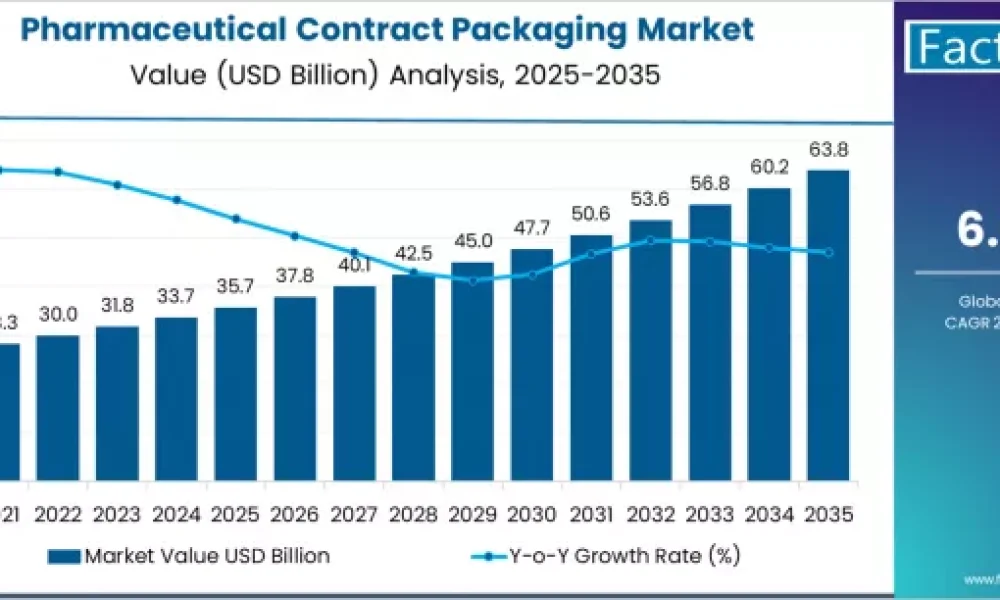
The U.S. pharmaceutical contract packaging market is poised for strong and sustained growth between 2025 and 2035, supported by rapid advancements in drug development, rising outsourcing activities, and the growing complexity of pharmaceutical packaging requirements. As pharmaceutical companies increasingly prioritize cost efficiency, supply-chain flexibility, and compliance with stringent regulatory standards, contract packaging organizations (CPOs) are projected to play a central role in the industry’s next decade of transformation.
The latest market outlook suggests that the U.S. pharmaceutical contract packaging industry will expand steadily, driven by the growth of biologics, personalized medicine, and the rising need for sterile, secure, and traceable packaging formats. With increasing regulatory demands and heightened focus on patient safety, packaging has evolved from a logistical necessity into a critical component of pharmaceutical value creation.
To access the complete data tables and in-depth insights, request a Discount On The Report here: https://www.factmr.com/connectus/sample?flag=S&rep_id=11663
Market Forecast and Growth Outlook
From 2025 to 2035, the U.S. pharmaceutical contract packaging market is expected to grow at a healthy pace, with revenue nearly doubling over the decade. This expansion is fueled by several forces: increased outsourcing by pharmaceutical manufacturers, stronger serialization compliance requirements, and a rising number of specialty drugs entering the market.
Growing demand for advanced primary packaging solutions — including prefilled syringes, vials, ampoules, blister packs, and sterile containers — is accelerating innovation. Simultaneously, the expansion of biologic therapies and temperature-sensitive formulations is driving the need for highly specialized CPOs capable of handling cold-chain packaging and aseptic processing.
As the U.S. healthcare sector invests more in high-value therapeutics, contract packagers that combine efficiency, regulatory expertise, and technological sophistication are expected to capture significant market share through 2035.
Key Market Drivers
1. Rising Pharmaceutical Outsourcing
Pharmaceutical companies are increasingly choosing to outsource packaging to reduce capital costs, streamline operations, and focus internal resources on R&D and commercialization. Contract packaging reduces the need for investments in new equipment, serialization lines, compliance systems, and specialized workforce training.
Outsourcing also provides scalability, allowing companies to quickly adjust production volumes based on market demand — a growing necessity amid unpredictable supply-chain dynamics.
2. Expansion of Biologics and Injectable Drugs
Biologics, biosimilars, gene therapies, and injectable formulations require high-precision packaging solutions under tightly controlled conditions. This trend is accelerating demand for contract packagers with capabilities in sterile fill-finish, vial and syringe packaging, cold-chain logistics, and contamination-resistant environments.
As the share of biologics in the U.S. drug market continues to rise, advanced packaging partners will become essential in ensuring safety and regulatory compliance.
3. Serialization and Anti-Counterfeiting Requirements
Regulations related to drug authentication, traceability, and tamper resistance are strengthening each year. The U.S. Drug Supply Chain Security Act (DSCSA) has amplified the need for serialized packaging solutions that can ensure supply-chain transparency and protect patients from counterfeit drugs.
Contract packaging providers with robust serialization infrastructure are expected to gain a competitive advantage through 2035.
4. Focus on Patient-Centric Packaging
Demand for user-friendly packaging — such as prefilled syringes, auto-injectors, dose-accurate blister packs, and child-resistant containers — continues to rise. These formats support better patient adherence, enhanced safety, and convenience for both clinicians and patients.
CPOs offering innovative packaging formats designed for home healthcare and chronic disease management will see accelerated growth.
5. Growth of Sustainable Packaging
Environmental concerns and corporate ESG commitments are pushing pharmaceutical companies to adopt sustainable packaging materials and processes. Recyclable plastics, biodegradable packaging, eco-friendly printing inks, and energy-efficient production lines are becoming essential elements in long-term packaging strategy.
CPOs that invest in sustainability will gain stronger partnerships and long-term contracts.
Market Segmentation and Emerging Trends
By Packaging Type
- Primary Packaging: Expected to continue dominating the market, fueled by demand for sterile containers, blister packs, bottles, prefilled syringes, and vials.
- Secondary Packaging: Includes labeling, kitting, bundling, and folding cartons — areas heavily influenced by serialization and branding needs.
- Tertiary Packaging: Increasingly driven by logistics optimization, bulk handling, and cold-chain transportation requirements.
By Material
- Plastics: The most widely used material due to versatility and cost-efficiency.
- Glass: Rapid growth driven by biologics, injectable solutions, and vial demand.
- Paperboard and Aluminum Foil: Strong adoption for cartons, labels, and barrier protection.
By Service Type
- Blister Packaging
- Bottling & Filling
- Vial & Syringe Packaging
- Labeling & Serialization
- Kitting & Assembly
Providers offering integrated, end-to-end packaging services will be best positioned to meet the growing complexity of U.S. pharmaceutical supply chains.
Competitive Landscape
The U.S. contract packaging market is moderately consolidated, with both large multinational CPOs and specialized niche players competing for market share. Companies differentiate based on:
- Regulatory compliance capabilities
- Technology and automation investments
- Cold-chain and sterile packaging capabilities
- Customization capacity
- Speed, scalability, and responsiveness
Leading organizations are expanding facilities, acquiring specialized packagers, and integrating automation and digital quality-control systems to enhance competitiveness.
Challenges Impacting Market Growth
1. High Capital Requirements
Establishing or upgrading packaging lines — particularly sterile or serialization-enabled systems — requires significant investment, limiting entry of new players.
2. Complex Regulatory Burden
Compliance with DSCSA, FDA guidelines, and evolving quality-control standards demands continuous investment in technology, workforce training, and documentation.
3. Supply-Chain Vulnerabilities
Disruptions in raw materials, cold-chain logistics, and transport networks create risk for packaging timelines and product integrity.
4. Skilled Workforce Shortage
Advanced sterile packaging and automated systems require highly trained personnel, posing recruitment challenges for CPOs.
Opportunities Ahead: 2025–2035
- Integration of digital quality-control systems such as QR tracking, AI inspection, and real-time analytics
- Expansion of cold-chain packaging for biologics, mRNA vaccines, and cellular therapies
- Adoption of smart packaging with embedded sensors and RFID technology
- Development of sustainable packaging solutions that reduce waste and carbon impact
- Strategic partnerships between drug manufacturers and full-service CPOs
Outlook to 2035
The U.S. pharmaceutical contract packaging market is on track to become more advanced, more automated, and more essential to the pharmaceutical supply chain. With packaging growing in strategic importance — from safety and compliance to patient experience and supply-chain security — contract packaging providers that innovate, diversify, and invest in new capabilities will lead the next decade of growth.
Have a specific Requirements and Need Assistant on Report Pricing or Limited Budget please contact us – [email protected]
To View Related Report : Pharmaceutical Capsule Filling Machines Market



