
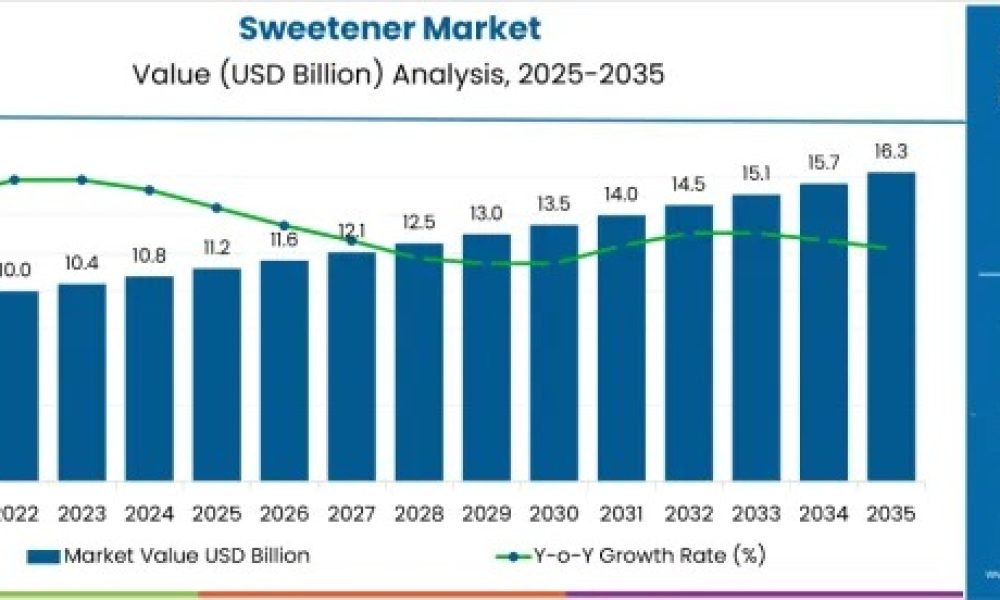
The global sweetener market continues its steady expansion, driven by rising consumer preference for low-calorie, natural, and functional alternatives. With the market projected to reach strong double-digit growth by 2035, industry stakeholders are prioritizing innovation, sustainability, and regulatory compliance to remain competitive in the evolving landscape.
The sweetener market is estimated to reach USD 16.3 billion by 2035, expanding from USD 11.2 billion in 2025 at a CAGR of 3.8%. The industry is set to generate an absolute dollar opportunity of USD 5.1 billion, reflecting 1.45x growth over the forecast period. Strong interest in plant-based, clean-label, and reduced-calorie foods is shaping demand patterns globally.
To Explore Detailed Market Data, Segment-Wise Forecasts, and Competitive Insights, Request Sample Report! https://www.futuremarketinsights.com/reports/sample/rep-gb-4505
By 2030, sweetener sales are projected to reach USD 13.5 billion, driven by growing processed food production, increasing demand for functional beverages, and consumer inclination toward natural ingredients. The second half of the decade is expected to add another USD 3.5 billion, led by supportive regulatory frameworks in Europe and North America and expanding industrial uptake in Asia-Pacific.
Natural sweeteners remain the most influential category, accounting for 42% of the market in 2025. Their prominence is attributed to strong adoption across bakery, confectionery, beverages, and nutraceuticals. Within parent industries, sweeteners hold nearly 40% of the broader sugar substitute market, emphasizing their importance in flavor enhancement, calorie reduction, and formulation stability.
Sweeteners also play a crucial role in pharmaceuticals, contributing nearly 12% through applications in chewable tablets, syrups, and nutraceuticals. In personal care, they hold about 6%, supported by use in oral care, skincare, and health supplements. Increasing cross-industry adoption continues to fuel market expansion.
Key factors driving growth include:
• Rising demand for low-calorie and sugar-reduced products
• Expansion of bakery, dairy, and beverage manufacturing in Asia-Pacific
• Regulatory push for clean-label formulations in North America & Europe
• Growing applications in pharmaceuticals, nutraceuticals, and personal care
• Technological advancements in natural, plant-based, and high-purity sweeteners
Manufacturers are investing heavily in plant-based, organic, and non-GMO formulations. Capacity expansions across China, India, the U.S., and Europe indicate a shift toward eco-friendly and compliant ingredient production. Leading players—Tate & Lyle, Cargill, ADM, Ajinomoto, DuPont, and Ingredion—continue to strengthen market presence through R&D, sustainability initiatives, and strategic partnerships.
Market Segmentation Highlights
The sweetener industry is segmented by product type, form, category, nature, end use, sales channel, and region. Natural, novel, and sugar alcohol sweeteners remain core investment areas due to their clean-label appeal and formulation benefits.
By Product Type – Natural Sweeteners Lead with 42% Share
Natural sweeteners dominate global demand, driven by clean-label preference and wide compatibility with beverage, bakery, dairy, and nutraceutical formulations. Increased production capacity in Asia-Pacific and North America is accelerating market penetration.
By End Use – Food Applications Hold 40% Share
Food remains the largest consumer segment, with high consumption in bakery, snacks, confectionery, and dairy products. The rise of functional and fortified foods is further elevating demand.
Market Dynamics
Drivers:
• Expanding processed food production
• Clean-label and low-glycemic product demand
• Rapid industrialization in Asia-Pacific
• Adoption in pharmaceuticals, nutraceuticals, and personal care
Restraints:
• Regulatory scrutiny on artificial sweeteners
• Volatility in raw material supply
• High production costs for natural and organic variants
Trends:
• Growth of plant-based and botanically sourced sweeteners
• Shift toward sustainable and eco-friendly production
• Development of high-intensity and low-glycemic alternatives
• Clean-label reformulations across major food categories
Country-Wise Growth Outlook
India leads with a projected CAGR of 11.3%, supported by growth in bakery, dairy, beverages, and nutraceuticals. The USA follows at 10.5%, driven by sugar-reduction initiatives and FDA-compliant formulations. China, Brazil, Germany, and France continue exhibiting strong adoption supported by evolving consumer lifestyles and regulatory support for natural sweeteners.
Subscribe for Year-Round Insights → Stay ahead with quarterly and annual data updates! https://www.futuremarketinsights.com/reports/brochure/rep-gb-4505
Competitive Landscape
The sweetener market is moderately consolidated with global players focusing on innovation, sustainability, and wider application portfolios. Companies such as Tate & Lyle, Cargill, ADM, Ajinomoto, Kemin, Ingredion, Wilmar, Roquette, JK Sucralose, and Hermes Sweeteners are engaging in mergers, capacity expansions, and high-purity product launches.
Over 60% of total consumption in 2025 came from natural, organic, and high-intensity sweeteners—reflecting the industry’s shift toward safe, health-forward ingredients. With increasing demand across food, beverages, pharmaceuticals, and personal care, companies are prioritizing advanced production technologies and strategic partnerships to strengthen global competitiveness.
About Future Market Insights (FMI)
Future Market Insights, Inc. (FMI) is an ESOMAR-certified, ISO 9001:2015 market research and consulting organization, trusted by Fortune 500 clients and global enterprises. With operations in the U.S., UK, India, and Dubai, FMI provides data-backed insights and strategic intelligence across 30+ industries and 1200 markets worldwide.



