
Educational Toy Market Market Overview:
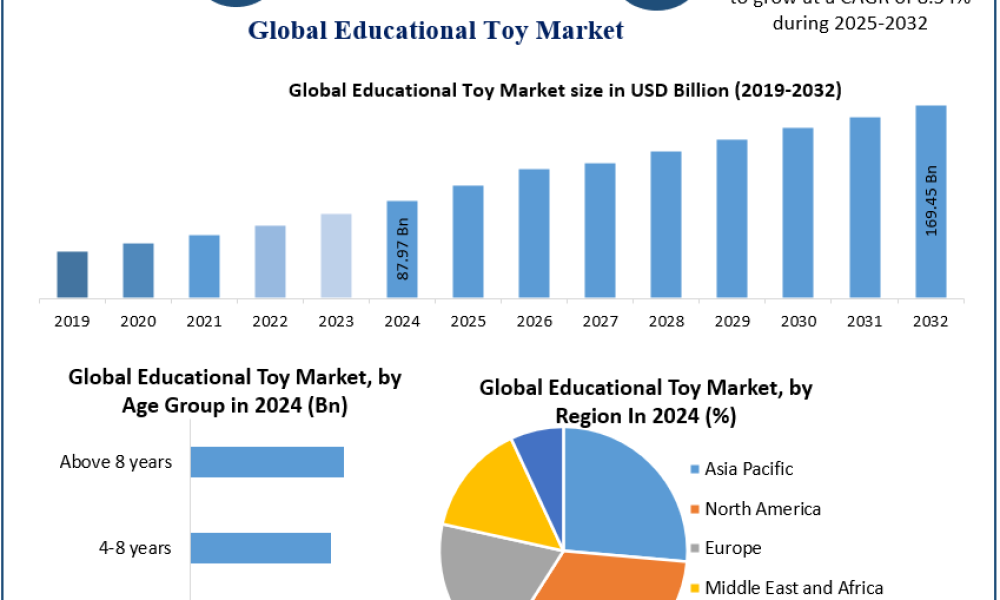
Educational Toy Market is set for significant growth, expanding from an estimated USD 87.97 billion in 2024 to nearly USD 169.45 billion by 2032, reflecting a compound annual growth rate (CAGR) of 8.54%. North America currently dominates the market due to high parental awareness, demand for STEM (Science, Technology, Engineering, Mathematics) toys, and strong retail and e-commerce infrastructure. Meanwhile, Asia Pacific is emerging as the fastest-growing region, spurred by rising disposable incomes, urbanization, and government initiatives promoting early childhood education and indigenous toy manufacturing.
Key Highlights & Insights
Market Size & Growth: Valued at USD 87.97 billion in 2024, with projections to reach USD 169.45 billion by 2032 at a CAGR of 8.54%.
Dominating Region: North America leads with a commanding market share, driven by high investment in educational toys, parental demand for skill-building products, and access to advanced retail platforms.
Fastest Growing Region: Asia Pacific, led by China and India, is expected to grow the fastest due to expanding young populations and government educational reforms.
Leading Segment: Robotics and STEM toys constitute a fast-growing segment, fueled by increasing interest in technology-driven educational tools.
Key Driver: Rising parental focus on holistic child development, integration of technology in toys, and expanding digital sales channels propel market expansion.
► Get a sample of the report:https://www.maximizemarketresearch.com/request-sample/147976/
Recent Developments
2024-2025: Industry leaders such as LEGO Group, Mattel, Hasbro, and VTech are actively investing in AI-powered interactive toys and robotics kits aimed at enhancing learning experiences.
Governments like India have initiated programs to position the nation as a global toy manufacturing hub, supporting local production of educational toys.
E-commerce platforms see increased educational toy sales, supported by subscription and personalized toy rental services.
Growth in eco-friendly and sustainably sourced toys is gaining traction, driven by consumer demand for green products.
Market Dynamics
Growth Drivers:
Increasing awareness of early childhood education and cognitive development.
Growing popularity of STEM education and technology-enabled learning toys.
Expansion in e-commerce, enabling broader consumer access and choice.
Government policies supporting local manufacturing and skill development in children.
Challenges:
High costs of advanced educational and robotic toys.
Regulatory complexities in safety standards and compliance.
Competition from digital games and entertainment apps.
Regional Analysis
North America: Market leader, with widespread acceptance of educational toys and investments in innovation.
Asia Pacific: Fastest-growing, driven by large population base, rising middle class, and policy incentives in countries like China, India, and Japan.
Europe: Stable growth with emphasis on sustainability and educational reforms.
Latin America & Middle East/Africa: Emerging markets expanding awareness and retail infrastructure.
Product Segmentation
By Toy Type: Robotics and programmable toys, STEM kits, puzzles and board games, arts & crafts, activity toys.
By Age Group: Infant (0-2 years), toddler (3-5 years), early school-age (6-8 years), pre-teens (9-12 years).
By Distribution Channel: Offline retail, online platforms, specialty educational stores.
Key Trends
Surge in AI and robotics-enabled educational toys.
Growing integration of augmented reality (AR) and virtual reality (VR) in educational play.
Eco-conscious toy manufacturing gaining momentum.
Rise of subscription-based and personalized toy rentals.Increasing consumer preference for multi-functional, modular education toys.
Frequently Asked Questions (FAQs)
Q1: What factors are driving the growth of educational toys?
A: Trends in early childhood education, increased parental spending on learning toys, advances in AI and robotics, and expanding e-commerce are key growth drivers.
Q2: Which region dominates the market?
A: North America leads due to strong consumer demand, innovation, and retail reach.
Q3: What are the popular product types?
A: Robotics and STEM toys are the fastest growing, followed by puzzles, board games, and arts & crafts kits.
Q4: What challenges does the market encounter?
A: Price sensitivity, regulatory compliance, and competition from digital entertainment.
Conclusion
The global educational toy market is poised for robust growth driven by evolving educational priorities, technological innovation, and expanding access via online retail. North America remains the market leader with strong demand for interactive and skill-building toys, while Asia Pacific’s expanding population and supportive policies promise aggressive future growth. Continued innovation, sustainability focus, and multi-channel availability will be crucial for market participants to capitalize on emerging opportunities worldwide.
◉ Get Market Research Latest Trends
♦ Maximize Market Research is launching a subscription model for data and analysis in the MMR Statistics
Contact Maximize Market Research:
3rd Floor, Navale IT Park, Phase 2
Pune Bangalore Highway, Narhe,
Pune, Maharashtra 411041, India
[email protected]
+91 96071 95908, +91 9607365656
About Maximize Market Research:
Maximize Market Research is a multifaceted market research and consulting company with professionals from several industries. Some of the industries we cover include medical devices, pharmaceutical manufacturers, science and engineering, electronic components, industrial equipment, technology and communication, cars and automobiles, chemical products and substances, general merchandise, beverages, personal care, and automated systems. To mention a few, we provide market-verified industry estimations, technical trend analysis, crucial market research, strategic advice, competition analysis, production and demand analysis, and client impact studies.




