
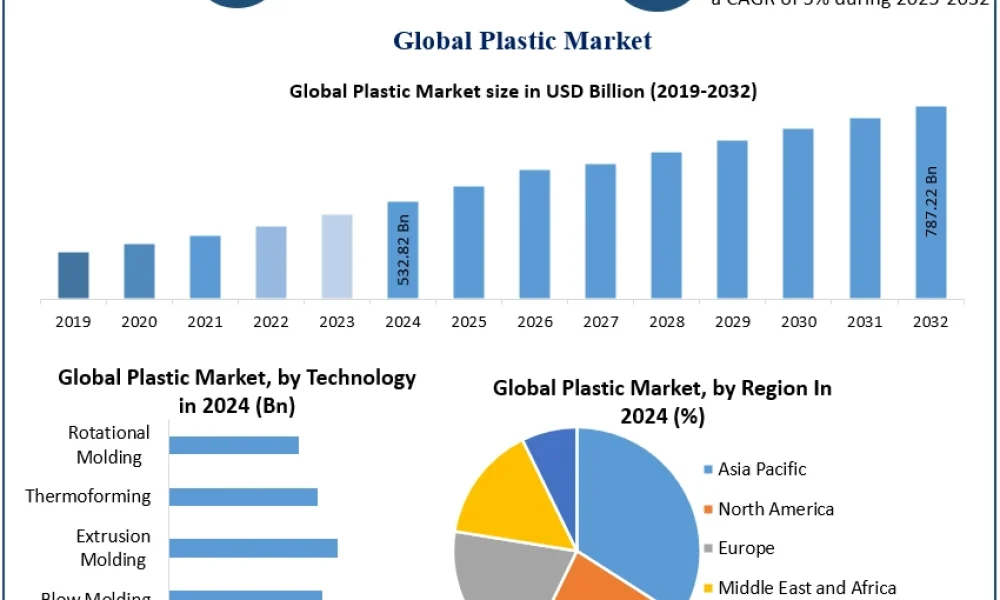
Plastic Market Market Overview:
Plastic Market continues its upward trajectory, projected to grow from USD 532.82 billion in 2024 to approximately USD 787.22 billion by 2032, expanding at a CAGR of about 5% during the forecast period. Asia Pacific dominates the market, driven by rapid industrialization, urbanization, and burgeoning demand from packaging, automotive, construction, and consumer goods industries. This region’s abundant raw material availability and manufacturing capabilities facilitate its leading position.
Key Highlights & Insights
Market Size & Growth: Valued at USD 532.82 billion in 2024, anticipated to reach USD 787.22 billion by 2032 with a CAGR of approximately 5.0%.
Dominating Region: Asia Pacific leads the market with over 50% share, fueled by China’s manufacturing prowess, India’s growing consumer markets, and expanding automotive and packaging sectors.
Leading Segment: Polyethylene (PE) and polypropylene (PP) dominate in terms of volume and revenue, largely used in packaging and automotive applications.
Key Driver: Increasing demand for lightweight, durable, and cost-effective materials in packaging, automotive components, and construction materials drives the plastic market.
► Get a sample of the report:https://www.maximizemarketresearch.com/request-sample/100495/
Recent Developments
2024-2025: Major chemical manufacturers like SABIC, LyondellBasell, and ExxonMobil expanded production capacities for advanced polymers in Asia Pacific.
Increased focus on developing bio-based and recycled plastics forms part of sustainability initiatives supported by government and industry collaborations.
Technological advancements in polymer processing and plastic recycling infrastructure have improved material efficiency and sustainability.
Rising e-commerce and food delivery sectors in urban centers have accelerated the use of flexible and rigid plastic packaging.
Market Dynamics
Growth Drivers:
Rapid urbanization and industrial growth in emerging economies.
Expanding construction sector demanding plastics for piping, insulation, and fixtures.
Booming automotive industry seeking lightweight plastic components for efficiency.
Growth in consumer goods and packaging sectors with evolving material innovations and recyclability.
Challenges:
Environmental concerns about plastic pollution prompting regulatory scrutiny.
Increasing policy pressure for sustainable materials and circular economy adoption.
Raw material price volatility impacting production costs.
Investments required to scale recycling and biodegradable alternatives.
Regional Analysis
Asia Pacific: Largest and fastest-growing region driven by manufacturing base, raw material availability, and multi-sector demand.
Europe: Significant market focusing on regulatory compliance and sustainable plastic alternatives.
North America: Mature market with emphasis on advanced polymers and sustainability technologies.
Latin America & Middle East/Africa: Emerging growth fueled by urbanization and packaging demand.
Product Segmentation
By Type: Polyethylene (PE), polypropylene (PP), polyvinyl chloride (PVC), polyethylene terephthalate (PET), others.
By Application: Packaging (dominant), automotive, construction, consumer goods, electronics, healthcare, others.
By Polymer: Thermoplastics (majority), thermosetting plastics.
Key Trends
Rising adoption of recycled plastics and bio-based polymers to meet sustainability goals.
Expansion of chemical recycling and advanced sorting techniques.
Increasing incorporation of plastics in lightweight automotive design.
Enhanced consumer demand for flexible packaging solutions in e-commerce and food sectors.
Collaborative industry efforts toward circular economy frameworks and extended producer responsibility.
Frequently Asked Questions (FAQs)
Q1: What is driving the growth of the plastics market?
A: Rapid industrialization, demand from packaging, automotive and construction sectors, and expanding consumer goods production are primary drivers.
Q2: Which region dominates the global plastics market?
A: Asia Pacific dominates due to its manufacturing capabilities and booming industrial demands.
Q3: What challenges face the plastics market?
A: Environmental concerns, regulatory restrictions, raw material cost fluctuations, and pressure for sustainable alternatives.
Q4: What trends are shaping the future of the plastics market?
A: Focus on recycled and bio-based plastics, chemical recycling, lightweight materials in automotive, and circular economy practices.
Conclusion
The global plastics market will continue expanding robustly through 2032, with Asia Pacific leading driven by industrial growth, material innovation, and sustainability initiatives. While challenges around environmental impact and regulatory pressure intensify, advances in recycling technologies and demand for lightweight, durable materials secure plastics’ indispensable role across key industries. Market players focusing on innovation, sustainability, and regional adaptability are well-positioned to capture future opportunities in the evolving plastics landscape.
◉ Get Market Research Latest Trends
♦ Global Integration Platform as a Service Market
♦ Maximize Market Research is launching a subscription model for data and analysis in the MMR Statistics
Contact Maximize Market Research:
3rd Floor, Navale IT Park, Phase 2
Pune Bangalore Highway, Narhe,
Pune, Maharashtra 411041, India
[email protected]
+91 96071 95908, +91 9607365656
About Maximize Market Research:
Maximize Market Research is a multifaceted market research and consulting company with professionals from several industries. Some of the industries we cover include medical devices, pharmaceutical manufacturers, science and engineering, electronic components, industrial equipment, technology and communication, cars and automobiles, chemical products and substances, general merchandise, beverages, personal care, and automated systems. To mention a few, we provide market-verified industry estimations, technical trend analysis, crucial market research, strategic advice, competition analysis, production and demand analysis, and client impact studies.




