
Beverage Cooler Market Market Overview:
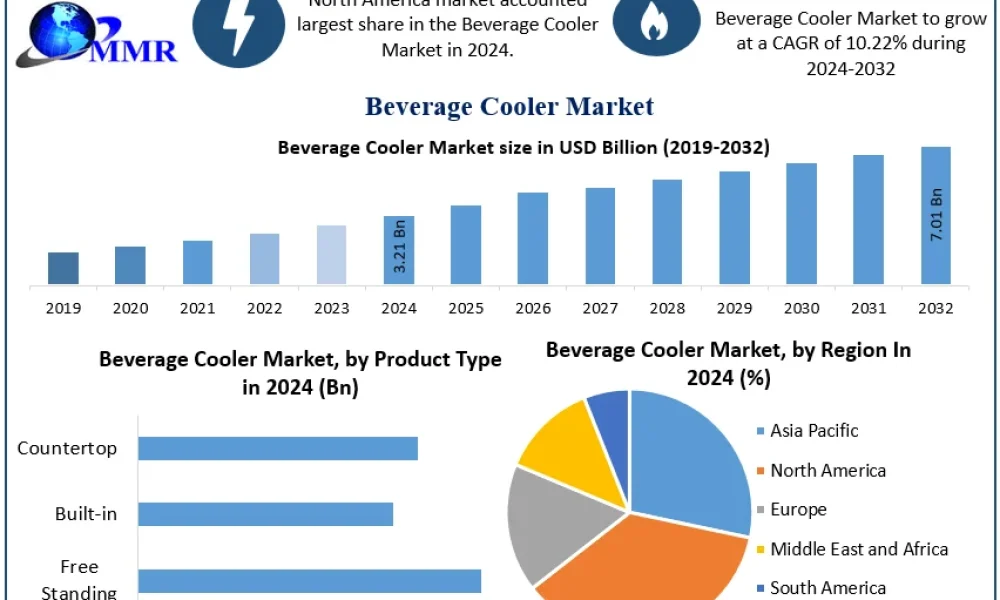
Beverage Cooler Market is witnessing rapid expansion, projected to grow from USD 3.21 billion in 2024 to USD 7.01 billion by 2032, exhibiting a robust CAGR of 10.22%. Rising consumer demand for chilled beverages, growing hospitality industries, recovery in travel and tourism, and increasing emphasis on energy-efficient cooling solutions are key growth drivers. North America dominates the market owing to high disposable incomes and a well-established culture around entertainment and beverage consumption, while Asia Pacific emerges as the fastest-growing region due to urbanization, rising middle-class income, and increased adoption in homes and commercial outlets.
Key Highlights & Insights
Market Size & Growth: The market was valued at USD 3.21 billion in 2024 and is forecasted to nearly double to USD 7.01 billion by 2032, growing at a CAGR of 10.22%.
Dominating Region: North America holds a significant share led by strong demand for energy-efficient and eco-friendly beverage coolers and a mature retail ecosystem.
Leading Segment: Freestanding beverage coolers dominate product type category due to their placement flexibility and capacity to serve residential and commercial segments.
Key Driver: Increasing consumption of cold beverages, growth in foodservice sectors such as restaurants, hotels, and convenience stores, and demand for energy-saving cooling technology spur market expansion.
► Get a sample of the report:https://www.maximizemarketresearch.com/request-sample/187631/
Recent Developments
2024-2025: Major manufacturers such as Arctic King, Danby, Marvel, Master-Bilt, and Vinotemp introduced advanced models featuring smart temperature controls, improved energy efficiency, and compact designs.
Asia Pacific players focus on local manufacturing capabilities and innovation to meet rising domestic and regional demand.
Strategic partnerships between beverage cooler manufacturers and hospitality businesses have enhanced market penetration.
Adoption of environmentally friendly refrigerants and sustainable production methods aligns with global green initiatives.
Market Dynamics
Growth Drivers:
Surge in demand for ready-to-drink and chilled beverages, particularly among youth and urban populations.
Expansion of service industries and recovery of tourism driving commercial demand for beverage coolers.
Rising consumer preference for energy-efficient and environmentally conscious appliances.
Growth of online retail and direct-to-consumer sales channels expanding product accessibility.
Challenges:
High upfront costs of advanced beverage cooler models may limit adoption in price-sensitive markets.
Supply chain disruptions and raw material cost fluctuations can impact production and pricing.
Competition from alternative cooling solutions and informal beverage storage methods.
Regional Analysis
North America: Largest market by value, benefiting from high consumer spending and a mature market infrastructure.
Asia Pacific: Fastest-growing market fueled by urbanization, rising disposable incomes, and increasing hospitality sector expansion across China, India, Japan, and Southeast Asia.
Europe: Steady growth supported by environmental regulations and demand from foodservice industry.
Latin America, Middle East & Africa: Emerging markets with growing retail and hospitality sectors contributing to incremental demand.
Product Segmentation
By Product Type: Freestanding, built-in, and countertop beverage coolers.
By Capacity: Up to 50 liters, 51-100 liters, 101-200 liters, and above 200 liters.
By End User: Residential and commercial sectors.
By Distribution Channel: Online retail, offline retail, direct sales, and specialty stores.
Key Trends
Growing preference for compact, energy-efficient coolers with intelligent control systems.
Increasing integration of smart features for remote temperature management and monitoring.
Expansion of customizable and premium coolers catering to lifestyle and luxury preferences.
Rising adoption of sustainable refrigerants and production processes.
Emphasis on enhancing cooling performance to maintain beverage quality across varying ambient environments.
Frequently Asked Questions (FAQs)
What is the current global market size for beverage coolers?
The market was valued at USD 3.21 billion in 2024.What is the expected market size by 2032?
Forecasted to reach USD 7.01 billion by 2032.Which region dominates the beverage coolers market?
North America holds the largest market share, followed by Asia Pacific which is the fastest-growing.What are the key product types in the market?
Freestanding beverage coolers dominate, favored for flexibility and capacity in residential and commercial settings.
Conclusion
The beverage cooler market’s promising outlook is underpinned by rising consumer demand for chilled beverages, expanding commercial end-users, and advancements in energy-efficient technologies. North America continues to lead with robust market share and innovation, while Asia Pacific’s rapid urbanization and rising incomes position it as a major growth engine. Together, these dynamics offer exciting opportunities for manufacturers and stakeholders to capitalize on evolving consumer and industry needs well into the 2030s.
◉ Get Market Research Latest Trends
♦ Global Multichannel Order Management Market
♦ Maximize Market Research is launching a subscription model for data and analysis in the MMR Statistics
Contact Maximize Market Research:
3rd Floor, Navale IT Park, Phase 2
Pune Bangalore Highway, Narhe,
Pune, Maharashtra 411041, India
[email protected]
+91 96071 95908, +91 9607365656
About Maximize Market Research:
Maximize Market Research is a multifaceted market research and consulting company with professionals from several industries. Some of the industries we cover include medical devices, pharmaceutical manufacturers, science and engineering, electronic components, industrial equipment, technology and communication, cars and automobiles, chemical products and substances, general merchandise, beverages, personal care, and automated systems. To mention a few, we provide market-verified industry estimations, technical trend analysis, crucial market research, strategic advice, competition analysis, production and demand analysis, and client impact studies.




