
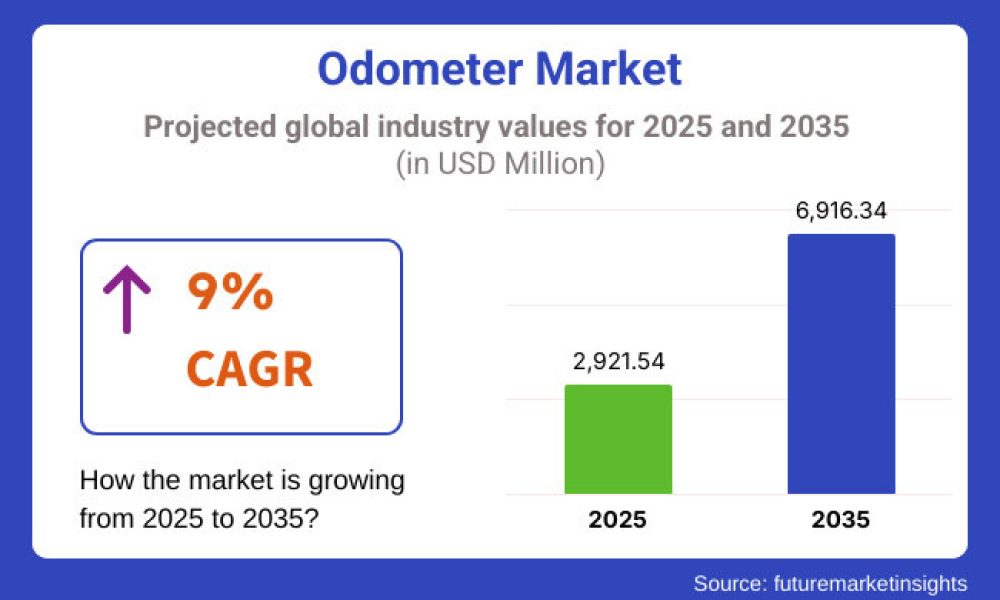
The Global Odometer Market is projected to expand from USD 2,921.54 million in 2025 to USD 6,916.34 million by 2035, growing at a compound annual growth rate (CAGR) of 9%. This robust expansion is fueled by rising adoption of digital and GPS-integrated odometers, increasing focus on connected vehicle ecosystems, and advancements in AI-powered mileage tracking and fraud prevention technologies.
Odometers, essential for tracking vehicle mileage, play a key role in fleet management, vehicle diagnostics, insurance telematics, and regulatory compliance. As vehicles become smarter and more connected, odometer systems are evolving from simple mechanical counters into intelligent, cloud-linked sensors capable of delivering real-time analytics and tamper-proof mileage verification.
Digital Shift and Smart Connectivity Drive Market Transformation
The global automotive industry is witnessing a transition from mechanical to digital odometers, with innovations in microprocessor-based sensors, wireless communication, and GPS connectivity. These systems not only measure mileage with high accuracy but also integrate seamlessly with vehicle health monitoring platforms, enabling predictive maintenance and operational transparency.
Subscribe for Year-Round Insights → Stay ahead with quarterly and annual data updates
https://www.futuremarketinsights.com/reports/sample/rep-gb-13963
Manufacturers are rapidly introducing AI-driven odometer analytics, blockchain-secured mileage logs, and over-the-air (OTA) calibration systems to enhance security and performance. This digital transformation is further accelerated by the rapid uptake of electric and autonomous vehicles, where precise mileage data supports energy optimization, predictive wear tracking, and usage-based insurance models.
Regional Market Highlights
United States: Regulatory Reform and Connected Mobility
The U.S. odometer market is forecasted to grow at a 9.2% CAGR, led by stringent anti-fraud regulations, expanding fleet telematics adoption, and the growing penetration of digital dashboards.
American OEMs are investing in AI-enabled mileage verification systems and blockchain-based odometer validation to ensure transparency in vehicle resale and insurance claims. Integration with cloud platforms and telematics suites further strengthens the market, particularly across logistics, ride-hailing, and rental fleets.
Europe: Pioneering Digital Authentication and Fleet Efficiency
In Europe, nations such as Germany, France, the UK, and Italy are driving innovation through tamper-proof odometer regulations, real-time mileage tracking, and blockchain-backed data recording.
The European Union’s push for mileage-based taxation transparency, coupled with advancements in ADAS and fleet connectivity, is boosting adoption. The region’s strong automotive manufacturing base and investments in V2I (Vehicle-to-Infrastructure) systems further reinforce its leadership in smart odometer development.
Asia-Pacific: Rapid Expansion and Manufacturing Leadership
APAC is the fastest-growing market, with China, India, Japan, and South Korea at the forefront. The region benefits from large-scale vehicle production, digital infrastructure growth, and rising demand for IoT-based odometers in both passenger and commercial vehicles.
Japan’s precision engineering and South Korea’s connected mobility initiatives are catalyzing breakthroughs in AI-integrated and 5G-enabled odometers. Meanwhile, India’s focus on fleet efficiency and EV integration is supporting large-scale adoption of cost-effective, smart odometer solutions.
Saudi Arabia and Middle East: Emerging Smart Vehicle Hub
In Saudi Arabia, under the Vision 2030 initiative, the automotive ecosystem is embracing connected vehicle technologies and digital dashboard systems. With growing demand for fleet monitoring, ride-sharing analytics, and tamper-resistant odometers, the region is emerging as a strategic growth frontier. Partnerships between local mobility startups and global component suppliers are expected to further enhance market participation.
Market Segmentation Insights
- By Type:
Electronic odometers dominate due to their superior accuracy, integration with digital clusters, and compatibility with telematics systems.
Hybrid odometers—combining mechanical resilience with digital precision—are gaining traction in heavy-duty and off-road vehicles. - By Vehicle Type:
Passenger vehicles lead adoption, driven by digital dashboards and navigation-linked odometers in EVs, sedans, and SUVs.
Commercial vehicles represent a major growth area, leveraging GPS-enabled odometers for fleet management, predictive maintenance, and route optimization. - By Sales Channel:
OEMs continue to lead installations, integrating odometer systems with smart clusters and diagnostics. The aftermarket segment is expanding due to retrofitting needs, recalibration services, and digital upgrades for older vehicles.
Challenges and Opportunities
Key Challenges:
- Rising cases of odometer fraud and data manipulation are undermining trust in vehicle resale markets.
- Compatibility issues between legacy vehicles and next-gen digital odometers continue to pose technical barriers.
Emerging Opportunities:
- Growing demand for AI-powered predictive analytics in connected vehicles.
- Development of blockchain-linked odometer systems ensuring mileage authenticity.
- Integration of 6G and edge computing for instant data synchronization across smart vehicle fleets.
Competitive Landscape
The odometer market remains moderately consolidated with a mix of global automotive electronics leaders and specialized instrumentation firms:
- Continental AG (18–22%) – Market leader in digital and hybrid odometers with IoT-based diagnostic integration.
- Visteon Corporation (14–18%) – Pioneer in smart digital dashboards and telematics-based odometer analytics.
- Denso Corporation (11–15%) – Specializes in precision analog-digital odometers and OEM-grade instrumentation.
- Nippon Seiki Co., Ltd. (8–12%) – Developer of advanced display odometers with real-time tracking.
- Yazaki Corporation (6–10%) – Focuses on high-durability odometers for both passenger and commercial segments.
Other notable contributors include Magneti Marelli S.p.A., Bosch, Stoneridge Inc., Harman International, and Veethree Group, all investing heavily in digital cockpit and telematics-enabled odometer systems.
Tailor Your Solution: Request Customization for Your Unique Needs!
https://www.futuremarketinsights.com/customization-available/rep-gb-13963
Outlook: Connected Mileage, Smarter Mobility
Between 2025 and 2035, the odometer industry will continue to evolve toward AI-driven mileage prediction, blockchain-verified accuracy, and cloud-synchronized fleet management. The shift to self-calibrating, digitally authenticated odometers will redefine how vehicles record, share, and verify mileage globally.
As smart mobility ecosystems expand across the USA, Europe, APAC, and Saudi Arabia, odometers will transition from basic measurement tools to intelligent nodes in a connected automotive future — ensuring transparency, efficiency, and trust across the global vehicle lifecycle.
Have a specific Requirements and Need Assistant on Report Pricing or Limited Budget please contact us – [email protected]
About Future Market Insights (FMI)
Future Market Insights, Inc. (FMI) is an ESOMAR-certified, ISO 9001:2015 market research and consulting organization, trusted by Fortune 500 clients and global enterprises. With operations in the U.S., UK, India, and Dubai, FMI provides data-backed insights and strategic intelligence across 30+ industries and 1200 markets worldwide.



