
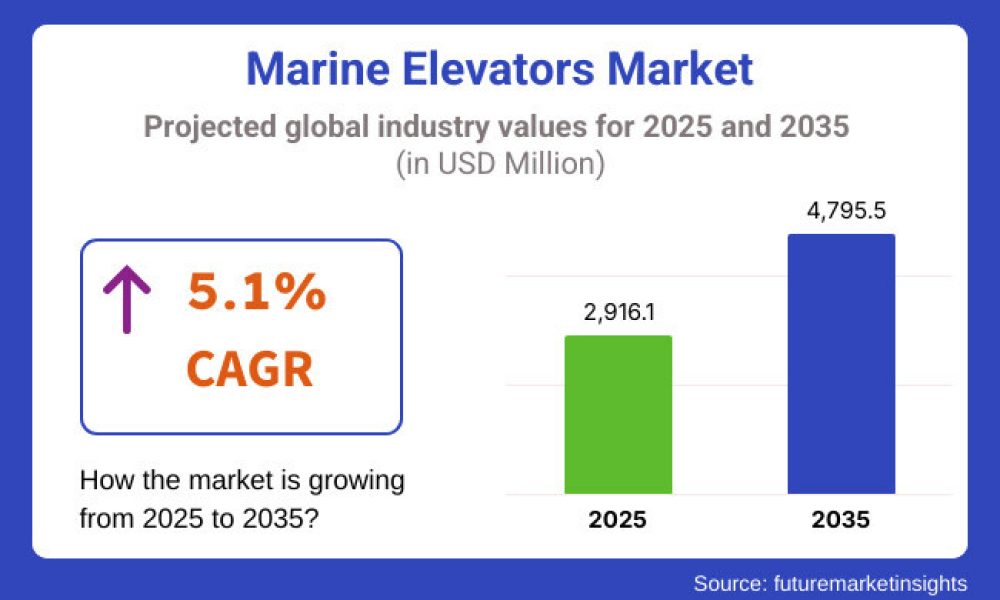
The Global Marine Elevators Market is projected to grow from USD 2,916.1 million in 2025 to USD 4,795.5 million by 2035, registering a CAGR of 5.1% during the forecast period. This steady growth is powered by rising investments in naval modernization programs, smart automation systems, and the expansion of commercial and defense shipbuilding industries across major maritime regions such as the United States, Europe, Asia-Pacific, and Saudi Arabia.
Marine elevators, essential for vertical transport in ships, submarines, and offshore vessels, play a crucial role in ensuring crew safety, operational efficiency, and cargo handling precision. As global fleets become more technologically advanced, marine elevators are evolving from traditional hydraulic units into AI-enabled, IoT-integrated systems designed to meet modern naval and commercial demands.
Modernization of Naval Fleets and Maritime Infrastructure Fuels Growth
The modernization of naval fleets in the U.S., China, India, and Western Europe is significantly boosting the demand for high-efficiency aircraft and ammunition elevators. These systems are critical for managing aircraft, weapons, and logistics onboard advanced defense ships.
Aircraft carriers remain the largest market segment, with next-generation designs incorporating automated load management, predictive maintenance algorithms, and vibration-control technologies to ensure operational readiness and deck efficiency.
Subscribe for Year-Round Insights → Stay ahead with quarterly and annual data updates
https://www.futuremarketinsights.com/reports/sample/rep-gb-13966
Additionally, the expansion of cruise tourism, offshore energy projects, and commercial shipping continues to propel installations of marine elevators for crew, cargo, and equipment handling. The integration of intelligent control systems, digital twin simulations, and AI-based diagnostics further enhances safety and serviceability in harsh marine conditions.
Regional Market Insights
North America: Defense Modernization and Automation Lead the Way
The U.S. and Canada dominate North American demand, backed by major naval upgrade programs and offshore energy initiatives. Strict safety standards set by the U.S. Coast Guard and American Bureau of Shipping (ABS) are driving adoption of marine elevators with advanced safety interlocks, corrosion-resistant materials, and predictive maintenance features.
With automation reshaping ship operations, North American manufacturers are investing in AI-powered elevator control systems and modular retrofit solutions to extend the lifespan of existing fleets.
Europe: Technological Excellence and Green Compliance
Germany, Norway, France, Italy, and the UK continue to lead the European market through innovations in energy-efficient, environmentally compliant marine elevator systems. Europe’s strong shipbuilding base in luxury cruise ships, offshore wind installations, and naval vessels fuels steady elevator demand.
EU sustainability directives are encouraging the use of low-energy regenerative drives and eco-friendly hydraulic fluids, making Europe a hub for green marine elevator innovation.
Asia-Pacific: Fastest-Growing Market with Shipbuilding Supremacy
China, Japan, and South Korea anchor the world’s largest shipbuilding ecosystem, creating immense opportunities for marine elevator manufacturers. These countries are witnessing rapid uptake of smart, durable elevator systems in commercial ships, LNG carriers, and naval platforms.
Meanwhile, Southeast Asia’s growing cruise tourism and port infrastructure in Singapore and the Philippines is further stimulating demand. The region’s focus on cost-efficient production is pushing suppliers toward lightweight, corrosion-proof, and modular elevator solutions.
Saudi Arabia and the Middle East: Emerging Maritime Powerhouse
Under Vision 2030, Saudi Arabia is developing advanced naval and port infrastructure, opening new avenues for marine elevator suppliers. The demand for crew transfer, maintenance, and logistic elevators is surging alongside new shipyard projects and offshore expansion.
Manufacturers are collaborating with local shipbuilders to deploy IoT-based elevators with smart diagnostics—a key step in transforming the Middle East into a modern maritime hub.
Challenges and Emerging Opportunities
Challenge: Marine elevators must withstand salt corrosion, humidity, vibration, and high service demands, making durability and maintenance major cost concerns. Repair logistics at sea further complicate system upkeep.
Opportunity: The rise of AI-driven predictive maintenance, IoT-enabled monitoring, and regenerative braking systems presents opportunities for long-term operational savings and safety improvements.
Sustainability initiatives and hybrid-electric actuation technologies are also creating new growth frontiers in green ship design.
Market Segmentation Insights
- By Product Type:
- Aircraft Lifts — Largest and fastest-growing segment, vital for naval aviation operations.
- Ammunition Lifts — Increasingly adopted in modern defense ships for secure, high-speed ordnance handling.
- By Ship Type:
- Aircraft Carriers — Dominant segment driven by advanced naval aviation and fleet modernization.
- Aircraft Cruisers — Growing adoption in multi-role vessels with integrated lift logistics.
- By Sales Channel:
- OEM Installations dominate, though aftermarket retrofits are expanding with modernization efforts.
Country-Level Outlook (CAGR, 2025–2035)
- USA: 5.0% – Fueled by naval expansion and cruise ship retrofits.
- UK: 5.2% – Supported by Royal Navy modernization and offshore wind initiatives.
- European Union: 5.3% – Driven by sustainability mandates and luxury vessel production.
- Japan: 5.0% – Strong shipbuilding and advanced marine automation adoption.
- South Korea: 5.4% – Supported by government-backed smart shipbuilding programs.
Competitive Landscape
The global market is moderately consolidated, with key players focusing on automation, defense-grade safety, and reliability:
- L3Harris Technologies Inc. (30–35%) – Specializes in high-load naval elevators and submarine systems emphasizing automation and durability.
- PaR Systems LLC (20–25%) – Engineering precision marine elevators with robotic and AI-based controls for naval and commercial use.
- MacTaggart Scott (15–20%) – Provides certified elevator systems for aircraft carriers and submarines across global defense fleets.
- Other Key Players: Thyssenkrupp Marine Systems, TTS Group ASA, MacGregor (Cargotec), Schindler Marine, and Hütter GmbH — offering modular, luxury, and offshore-grade elevator systems for both defense and commercial vessels.
Tailor Your Solution: Request Customization for Your Unique Needs!
https://www.futuremarketinsights.com/customization-available/rep-gb-13966
Future Outlook: Smarter, Safer, and Sustainable
Between 2025 and 2035, the Marine Elevators Market will transition toward AI-integrated automation, digital twin simulations, and green hydraulic systems, redefining shipboard mobility.
As smart shipping and naval digitalization advance across the USA, Europe, APAC, and Saudi Arabia, marine elevators will evolve from mechanical components into connected, intelligent systems—enhancing safety, efficiency, and sustainability at sea.
Have a specific Requirements and Need Assistant on Report Pricing or Limited Budget please contact us – [email protected]
About Future Market Insights (FMI)
Future Market Insights, Inc. (FMI) is an ESOMAR-certified, ISO 9001:2015 market research and consulting organization, trusted by Fortune 500 clients and global enterprises. With operations in the U.S., UK, India, and Dubai, FMI provides data-backed insights and strategic intelligence across 30+ industries and 1200 markets worldwide.



