
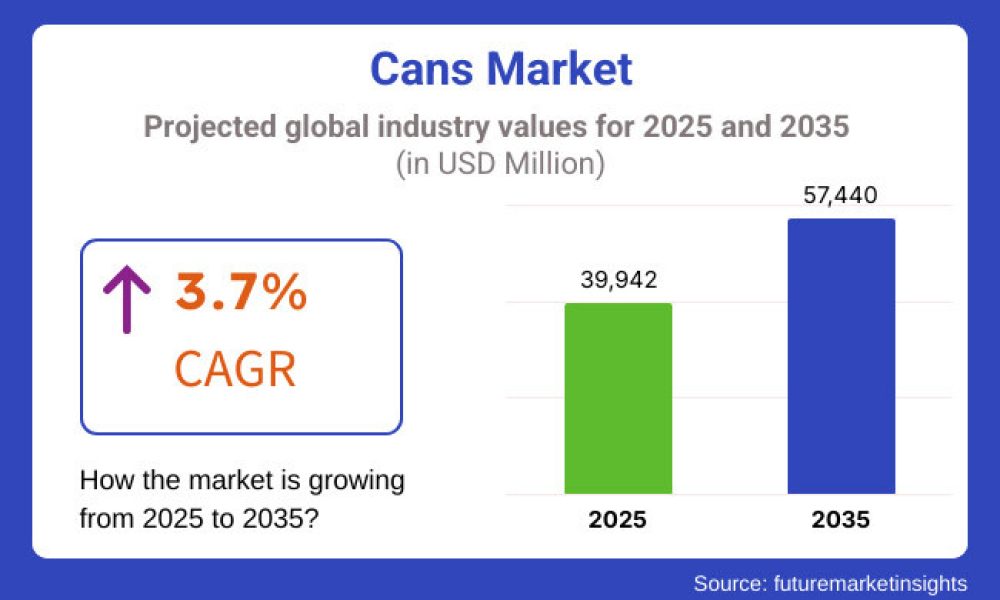
The global cans market is entering a transformative decade, projected to surge from $58.2 billion in 2025 to $93.0 billion by 2035, registering a CAGR of 4.8%. This growth is fueled by rising demand for recyclable packaging, innovations in can formats, and strategic shifts in regional consumption patterns. Aluminium and steel cans continue to dominate due to their lightweight, cost-effective, and eco-friendly properties, while plastic and paper composite variants are gaining traction in niche applications.
Key Market Insights at a Glance
- Market Size: $58.2 billion (2025) → $93.0 billion (2035)
- CAGR: 4.8% over the forecast period
- Top Material: Aluminium (48.6% market share)
- Leading Closure Type: Pull-tab cans (54.2% share)
- Primary End-Use Sectors: Food & beverages, pharmaceuticals, personal care
Segment Overview
The market is segmented by material type, closure type, and end-use industry. Aluminium cans lead the pack, favored for their recyclability and durability. Steel cans follow closely, especially in industrial and bulk packaging. Pull-tab closures dominate due to convenience and tamper-evidence, while screw-top and snap-on variants are gaining ground in premium segments. Food and beverage applications account for the lion’s share, with growing adoption in ready-to-drink, canned meals, and energy drinks.
Regional Overview
- North America: The U.S. and Canada are witnessing a resurgence in canned beverages, driven by craft beer and functional drinks. Sustainability mandates and consumer preference for recyclable packaging are accelerating aluminium can adoption.
- Europe: Stringent environmental regulations and circular economy goals are pushing manufacturers toward lightweight, low-carbon cans. Germany, France, and the UK are leading innovation in smart labelling and traceability.
- APAC: China and India are emerging as high-growth markets, with expanding middle-class consumption and urbanization. Local production hubs and export-oriented strategies are boosting regional competitiveness.
- Middle East & Saudi Arabia: The region is investing in sustainable packaging infrastructure, with Saudi Arabia positioning itself as a key manufacturing base for aluminium cans targeting food and pharma exports.
Competitive Landscape
The cans market is highly consolidated, with global players focusing on capacity expansion, material innovation, and strategic partnerships. M&A activity is intensifying, especially in emerging markets where regional players are scaling up to meet demand. Key players are investing in digital printing, smart labelling, and lightweighting technologies to differentiate offerings and meet evolving regulatory standards.
Key Players of Sustainable Label Industry
Sustainability is no longer optional—it’s a competitive imperative. Leading companies in the sustainable label space are integrating eco-friendly inks, biodegradable adhesives, and blockchain-enabled traceability into can packaging. These innovations are enhancing brand transparency and consumer trust, particularly in food and pharma segments. Players pioneering this shift include those specializing in smart labels, RFID-enabled tracking, and carbon-neutral packaging solutions.
Recent Strategic Developments
- Major manufacturers are expanding production facilities in APAC and the Middle East to tap into cost efficiencies and regional demand.
- Investments in AI-driven quality control and automation are streamlining operations and reducing waste.
- Partnerships with beverage brands are driving co-development of custom can formats and smart closures.
- Sustainability certifications and lifecycle assessments are becoming standard practice across the supply chain.
Market Outlook: Powering the Next Decade
The next ten years will redefine the cans market through a blend of sustainability, smart segmentation, and regional agility. As consumer preferences shift toward eco-conscious choices and governments tighten packaging regulations, manufacturers must innovate across materials, formats, and supply chains. The rise of smart cans—integrating QR codes, freshness indicators, and interactive branding—will further elevate consumer engagement and traceability.
In this dynamic landscape, agility, innovation, and sustainability will be the cornerstones of market leadership. The cans market is not just growing—it’s evolving into a smarter, greener, and more connected ecosystem.
To access the complete data tables and in-depth insights, request a sample report here: https://www.futuremarketinsights.com/reports/sample/rep-gb-15563
Full Market Report Available for Delivery. For Purchase or Customization, Please Request Here: https://www.futuremarketinsights.com/checkout/15563
Have a specific Requirements and Need Assistant on Report Pricing or Limited Budget please contact us – [email protected]
About Future Market Insights (FMI)
Future Market Insights, Inc. (FMI) is an ESOMAR-certified, ISO 9001:2015 market research and consulting organization, trusted by Fortune 500 clients and global enterprises. With operations in the U.S., UK, India, and Dubai, FMI provides data-backed insights and strategic intelligence across 30+ industries and 1200 markets worldwide.



