
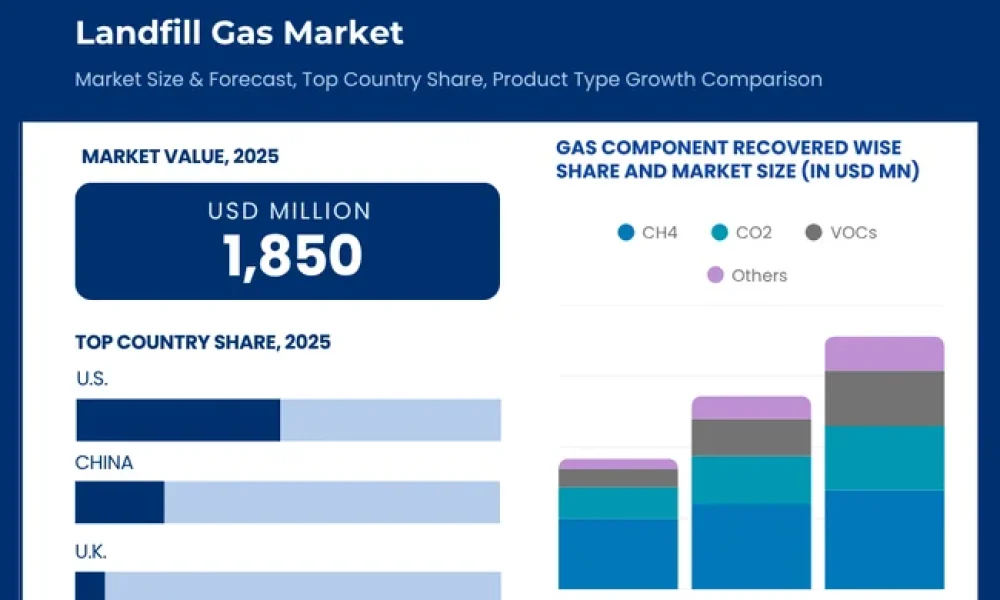
The global landfill gas (LFG) market is projected to expand from approximately USD 1.70 billion in 2024 to about USD 4.11 billion by 2035, representing a compound annual growth rate (CAGR) of roughly 8.3% over the forecast period. Growth is driven by stringent emission legislation targeting methane, increasing demand for renewable energy sources, and rising volumes of municipal solid waste underpinning larger landfill gas feed-stocks.
Landfill gas recovery and utilisation—including electricity generation, pipeline injection, combined heat & power, and vehicle fuel applications—are increasingly gaining traction. Municipalities, utilities and waste-management companies are recognising landfill gas as a cost-effective, scalable renewable energy pathway while simultaneously addressing climate-change mitigation via methane capture.
Key Market Insights at a Glance
Market Value (2024): ~USD 1.70 billion
Forecast Value (2035): ~USD 4.11 billion
CAGR (2025–2035): ~8.3%
Dominant Gas Component: Methane (CH₄) recovery remains central to value, given its high energy and environmental potential
Leading Application Segment: Electricity generation (largest share)
Key Growth Regions: North America (leading share), followed by Europe and Asia-Pacific (fastest growth)
Prominent Players: Waste Management Inc.; Veolia Environment S.A.; SUEZ; Tetra Tech Inc.; Aria Energy Corp.; Covanta Holding Corporation
To Access the Complete Data Tables & in-depth Insights, Request a Discount on this report: https://www.factmr.com/connectus/sample?flag=S&rep_id=429
Market Drivers / Growth Overview
Several factors are accelerating growth in the landfill gas market:
Regulatory Pressure and Environmental Mandates: Governments are tightening limits on methane and other landfill emissions, and offering incentives such as tax credits, feed-in tariffs, and renewable identification numbers (RINs) to promote landfill gas-to-energy projects.
Rising Waste Volumes and Urbanisation: In many regions, municipal solid waste volumes continue to increase, feeding larger and more persistent landfill gas streams which improve project economics and attractiveness.
Energy Diversification and Renewable Integration: Landfill gas is becoming a valued link between waste-management and energy sectors, offering a dispatchable renewable energy source which complements intermittent sources such as solar and wind.
Technology Evolution: Improvements in gas collection systems, purification (for pipeline-injection/vehicle-fuel use), and modular gas-to-energy schemes lower cost and raise feasibility of projects across more landfill sizes and geographies.
Industrial & Utility Use-Cases: Beyond electricity generation, landfill gas is increasingly used in combined heat & power (CHP), direct thermal applications and as renewable natural gas (RNG) injected into pipelines or used in transport fuel, creating new value streams.
However, obstacles remain: higher upfront capital for gas-collection and purification infrastructure, variable gas-yield and composition between sites, regulatory differences across jurisdictions and competition from other renewables. These factors moderate growth but do not offset the positive structural trends.
Segmentation & Key Drivers
By Technology: Thermal technologies (combustion engines, turbines, pyrolysis/gasification) dominate in electricity generation applications. Biochemical technologies (anaerobic digestion) and mechanical technologies (gas collection and conditioning systems) are also key.
By Gas Component Recovered: Methane is the primary target given its energy value and climate-impact reduction potential. Carbon dioxide (CO₂) and volatile organic compounds (VOCs) also contribute scope for recovery/abatement.
By Application:
Electricity Generation – largest share given compatibility with grid systems and landfill-site integration.
Direct Use – thermal applications, boilers, leachate evaporation.
Vehicle Fuel / Pipeline Injection – growing rapidly with the RNG trend.
By End-Use Industry: Utilities/power producers, industrial manufacturing, commercial facilities, municipal operations and transportation.
By Region: North America leads; Europe and Asia-Pacific show faster growth. Key drivers include regulatory regimes, waste infrastructure, and energy transition policies.
Segmentation growth is influenced by site-scale economics, availability of infrastructure (grid, pipeline), policy support for renewable gas/fuel, and regional landfill characteristics (size, waste composition, age).
Regional & Country Insights
North America: Maintains leadership position thanks to mature landfill-gas infrastructure, supportive policy environment and large waste-management industry.
Europe: Steady growth backed by strong decarbonisation agendas, feed-in tariffs, and circular-economy strategies linking waste and energy sectors.
Asia-Pacific: Fastest growth region, driven by rapid urbanisation, rising waste generation, and increasing focus on landfill-gas-to-energy projects in China, India and Southeast Asia.
Latin America / Middle East & Africa: Emerging opportunity with increasing landfill-gas-project development, though from lower base due to infrastructure and financing constraints.
Competitive Landscape
The landfill gas market is moderately concentrated with global waste-management and energy‐services firms leading. Key players include Waste Management Inc., Veolia Environment S.A., SUEZ, Tetra Tech Inc., Aria Energy Corp., Covanta Holding Corporation. These companies offer end-to-end services including gas-collection, purification, energy conversion and site operations. Strategy focuses include securing landfill-gas contracts, expanding RNG capabilities, entering developing-region markets, and leveraging partnerships with utilities and municipalities.
Competitive differentiation is achieved via contract scale, financing models, technical expertise for challenging sites, modular/efficient gas-to-energy systems and ability to monetise multiple value streams (electricity + biomethane + carbon credits).
Recent Developments
Major landfill-gas expansions and RNG plant upgrades in the U.S. and Europe, enabling increased capacity and higher value recovery from existing sites.
Strategic investments by waste-management firms in RNG infrastructure and partnerships with utilities to inject purified landfill gas into natural-gas pipelines.
Technological deployment of advanced gas-purification systems enabling landfill-gas upgrading to pipeline-quality biomethane and vehicle-fuel use.
Growing interest in emerging markets with landfill-gas-to-energy pilots tied to public-private partnerships and donor infrastructure funding.
Market Outlook & Strategic Insights
Over the forecast period through 2035, the landfill gas market is set to expand strongly, albeit with some site-specific variability in economics and regulatory context. Key strategic priorities for stakeholders include:
Focusing on pipeline-quality biomethane (RNG) applications and integration into transport/industrial sectors to capture higher value-streams.
Targeting emerging markets where landfill gas collection and utilisation infrastructure is still under-penetrated and where waste-generation growth is high.
Enhancing site-optimisation and yield reliability through improved gas-collection systems, real-time monitoring and lease/contract structures that share risk between operators and landfill owners.
Forming strategic alliances with utilities, energy-off‐takers and waste-management firms to secure long-term offtake, financing and project-scale economies.
Capitalising on carbon-credit and carbon-emission-reduction frameworks to improve project paybacks and investment attractiveness.
Organizations that align with these strategic imperatives—while demonstrating robust project execution, regulatory compliance and cost-efficiency—are well positioned to capture substantial value in a market projected to exceed USD 4.11 billion by 2035.
Purchase Full Report for Detailed Insights
For access to full forecasts, regional breakouts, company share analysis, and emerging trend assessments, you can purchase the complete report: https://www.factmr.com/checkout/429
Have specific requirements or need assistance on report pricing or have a limited budget? Please contact [email protected]
Contact:
US Sales Office
11140 Rockville Pike
Suite 400
Rockville, MD 20852
United States
Tel: +1 (628) 251-1583, +353-1-4434-232
Email: [email protected]
About Fact.MR:
Fact.MR is a global market research and consulting firm, trusted by Fortune 500 companies and emerging businesses for reliable insights and strategic intelligence. With a presence across the U.S., UK, India, and Dubai, we deliver data-driven research and tailored consulting solutions across 30+ industries and 1,000+ markets. Backed by deep expertise and advanced analytics, Fact.MR helps organizations uncover opportunities, reduce risks, and make informed decisions for sustainable growth.



