
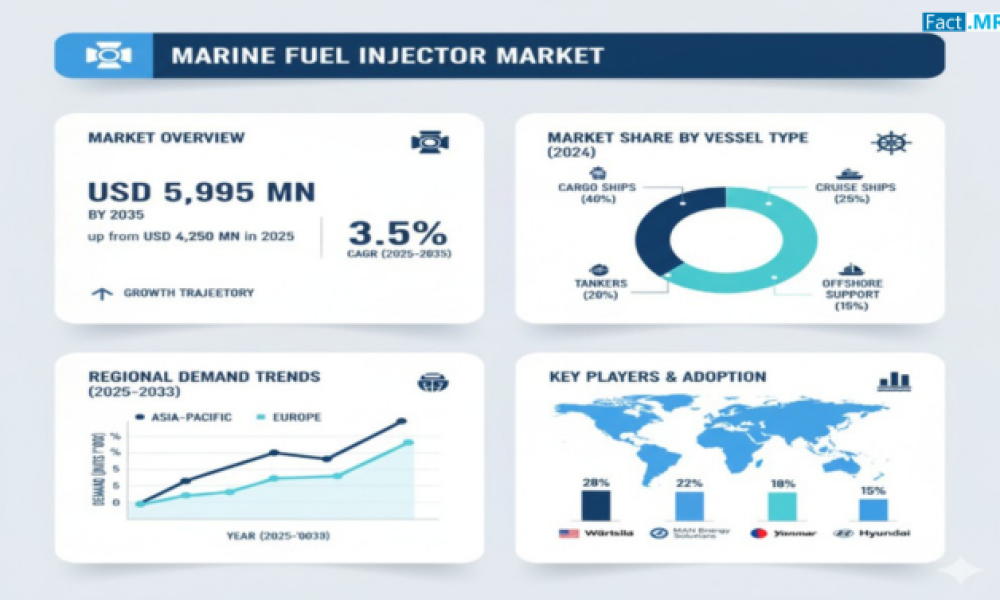
The global marine fuel injector market is poised for steady growth over the next decade, underpinned by rising seaborne trade, recreational marine activities, and advancements in fuel injection technologies. According to Fact.MR, the market is valued at USD 4.25 billion in 2025 and is projected to reach USD 5.99 billion by 2035, registering a compound annual growth rate (CAGR) of 3.5%.
The report, “Marine Fuel Injector Market: Global Forecast 2025–2035,” highlights the growing importance of fuel injectors in enhancing marine engine efficiency, reducing emissions, and supporting compliance with stringent environmental regulations. Marine fuel injectors, installed at the intake manifold before the inlet valve, ensure optimal atomization of fuel and a homogeneous air-fuel mixture, critical for both diesel and electric marine engines.
Technological Innovations Driving Growth
The market is witnessing a shift toward uncooled marine fuel injectors in diesel engines due to their higher energy efficiency, simplified maintenance, and lower operational costs. Concurrently, integration with digital monitoring systems and ESG-compliant designs is emerging as a key differentiator, enabling precise fuel management, predictive maintenance, and improved engine performance.
“Marine fuel injectors are evolving from mechanical components into intelligent systems,” said a Fact.MR analyst. “Advanced designs, combined with digital integration, are redefining operational efficiency across commercial, fishing, and passenger vessels.”
To access the complete data tables and in-depth insights, request a sample report here: Request Sample Report
Market Dynamics and Opportunities
The expansion of the global shipbuilding industry and increased seaborne trade are primary drivers, complemented by rising demand from recreational boating and personal watercrafts. Government regulations enforcing stricter emission norms are further boosting adoption. However, the growth of electric boats may limit conventional injector demand, prompting manufacturers to innovate and diversify product offerings.
Regional growth varies, with Asia Pacific leading due to major shipbuilding nations such as India, China, Japan, and South Korea. India is projected to grow at a CAGR of 7.1%, China at 6.2%, the U.S. at 3.9%, and Germany at 3.5%. Europe and Oceania are also significant contributors due to the expansion of recreational marine activities.
Segment Insights
- Engine Capacity:Injectors for engines above 2000 HP are gaining traction for commercial and cargo applications, while engines up to 500 HP dominate recreational segments.
- Engine Type:Four-stroke engines remain predominant, though two-stroke engines continue to maintain relevance in smaller vessels.
- Application:Passenger vessels, fishing vessels, cargo carriers, and personal watercraft are key end-use segments, with recreational and service vessels showing fastest growth.
- Injector Type:Uncooled fuel injectors are preferred for energy efficiency and ease of maintenance, while cooled injectors serve high-performance, heavy-duty applications.
Regional Overview
- North America:Moderate growth, driven by cruise and cargo fleet modernization.
- Europe:Steady adoption in Germany, U.K., and Nordic countries due to regulatory compliance and technological upgrades.
- Asia Pacific:Fastest-growing market; major shipbuilding nations and rising recreational marine activity drive demand.
- Oceania:Growth in tourism and recreational boating supports injector sales.
- Middle East & Africa:Emerging demand in GCC countries and South Africa, primarily for commercial marine fleets.
Competitive Landscape
Leading manufacturers include TWINCO PTE LTD., Woodward Inc., Cummins Inc., Liebherr International AG, Robert Bosch GmbH, Caterpillar Inc., Denso Corporation, Delphi Automotive PLC, Rolls-Royce Holding PLC, and ANSU Corporation Europe Ltd. Companies focus on R&D, technological integration, and ESG-aligned designs to maintain a competitive edge in a consolidated market.
Market Outlook
Over the next decade, the marine fuel injector market is expected to embrace digital integration, sustainability, and enhanced efficiency. Growth will be driven by rising commercial fleets, recreational vessels, and innovations in injector technology. Manufacturers leveraging automation, predictive analytics, and emission-compliant designs are poised to lead the next phase of market evolution.
“Marine fuel injectors are becoming pivotal in achieving both operational efficiency and environmental compliance,” added the Fact.MR analyst. “The future belongs to manufacturers that innovate across technology, sustainability, and digital integration.”
Purchase Full Report for Detailed Insights
For access to full forecasts, regional breakouts, company share analysis, and emerging trend assessments, you can purchase the complete report here: Access Full Report – Marine Fuel Injector Market
About Fact.MR
Fact.MR is a global market research and consulting firm, trusted by Fortune 500 companies and emerging businesses for reliable insights and strategic intelligence. With a presence across the U.S., UK, India, and Dubai, we deliver data-driven research and tailored consulting solutions across 30+ industries and 1,000+ markets. Backed by deep expertise and advanced analytics, Fact.MR helps organizations uncover opportunities, reduce risks, and make informed decisions for sustainable growth.



