
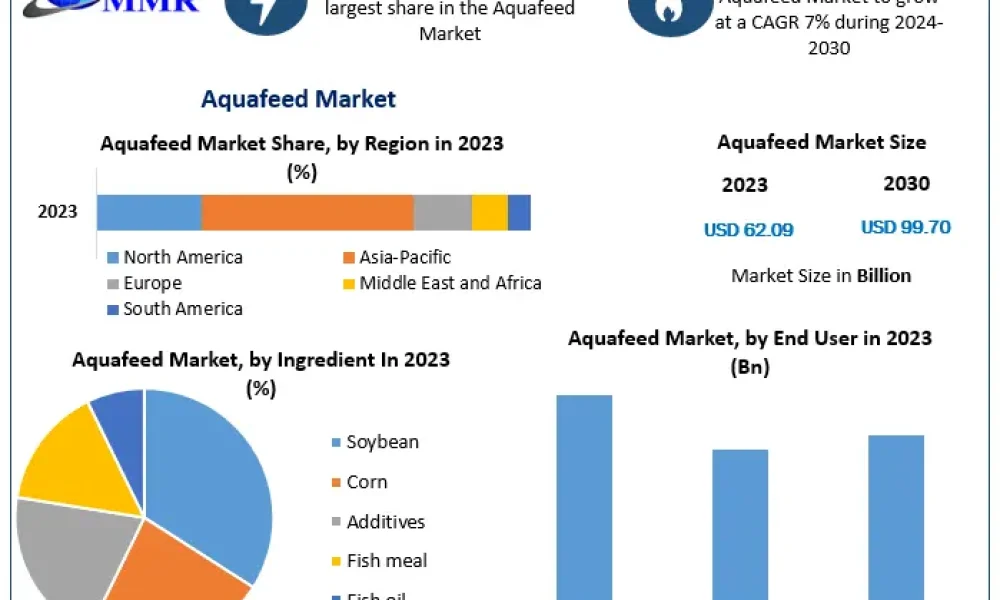
Aquafeed Market Overview:
Aquafeed Market, valued at USD 183 billion in 2024, is expected to grow robustly to USD 376 billion by 2033, reflecting a CAGR of approximately 7.46%. Asia Pacific emerges as the largest and fastest-growing regional market, propelled by rapid urbanization, population growth, rising seafood consumption, and extensive government support incentivizing sustainable aquaculture practices.
Key Highlights & Insights
Market Size & Growth: The aquafeed market stood at USD 183 billion in 2024 and is projected to reach USD 376 billion by 2033, growing at a CAGR of 7.46%.
Dominating Region: Asia Pacific holds the highest market share due to its vast aquaculture production, especially in China, India, Vietnam, and Indonesia. The region accounts for over 53% of revenue and more than 58% of global consumption.
Leading Segment: Fish segment dominates the end-user category, driven by the low-cost, high-protein value of fish feed and increased fish farming activities supported by Recirculating Aquaculture Systems (RAS) and aquaponics.
Key Driver: Rising consumer demand for seafood, government initiatives like India’s Blue Revolution Scheme, technological advancements in feed formulations, and increasing adoption of plant-based protein sources such as soybean meal in feeds stimulate the market growth.
Request a Free Sample Copy or View Report Summary:https://www.maximizemarketresearch.com/request-sample/31756/
Recent Developments
2024-2025: Major companies including Archer Daniels Midland Company, Cargill, Alltech, and Nutreco have expanded production capacities and invested heavily in R&D for sustainable feed ingredients and precision feeding technologies.
Governments in Asia Pacific have initiated subsidies and programs supporting sustainable aquaculture and feed safety.
Innovations focus on replacing fishmeal with plant protein alternatives (e.g., soybean meal) to reduce environmental impact.
The adoption of probiotics, enzymes, and feed acidifiers in feed improves digestion, feed conversion ratio, and overall aquatic animal health.
Market Dynamics
Growth Drivers:
Accelerated urbanization and increased protein demand are boosting seafood consumption globally.
Technology-driven improvements in feed quality enhance production efficiency and sustainability.
Environmental concerns and fishmeal price volatility push industry toward alternative, eco-friendly feed ingredients.
Expanding aquaculture in emerging economies driven by government policies and market investments.
Challenges:
Dependence on fishmeal and fish oil with fluctuating availability and prices.
Disease outbreaks in aquaculture impacting feed demand and supply stability.
Supply chain disruptions caused by trade restrictions and global economic factors.
Opportunities:
Introduction of novel feed ingredients including algae, insect protein, and microbial biomass.
Application of AI and IoT for precision aquafeed feeding optimization.
Expansion of ornamental fish culture markets creating niche feed demand.
Growth in aquaponics and recirculating systems increasing feed complexities and opportunities.
Regional Analysis
Asia Pacific: The largest and fastest growing market with significant production of carp, tilapia, shrimp, and other aquatic species. Rising per capita fish consumption and urbanization are key growth enablers.
North America: Growing with increased demand for seafood and strong R&D investments by key feed companies.
Europe: Focus on sustainable and certified aquafeeds backed by stringent regulatory frameworks.
Latin America and Middle East & Africa: Emerging markets benefiting from developing aquaculture sectors and improved infrastructure.
Product Segmentation
By Ingredient: Soybean meal (largest), corn, fishmeal, fish oil, additives such as antibiotics, vitamins, amino acids, enzymes.
By End User: Fish (largest share), mollusks, crustaceans.
By Additives: Antibiotics, vitamins, antioxidants, amino acids, feed enzymes, acidifiers.
Key Trends
Shift toward plant-based and alternative proteins to reduce dependence on marine resources.
Increased use of functional additives to improve immunity and feed digestibility.
Growth in sustainable and organic-certified aquafeed products.
Adoption of smart feeding technologies integrating AI and IoT for better feed management.
Expansion of aquaculture into less conventional species requiring specialized feeds.
Quote
“Asia Pacific’s dominance in the aquafeed market is a testament to the region’s unparalleled aquaculture output and commitment to sustainable production innovation. As seafood demand climbs globally, advancements in feed technology and environmental stewardship will continue to drive this essential industry.”
About Maximize Market Research:
Maximize Market Research is a multifaceted market research and consulting company with professionals from several industries. Some of the industries we cover include medical devices, pharmaceutical manufacturers, science and engineering, electronic components, industrial equipment, technology and communication, cars and automobiles, chemical products and substances, general merchandise, beverages, personal care, and automated systems. To mention a few, we provide market-verified industry estimations, technical trend analysis, crucial market research, strategic advice, competition analysis, production and demand analysis, and client impact studies.
Contact Maximize Market Research:
3rd Floor, Navale IT Park, Phase 2
Pune Banglore Highway, Narhe,
Pune, Maharashtra 411041, India
+91 96071 95908, +91 9607365656




