
Market Overview and Growth Drivers
The global fiber reinforced concrete market is on a compelling trajectory, expected to expand from US$ 3.8 billion in 2025 to US$ 5.9 billion by 2032, representing a steady compound annual growth rate (CAGR) of 6.4 %. This consistent uptrend underlines the rising prominence of FRC in contemporary construction, infrastructure, and sustainability-driven engineering. In this blog, we explore the major trends, drivers, challenges, segmentation, regional dynamics, and key companies shaping the FRC landscape.
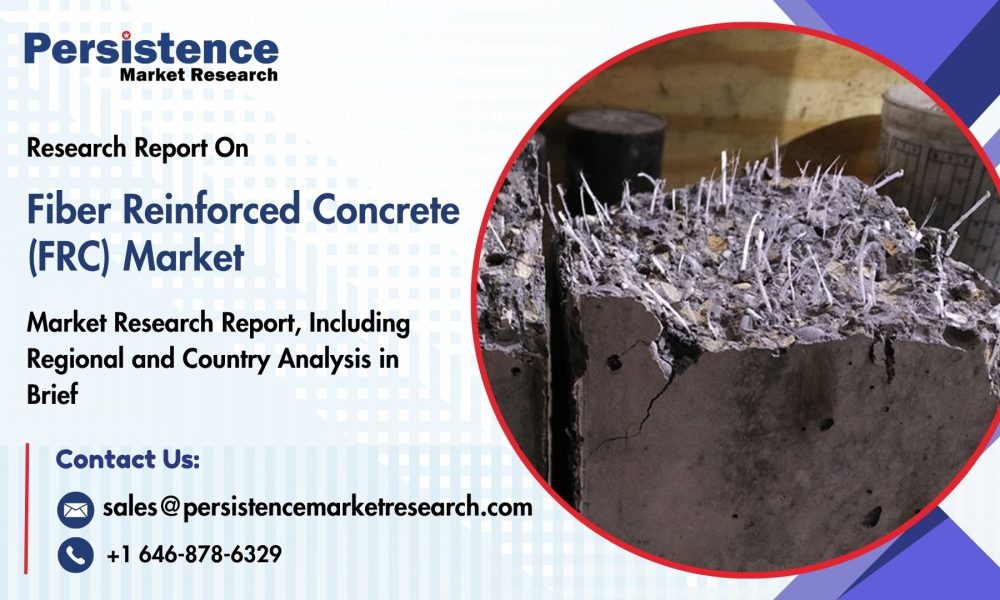
Fiber reinforced concrete blends conventional concrete with discrete fibers—such as steel, glass, synthetic, or natural fibers—to improve mechanical properties, crack control, toughness, and durability. Over recent years, the appeal of FRC has grown in tandem with global infrastructure needs and evolving design expectations.
One of the most significant drivers is the rapid expansion of infrastructure and urban development across emerging and mature markets. Governments are investing heavily in roads, bridges, tunnels, airports, and smart-city initiatives—projects that demand materials with better longevity, reduced maintenance, and higher performance under load.
Meanwhile, sustainability has become a prime concern in the construction sector. FRC supports green building goals because it can reduce the reliance on conventional steel reinforcement, enable thinner sections (hence lower embodied carbon), and extend service life—thereby minimizing repair cycles and waste.
Get a Sample PDF Brochure of the Report (Use Corporate Email ID for a Quick Response): https://www.persistencemarketresearch.com/samples/35276
Other important growth enablers include:
- Volatility in rebar / steel costs: In some regions, FRC offers a hedge against fluctuating steel prices by partially replacing rebar content.
- Adoption of precast & modular construction methods: Off-site prefabrication increasingly demands reliable, crack-resistant materials, and FRC fits well into that trend.
- Technological advances & fiber innovations: Better dispersion techniques, novel synthetic fibers, hybrid fiber mixes, and integration into 3D-printed concrete are opening new possibilities.
- Stricter building standards and low-carbon mandates: Green building codes and low-embodied-carbon requirements are pushing adoption of higher-performance mixes like FRC.
Nonetheless, the market is not without headwinds. Steel fiber costs can be volatile, and fiber-reinforced formulations often carry a price premium compared to standard mixes. Moreover, in regions with limited awareness or technical capacity, adoption remains slow.
Segmentation Insights
Understanding how the market breaks down is key to spotting opportunities. The FRC market can be segmented along several dimensions:
- By Fiber Type
- Steel fibers dominate, thanks to superior tensile strength, crack resistance, and structural benefit in heavy-load applications (bridges, industrial floors, tunnels).
- Polypropylene, glass, synthetic macro fibers, or hybrid mixes are used more in non-structural or specialty uses, offering a balance between cost and performance.
- Emerging fiber types (carbon-based, bio-based, recycled fibers) are under R&D for more sustainable or high-performance applications.
- By Application / End Use
- Structural uses (bridges, slabs, tunnels) often command premium use of high-performance fibers.
- Non-structural applications (architectural elements, aesthetic facades, interior surfaces) are growing, especially where crack control and surface finish matter.
- Specialty uses (blast-resistant structures, marine environments, repair and rehabilitation) also present niche growth pockets.
- By Construction Method
- Precast concrete is a leading method, benefiting from faster construction and easier quality control of fiber mixes.
- Cast-in-place (in-situ) methods are also rising, especially in projects where onsite pouring is more practical.
- Shotcrete and sprayed concrete also benefit from fiber reinforcement, especially in repair, tunneling, and slope stabilization.
- By Region / Geography
- Asia-Pacific is often projected to be the fastest-growing region, propelled by heavy infrastructure spending in China, India, and Southeast Asia.
- North America and Europe continue to adopt FRC steadily due to stringent standards and refurbishment demand.
- Other regions like Latin America, Middle East & Africa are gradually picking up, particularly in urbanizing countries with infrastructure expansion.
Regional Dynamics & Outlook
In Asia-Pacific, the combination of rapid urbanization, massive infrastructure plans (roads, metro, airports), and climate-resilient design focus gives FRC strong tailwinds. Governments in India and China, in particular, are channeling capital into highway and smart-city programs which favor durable, high-performance materials.
Europe remains a mature and innovation-driven market. Its regulatory environment, emphasis on sustainability, and demand for infrastructure renewal support the uptake of fiber-reinforced concrete. One report suggests Europe holds over 35% share in the concrete fiber domain.
In North America, renovation of aging infrastructure and new green-building mandates are fueling demand. The U.S. “infrastructure push” and regulatory incentives for durable, low-maintenance materials help FRC adoption.
Developing regions (Latin America, Middle East, Africa) are more uneven in adoption but present rising opportunities as new highway projects, urban housing, and industrial expansion take off.
For Customized Insights on Segments, Regions, or Competitors, Request Personalized Purchase Options: https://www.persistencemarketresearch.com/request-customization/35276
Company Insights
The competitive landscape in the FRC market includes global chemical, materials, fiber, and admixture firms. Below are some of the key players operating in the space (not exhaustive) with major presence or influence:
✦ BASF SE
✦ Sika AG
✦ Bekaert
✦ CEMEX S.A.B. de C.V.
✦ ABC Polymer Industries, LLC
✦ Nycon / Nycon Fibers
✦ GCP Applied Technologies
✦ Master Builders Solutions
✦ Propex Operating Company
✦ Owens Corning
These companies often lead in R&D, regional penetration, supply chain integration, fiber or admixture technology, and strategic partnerships.
Many of these firms also channel investments towards sustainable fiber technologies, localized production expansion, and tailored fiber-concrete systems for specific climates and seismic zones.
Challenges & Restraints
While the growth prospects are solid, the FRC market faces certain constraints:
- High cost of fiber materials – particularly steel fibers — and fluctuations in raw material prices can raise mix costs.
- Technical and mix-design complexity – ensuring uniform fiber dispersion, compatibility with admixtures, and avoiding workability issues may deter adoption in less developed markets.
- Lack of awareness or technical capacity in some regions, especially small contractors, to optimize fiber-concrete design.
- Competition from alternative reinforcement technologies, novel composites, or ultra-high-performance concretes.
- Regulatory inertia or inertia in building codes may slow faster adoption in some geographies.
Outlook & Strategic Considerations
Given the projected growth from US$ 3.8 billion (2025) to US$ 5.9 billion (2032), the FRC market offers ample opportunity—but success will depend on execution and innovation.
- Tailoring fiber-concrete systems to local climates, seismic zones, and materials availability will be crucial.
- Lowering cost by optimizing fiber dosage, hybrid fiber blends, or localized fiber production can improve competitiveness.
- Partnering with precast and modular construction firms can accelerate uptake.
- Emphasizing sustainability credentials—as FRC reduces life-cycle maintenance, carbon, and waste—can resonate with clients and regulators.
- Investing in R&D for novel fibers (e.g. bio-based, carbon, recycled) and improved mixing/dispersion technologies will provide differentiation.
- Educating local construction firms, engineers, municipalities about performance benefits and cost trade-offs will help drive market growth in underpenetrated areas.
In sum, fiber reinforced concrete is well-positioned to play a transformative role in modern infrastructure and sustainable construction. With global investment in resilient, long-lasting structures rising, the FRC market stands to deliver both technical advantage and business opportunity in the coming decade.
Explore the Latest Trending Research Reports:
About Persistence Market Research:
At Persistence Market Research, we specialize in creating research studies that serve as strategic tools for driving business growth. Established as a proprietary firm in 2012, we have evolved into a registered company in England and Wales in 2023 under the name Persistence Research & Consultancy Services Ltd. With a solid foundation, we have completed over 3600 custom and syndicate market research projects, and delivered more than 2700 projects for other leading market research companies’ clients.
Our approach combines traditional market research methods with modern tools to offer comprehensive research solutions. With a decade of experience, we pride ourselves on deriving actionable insights from data to help businesses stay ahead of the competition. Our client base spans multinational corporations, leading consulting firms, investment funds, and government departments. A significant portion of our sales comes from repeat clients, a testament to the value and trust we’ve built over the years.
Contact Us:
Persistence Market Research
G04 Golden Mile House, Clayponds Lane
Brentford, London, TW8 0GU UK
USA Phone: +1 646-878-6329
UK Phone: +44 203-837-5656
Email: [email protected]
Web: https://www.persistencemarketresearch.com




