
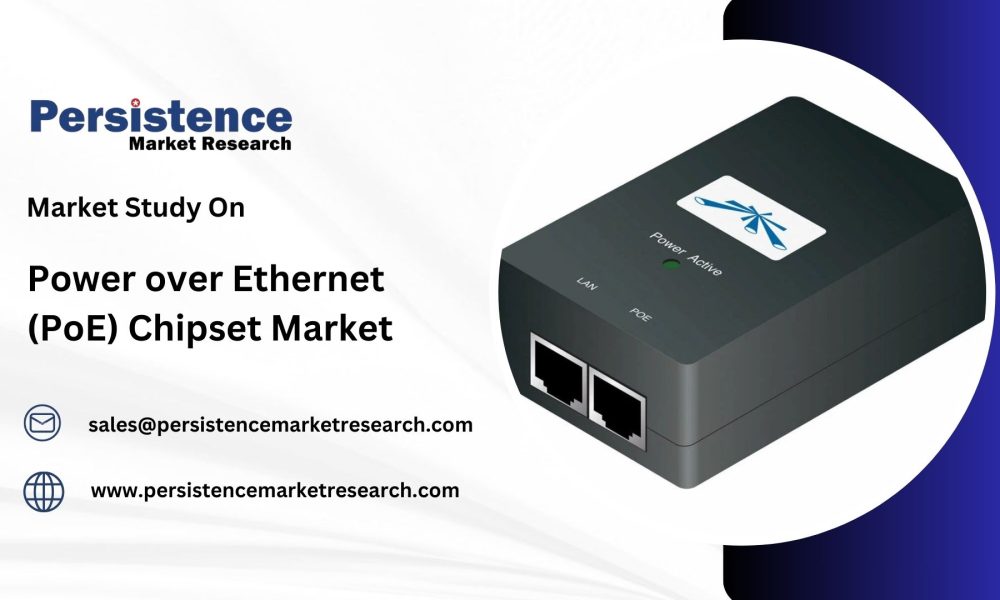
The global power over Ethernet (PoE) chipset market is gaining remarkable traction as enterprises, smart building developers, and IoT solution providers increasingly rely on efficient and cost-effective networking solutions. According to industry estimates, the PoE chipset market is anticipated to be valued at US$659.1 million in 2024 and projected to reach US$1,225.1 million by 2031, expanding at a CAGR of 9.6% during the forecast period (2024–2031).
This steady growth reflects the rising adoption of smart infrastructure, industrial automation, advanced surveillance, and IoT ecosystems—all of which demand seamless integration of power and data through a single cable infrastructure. As the global digital economy evolves, the PoE chipset industry is becoming an integral enabler of innovation.
What is Power over Ethernet (PoE)?
Power over Ethernet is a technology that allows electrical power and data signals to be transmitted simultaneously over standard Ethernet cables. Instead of using separate power lines, PoE enables devices such as IP cameras, wireless access points, VoIP phones, and IoT sensors to receive both power and data through a single Ethernet cable.
The heart of this system lies in PoE chipsets—the integrated circuits that manage power delivery, regulate voltage, and ensure efficient communication between the powered device (PD) and power sourcing equipment (PSE).
The growing adoption of PoE solutions is largely driven by its simplicity, cost savings, and scalability in both commercial and industrial environments.
Market Overview and Growth Drivers
Market Size and Forecast
- 2024 Market Value: US$659.1 million
- 2031 Projected Value: US$1,225.1 million
- CAGR (2024–2031): 9.6%
- Historical CAGR (2018–2023): 9.1%
This robust growth trajectory underlines how PoE technology is transitioning from niche applications to mainstream deployments across multiple industries.
Key Growth Drivers
- Smart Buildings and Infrastructure Development
Increasing adoption of smart lighting, HVAC controls, and IoT-enabled devices in commercial and residential buildings is fueling PoE demand. - Industrial Automation and Industry 4.0
Manufacturing facilities are embracing PoE to connect sensors, robotic systems, and control devices, streamlining operations and reducing wiring complexity. - Rise of IoT Ecosystems
The exponential growth of IoT devices requires flexible and efficient power solutions, making PoE chipsets indispensable. - Energy Efficiency and Sustainability
Chip manufacturers are focusing on energy-efficient PoE solutions that reduce power loss and align with renewable energy integration. - Cost-Effective Network Expansion
By eliminating separate electrical wiring, PoE enables faster and more affordable network deployments—an essential factor in urbanization and smart city projects.
Segment Analysis
The PoE chipset market can be segmented by type, device, application, and region.
By Type
- Powered Device (PD) Chipsets – These dominate the market as PoE-enabled devices such as IP cameras, wireless access points, and smart lighting systems become widespread.
- Power Sourcing Equipment (PSE) Chipsets – Used in Ethernet switches and injectors, PSE chipsets are experiencing steady growth as enterprises upgrade their networking infrastructure.
By Device
- IP Cameras – Security and surveillance systems rely heavily on PoE technology for easy deployment and uninterrupted power.
- Wireless Access Points (WAPs) – As Wi-Fi networks expand in enterprises, schools, and smart cities, PoE chipsets play a vital role in powering these devices.
- VoIP Phones – Unified communications continue to support PoE adoption, especially in enterprises and government offices.
- Smart Lighting Systems – A rapidly emerging segment in the PoE market, particularly in smart city and green building initiatives.
By Application
- Commercial Sector – Offices, hotels, educational institutions, and healthcare facilities are key adopters.
- Industrial Sector – Manufacturing plants and warehouses rely on PoE for automation.
- Residential Sector – Growth in smart home devices and security cameras contributes to rising demand.
Regional Insights
The global PoE chipset market exhibits diverse regional dynamics, with adoption rates varying across geographies.
- North America
- Holds a significant share due to early adoption of smart building technologies and advanced IT infrastructure.
- Major players in the U.S. are investing heavily in R&D for high-efficiency PoE chipsets.
- Europe
- Growth driven by stringent energy efficiency regulations and demand for smart city solutions.
- Countries like Germany, France, and the U.K. are leading adopters of industrial automation powered by PoE.
- Asia Pacific
- Expected to exhibit the fastest CAGR during the forecast period.
- Rapid urbanization, expansion of manufacturing hubs, and government-led smart city projects in China, India, and Japan are key drivers.
- Latin America and Middle East & Africa (MEA)
- Emerging markets with growing deployment of surveillance, IoT devices, and telecom infrastructure.
- Opportunities exist in infrastructure modernization and digital transformation initiatives.
Technological Advancements in PoE Chipsets
As demand increases, manufacturers are innovating to make PoE chipsets more efficient and versatile. Some notable trends include:
- Higher Power Delivery Standards: Adoption of IEEE 802.3bt (also known as PoE++) enables delivery of up to 90–100W, supporting high-power devices like laptops, LED lighting, and digital displays.
- Integration with Renewable Energy Sources: New chipsets are designed to work efficiently with solar and other renewable power sources.
- Low-Power IoT Devices: Specialized chipsets are being developed to cater to ultra-low-power IoT sensors.
- Thermal Management Solutions: Innovative designs are reducing heat generation and improving reliability of PoE systems.
- AI-Enabled PoE Switches: Integration with AI for real-time monitoring, predictive maintenance, and power optimization.
Competitive Landscape
The PoE chipset market is moderately consolidated, with leading companies focusing on product innovation, mergers, and partnerships.
Key Market Players
- Texas Instruments Incorporated
- Analog Devices, Inc.
- Maxim Integrated (Analog Devices Subsidiary)
- Microchip Technology Inc.
- Broadcom Inc.
- STMicroelectronics N.V.
- Silicon Labs
- Onsemi
These companies are investing heavily in R&D to enhance power efficiency, reduce costs, and expand PoE chipset capabilities for next-gen IoT and smart building solutions.
Elevate your business strategy with comprehensive market data. Request a sample report now: https://www.persistencemarketresearch.com/samples/34694
Opportunities in the Market
- Smart City Deployments
Governments worldwide are investing in smart infrastructure, from surveillance systems to connected street lighting, presenting a massive growth opportunity. - 5G and Edge Computing
PoE chipsets are vital for powering edge devices and small cell networks that support 5G rollout. - Healthcare Applications
Hospitals are increasingly adopting PoE-powered medical devices, patient monitoring systems, and smart lighting to improve efficiency and reduce downtime. - Green Building Certifications
As LEED and BREEAM certifications become benchmarks, PoE-based energy-efficient lighting and control systems are in high demand. - Emerging Markets
Countries in Southeast Asia, Africa, and Latin America are investing in telecom and IT infrastructure, opening untapped opportunities for PoE chipset providers.
Challenges in the Market
Despite its rapid growth, the PoE chipset market faces certain challenges:
- High Initial Costs: Deployment of PoE infrastructure requires upfront investment in compatible switches and devices.
- Heat Dissipation Issues: Higher power delivery chipsets face challenges in managing heat within confined environments.
- Compatibility Concerns: Interoperability between older devices and new PoE standards can limit adoption.
- Cybersecurity Risks: As more devices connect via PoE, network vulnerabilities increase.
Addressing these issues will be critical for sustaining long-term growth.
Future Outlook
The future of the PoE chipset market looks promising, with widespread adoption expected across industries. By 2031, the market will nearly double in value, driven by advancements in IoT, industrial automation, and green building technologies.
- PoE will transition from a niche networking solution to a cornerstone of modern infrastructure.
- The adoption of high-power PoE (up to 100W) will broaden applications in digital displays, laptops, and smart lighting systems.
- Integration with AI, cloud computing, and edge technologies will enhance functionality and efficiency.
- Asia Pacific will emerge as the growth powerhouse, while North America and Europe continue to lead innovation.
Conclusion
The global power over Ethernet (PoE) chipset market is on a robust growth path, set to expand from US$659.1 million in 2024 to US$1,225.1 million by 2031, at a CAGR of 9.6%. The demand is fueled by smart buildings, IoT ecosystems, industrial automation, and sustainability initiatives.
With continuous innovation in chipset technology and rising investments in smart infrastructure, PoE is set to redefine power and connectivity worldwide. For businesses, investors, and technology developers, this market presents a dynamic opportunity to shape the future of connected systems.
Related Reports: