
Bluetooth Speaker Market Overview and Key Insights
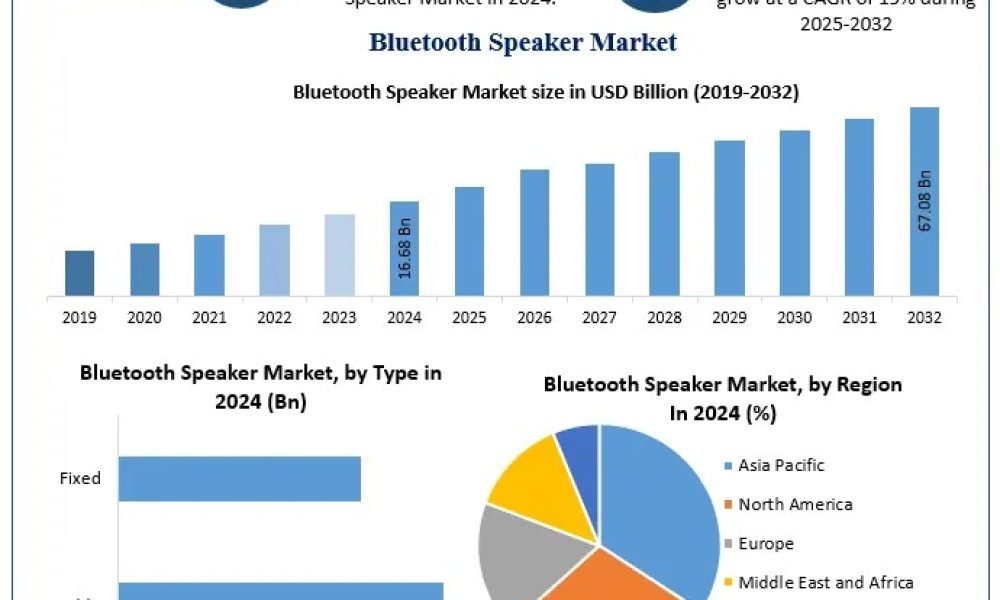
Bluetooth Speaker Market was valued at USD 16.68 billion in 2024 and is expected to expand rapidly at a CAGR of 19%, reaching approximately USD 67.08 billion by 2032. The market is driven by increasing demand for portable audio devices, widespread smartphone usage, and the popularity of music and video streaming platforms. Enhanced connectivity, integration with smart home systems, and continual product innovation are crucial factors fueling market growth.
Key Highlights and Insights
Market Size & Growth: USD 16.68 billion in 2024, forecast to reach USD 67.08 billion by 2032, with a strong CAGR of 19% from 2025 to 2032.
Dominating Region: North America leads the market, accounting for a 31.5% share. This dominance is fueled by high smartphone penetration, a strong smart home adoption trend, and consumer preference for Wi-Fi and AI-enabled speakers. From 2025 to 2032, Asia Pacific is projected to have the highest CAGR (13%), driven by rising tech-driven luxury consumption in countries like China and India.
Leading Segment: Portable Bluetooth speakers are expected to see the highest growth due to their compact size, battery-powered convenience, and increased usage in residential settings. Meanwhile, offline retail channels dominate the present market despite rapid growth in online distribution.
Key Driver: Adoption of music streaming services, growth in smart home networks, demand for lightweight and wireless devices, and advancements in AI-powered audio technology. Consumer preference is actively shifting toward portable, battery-efficient, and multi-functional speakers.
Recent Developments
Bose launched portable Bluetooth speakers with up to 12 hours of playtime, enhancing the market’s innovation profile.
IKEA introduced a new portable lamp integrating a Bluetooth speaker with Spotify Tap functionality, catering to hybrid lifestyle needs.
Harman and Ultimate Ears unveiled new waterproof and compact models, increasing the appeal and diversity of products in this segment.
Brands are focusing on R&D, new features like noise cancellation for conferencing, and collaborations with smart home ecosystems.
Market Dynamics
Drivers: Rapid growth in residential segment, integration with infotainment and hands-free devices, voice control systems, and home theatre setups drive demand.
Restraints: Market saturation, intense competition, price wars, and technological limitations such as battery life and Bluetooth range.
Challenges: Counterfeit products, signal interference, rising raw material and logistics costs, and maintaining profit margins.
Regional Analysis
North America: Largest market by value, high adoption of smart speakers and integration with home networks.
Asia Pacific: Fastest-growing region, boosted by increasing urbanization, higher disposable incomes, smartphone proliferation, and a shift to streaming platforms.
Europe: Steady growth due to stylish, premium products and strong retail infrastructure.
Other regions: Expanding, but trail in terms of market share and innovation.
Product Segmentation
By Type: Portable and fixed; portable speakers are the growth engine.
By Wattage: Low (1-10W), medium, high, very high.
By Distribution Channel: Online (fastest CAGR), offline (largest share in 2024).
By End User: Residential (dominant), commercial.
Key Trends
Integration of Bluetooth speakers in home automation and smart home systems.
Rise of AI-powered, voice assistant-enabled products (Alexa, Echo).
Growth of waterproof, dustproof, and rugged models for outdoor usage.
Premiumization and variety in sound profiles, aesthetics, and functionality.
Expansion of e-commerce and direct-to-consumer channels.
Quote
The Bluetooth speaker market is revolutionizing consumer audio experiences—driven by portability, smart integration, and on-the-go connectivity. With strong growth projected, ongoing advancements and lifestyle shifts will continue to shape this dynamic sector.




