
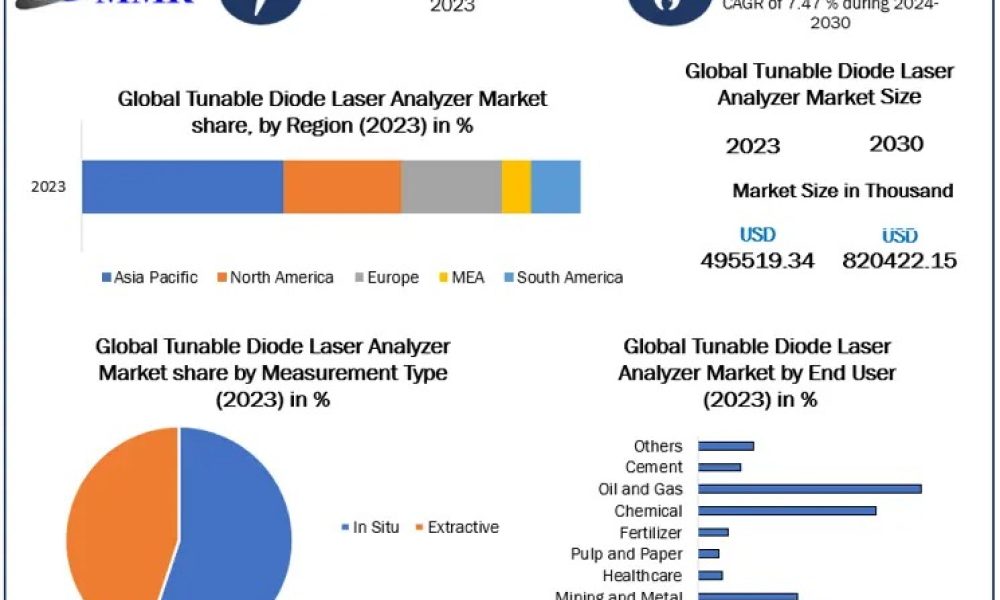
Tunable Diode Laser Analyzer (TDLA) Market in 2025 is valued at approximately $487 million to $572 million depending on the source, with forecasts predicting substantial growth through 2030-2035. The market is expected to grow at a compound annual growth rate (CAGR) ranging roughly from 7.3% to around 10%, reaching values between $804 million and over $1.1 billion by the early to mid-2030s.
Market Size and Growth Projections
Key Growth Drivers
Several factors contribute to the strong growth of the TDLA market:
Stringent Environmental Regulations: Governments worldwide are imposing strict emission standards to curtail greenhouse gases and hazardous emissions. This is prominently seen in the oil and gas, power generation, and chemical industries, where real-time monitoring of gases like methane, oxygen, and carbon monoxide is mandatory for compliance and safety.
Industrial Automation & Process Optimization: The trend towards Industry 4.0 in manufacturing demands reliable, high-precision monitoring instruments that can integrate with automated control systems. TDLA fits this requirement due to its real-time data capabilities and low maintenance needs.
Increasing Industrialization in Emerging Markets: Rapid industrial growth, especially in Asia-Pacific countries like China and India, is boosting demand for advanced gas monitoring to meet regulatory and safety requirements as well as improve operational efficiencies.
Adoption Across Various Industries: The TDLA technology applies broadly across power, mining, metals, healthcare, fertilizer, pulp and paper, cement, and other industries. Oil and gas remains a dominant segment with significant applications in leak detection, pipeline monitoring, and process safety.
Challenges
Calibration and Maintenance Costs: Despite its benefits, TDLA requires periodic calibration and skilled maintenance, which can be expensive and logistically challenging, especially in remote or harsh industrial environments. This factor may limit market adoption among smaller companies or less resourceful sectors.
Downtime for Calibration: Calibration downtime can disrupt operations, affecting productivity in continuous process industries.
Market Segmentation Insights
Measurement Type: The market is segmented primarily into in-situ and extractive analyzers. In-situ analyzers, which are installed directly in the process stream, dominate with over 60% share due to their ability to provide real-time, continuous measurements and reduce contamination or sample delays.
Gas Analyzer Type: Oxygen analyzers hold a significant market share, owing to their extensive application in combustion optimization and safety across industries.
End-user Industries: The oil and gas sector leads the demand for TDLAs, followed by power generation, chemicals, fertilization, and metal mining.
Key Growth Drivers
Increasing stringent environmental regulations globally drive demand for accurate emissions monitoring.
Industrial process optimization and automation demand real-time, precise gas analysis.
Adoption in key sectors such as oil & gas, power generation, chemicals, healthcare, and manufacturing.
Advancements in tunable diode laser technology improving sensitivity, dynamic range, and reducing maintenance.
Growing focus on safety, regulatory compliance, and carbon emission reductions.
Industry 4.0 integration and demand for smart, remote, and continuous monitoring solutions.
Economic growth in emerging regions like Asia Pacific, China, and India spur market expansion.
Prominent Applications & Market Segmentation
Measurement types: In Situ analyzers dominate due to real-time monitoring capability (64.18% share in 2023).
Gas types: Oxygen analyzers are a major segment, extensively used in combustion optimization and emission control.
End users: Oil and gas sector holds a dominant market share (27.32% in 2023), with critical needs in leak detection and emissions monitoring.
Geographical dominance: Asia Pacific leads the market, followed by significant growth in North America and Europe due to regulatory focus.
Summary
The tunable diode laser analyzer market shows strong growth prospects fueled by regulatory pressure, technological advancement, industrial automation, and environmental concerns. Market size analysts vary slightly but consistently forecast doubling or near doubling of market value within a decade from mid-2020s, with CAGR estimates typically between 7% and 10% depending on the forecast horizon and source.
This market landscape reflects the increasing need for precise, real-time gas analyzers used across diverse industries, reinforced by sustainability and safety priorities globally.




