
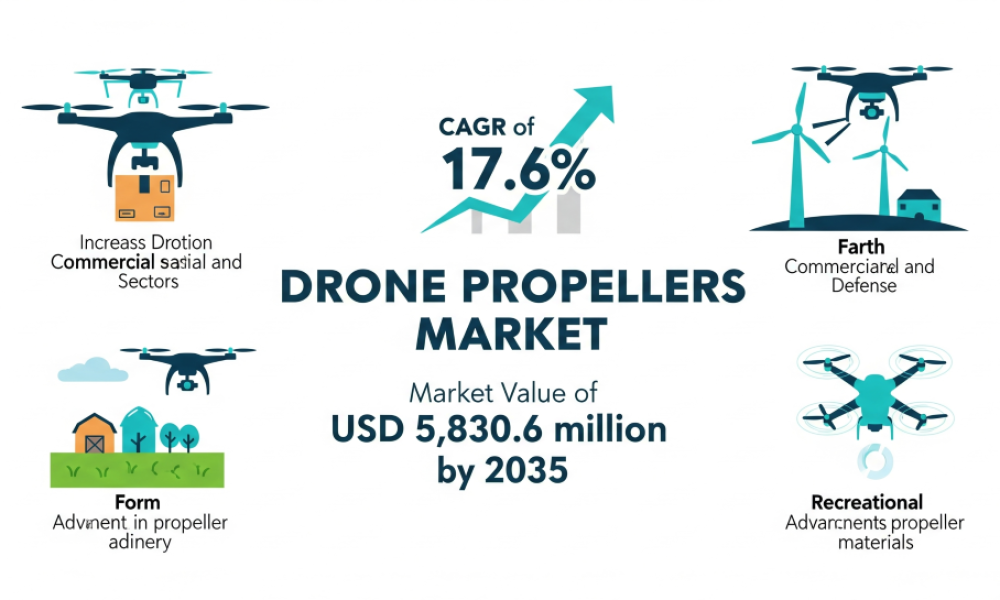
The global drone propellers market is expected to grow from USD 1,152.5 million in 2025 to USD 5,830.6 million by 2035, registering a CAGR of 17.6% during the forecast period. This growth is fueled by the increasing adoption of unmanned aerial vehicles (UAVs) across defense, logistics, precision agriculture, infrastructure inspection, and emergency response sectors.
Drone propellers are critical for delivering lightweight durability, aerodynamic efficiency, and stable thrust, making them essential for optimal performance in military, commercial, and recreational UAV applications.
Market Overview
Drone propellers play a pivotal role in UAV maneuverability, flight efficiency, and endurance. Rising use of drones in surveillance, mapping, parcel delivery, and agricultural monitoring has driven steady demand for advanced propeller designs. With UAVs increasingly deployed in high-value sectors such as defense and disaster management, propellers are engineered for superior strength-to-weight ratios, noise reduction, and aerodynamic stability.
The shift toward electric propulsion systems and long-endurance UAVs has prompted manufacturers to adopt materials like carbon fiber composites and reinforced polymers, offering lightweight durability and enhanced performance. These material innovations enable drones to operate reliably across diverse environments, from high-altitude terrains to humid coastal regions.
Drone Propellers Market Key Dynamics
The drone propellers market is driven by growing UAV adoption across logistics, surveillance, agriculture, and industrial inspections, while supply-side challenges and regulatory requirements remain key constraints.
Lightweight, efficient propellers enhance UAV endurance, payload capacity, and safety, with carbon-fiber designs dominating professional and defense applications. Material innovations improve strength-to-weight ratios, reduce fatigue, and extend battery life, supporting consistent market growth.
Advances in propulsion and aerodynamics boost flight efficiency, stability, and precision, particularly for logistics and defense operations. Noise-reducing and regulation-compliant designs, including toroidal and bio-inspired blades, further improve urban operation safety and user confidence.
Market Segmentation
By Material
- Carbon Fiber Propellers: Preferred for professional and defense-grade UAVs due to high strength and low weight.
- Plastic Propellers: Dominant in recreational and entry-level drones owing to affordability.
- Wood & Composite Propellers: Niche use in specialized UAV applications for balancing performance and cost.
By Propeller Type
- Fixed Pitch Propellers: Widely adopted for commercial drones due to simplicity and cost-effectiveness.
- Variable Pitch Propellers: Gaining traction in defense and logistics UAVs for enhanced maneuverability and thrust control.
By Application
- Defense & Security – Surveillance, reconnaissance, and combat support drones.
- Commercial & Industrial – Delivery drones, infrastructure inspection, and precision agriculture.
- Recreational & Hobbyist – Drone racing and consumer UAVs.
By Region
- North America: Largest market, driven by defense investments and strong drone regulations framework.
- Europe: Rising adoption in logistics, security, and agricultural applications.
- Asia-Pacific: Fastest-growing market, led by China, India, and Japan’s increasing UAV deployment.
- Middle East & Africa: Emerging demand in border surveillance and oilfield monitoring.
Full Market Report available for delivery. For purchase or customization, please request here – https://www.factmr.com/connectus/sample?flag=S&rep_id=7910
Competitive Landscape
The drone propellers market is highly competitive, with players focusing on material innovation, aerodynamic optimization, and integration with UAV ecosystems. Companies are developing low-noise, foldable, and high-thrust propellers to improve drone endurance and mission success rates.
Key Players
- DJI Innovations
- Gemfan Hobby
- T-Motor
- Master Airscrew
- HQProp
- XOAR International
- APC Propellers
Recent Developments
- In June 2025, DJI Innovations launched a new line of foldable carbon-fiber propellers designed for professional aerial cinematography drones, enhancing noise reduction and flight stability.
- In March 2025, T-Motor introduced high-thrust propellers for heavy-lift drones used in industrial logistics and defense operations.
- In December 2024, Gemfan Hobby partnered with drone racing leagues to provide advanced, lightweight propellers optimized for high-speed competitions.
- In October 2024, Master Airscrew announced new low-noise propeller designs compatible with popular consumer drones to improve recreational user experience.
Future Outlook
The drone propellers market is set for exponential growth as demand for UAVs intensifies across defense, logistics, and commercial sectors. Rising adoption of autonomous delivery drones, AI-driven surveillance systems, and drone racing leagues will further expand market opportunities.
Manufacturers are likely to focus on smart propellers equipped with sensors, adaptive pitch control, and integration with IoT-enabled UAV ecosystems. Additionally, regulatory approvals for beyond-visual-line-of-sight (BVLOS) drone operations will accelerate demand for reliable, high-performance propellers.
By 2035, lightweight, aerodynamic, and smart drone propellers will remain indispensable for UAVs, powering the next wave of unmanned aviation technology across industries.
Contact:
US Sales Office
11140 Rockville Pike
Suite 400
Rockville, MD 20852
United States
Tel: +1 (628) 251-1583, +353-1-4434-232
Email: [email protected]



