
Aluminum Casting Market Overview :
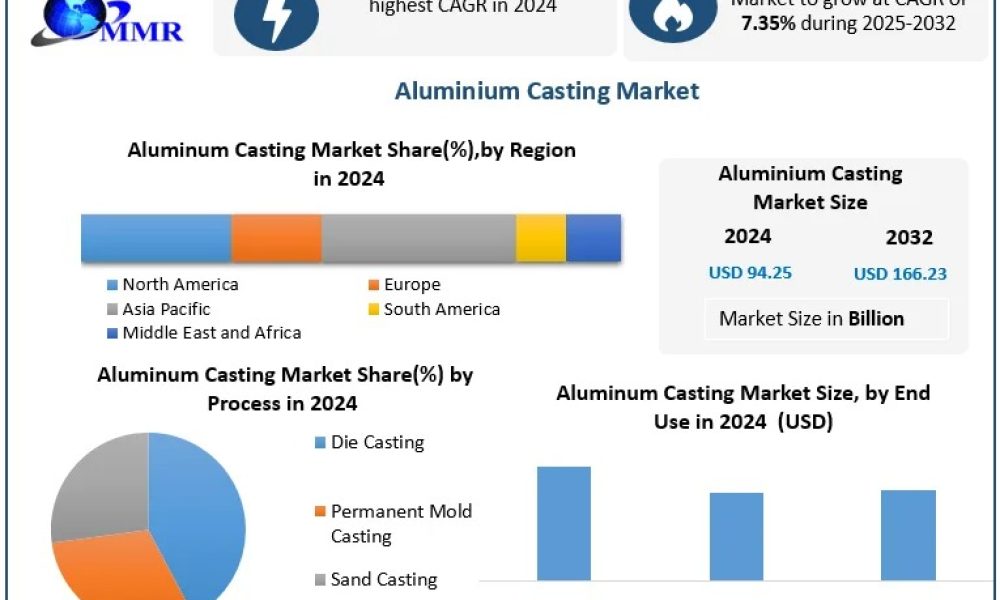
Aluminum Casting Market was valued at approximately USD 94.25 billion in 2024 and is projected to grow at a CAGR of 7.35% from 2025 to 2032, reaching nearly USD 166.23 billion by 2032. The market growth is driven by increasing demand for lightweight and energy-efficient materials, expanding automotive manufacturing, rising construction activities, and regulatory emphasis on sustainability and fuel efficiency in the transport sector.
Market Overview and Key Dynamics
Aluminum casting involves producing components via die casting, sand casting, and permanent mold casting for use in automotive, industrial, construction, and transportation sectors. This manufacturing process is increasingly favored due to aluminum’s combination of strength, light weight, corrosion resistance, and recyclability, especially as the automotive industry shifts towards fuel-efficient vehicle designs.
Globally, motor vehicle production reached 77.9 million units in 2024, significantly driving aluminum casting demand. The push to replace heavier metals like iron and steel with aluminum cast parts is strongest in Asia Pacific and North America, where advanced automotive manufacturing, electronics, and infrastructure growth sustain demand.
Regional Insights
Asia Pacific:
With its dominance in global automotive manufacturing, Asia Pacific holds the largest share of the aluminum casting market in 2024. China, India, and Japan are major contributors supported by booming construction and infrastructure development. The region’s skilled labor availability and raw material accessibility continue to fuel capacity expansion. Asia Pacific’s growth rate is forecast to remain robust throughout the forecast period.North America:
Known for innovation in automotive and aerospace industries, North America is a key market with strong demand for high-performance and lightweight components. Government regulations promoting fuel economy and emissions reductions further bolster aluminum casting adoption.Europe:
Europe features strong adherence to environmental regulations and growing uptake of aluminum castings in electric vehicle manufacturing, aerospace, and renewable energy segments.
Market Segmentation
By Process Type:
Die casting dominates the market due to its cost efficiency, suitability for mass production, and high precision.
Sand casting is preferred for low volume and complex parts that require enhanced mechanical properties.
Permanent mold casting utilizes metal molds for recyclable, repeatable manufacturing.
By End Use:
Transportation leads as the largest sector, driven by the adoption of aluminum components in automotive engine parts, chassis, transmission, and interiors.
Industrial and construction sectors also contribute significantly, with demand for durable, corrosion-resistant parts in machinery and infrastructure.
Key Trends
The automotive industry’s push for lightweight vehicles to meet stringent emission regulations is one of the major growth opportunities. Aluminum cast parts improve fuel efficiency and reduce carbon footprint compared to traditional metals.
Advancements in casting technologies such as vacuum die casting enhance the quality and structural integrity of components, especially for electric and hybrid vehicles.
Recycling and sustainability are key focuses, with companies investing in recycled aluminum materials and circular economy initiatives.
Competitive Landscape and Recent Developments
Industry leaders include Alcoa Corporation, Nemak, Dynacast, Endurance Technologies, Ryobi Ltd., Rheinmetall Automotive AG, and Constellium SE. These companies emphasize innovation in sustainable alloys, automated production processes, and lightweight solutions tailored for electric vehicle components.
In May 2025, Nemak announced a partnership with a leading EV manufacturer to produce high-pressure die-cast aluminum battery housings.
In January 2025, Endurance Technologies started operations at a new fully automated aluminum die-casting plant in India to address automotive demand.
Ryobi Limited introduced a high-strength aluminum casting solution for hybrid vehicle engines in late 2024, enhancing durability and thermal performance.
Constellium SE expanded its recycled aluminum casting line to reinforce circular economy goals.
Market Outlook
The aluminum casting market’s growth mirrors the wider industrial push towards lightweight, sustainable, and high-performance materials. Automotive sector evolution with electric and hybrid vehicles significantly bolsters demand, while construction and industrial advancements also sustain growth. Asia Pacific’s rise as a manufacturing powerhouse and ongoing infrastructure developments across regions will further propel the market.
With advancements in manufacturing technology, environmental focus, and expanding applications, the aluminum casting market is poised to grow strongly, offering opportunities for established players and new entrants prioritizing innovation and sustainability.
This comprehensive market trajectory underscores how aluminum casting remains central to the evolving material demands of global industrial and transportation sectors through 2032.




