
Definition
LiDAR (Light Detection and Ranging) for mobile robots refers to a laser-based sensing technology that enables Automated Guided Vehicles (AGVs) and Autonomous Mobile Robots (AMRs) to perceive their environment, navigate accurately, and detect obstacles in real time. LiDAR works by emitting laser beams and measuring the time taken for the light to bounce back after hitting objects, creating precise 2D or 3D maps.
In industrial automation, LiDAR is critical for applications such as warehouse material handling, factory floor navigation, and precision delivery. Single-line LiDAR is often used for basic 2D mapping, whereas multi-line and solid-state LiDAR enable 3D environmental awareness, improving navigation in complex spaces.
LiDAR systems for mobile robots typically integrate with onboard computing platforms and other sensors, such as cameras or ultrasonic systems, to achieve advanced functionalities like simultaneous localization and mapping (SLAM), real-time obstacle avoidance, and autonomous fleet management. The technology’s millimeter-level accuracy ensures precise movements, efficient inventory handling, and safe interactions with human workers in shared spaces.
Recent Developments
The LiDAR for Mobile Robots (AGV & AMR) market is experiencing rapid innovation, largely driven by the demand for more flexible and intelligent automation in warehousing, manufacturing, and logistics. A key trend is the development of 3D LiDAR and sensor fusion technologies that combine LiDAR with cameras, ultrasonic sensors, and other systems. This provides mobile robots with a more comprehensive and accurate understanding of their environment, enabling them to navigate complex, dynamic spaces and avoid obstacles more effectively. Manufacturers are also focusing on creating more compact, cost-effective, and energy-efficient LiDAR sensors to make them more accessible to a wider range of businesses, including small and medium-sized enterprises (SMEs). The integration of AI and machine learning algorithms with LiDAR data is also a major development, allowing AGVs and AMRs to learn and adapt to new environments and tasks.
Major Distribution
The distribution of LiDAR for Mobile Robots is highly specialized and follows a primarily business-to-business (B2B) model. The major distribution channels include direct sales from LiDAR manufacturers to mobile robot integrators and manufacturers. These companies, such as Boston Dynamics and KUKA, incorporate the LiDAR sensors as a core component of their AGV and AMR products. Another significant channel is a network of specialized robotics and automation distributors and resellers. These partners play a crucial role by offering a broader range of automation components, from sensors to software, and providing technical support and integration services to end-users who are deploying these robots in their facilities. This multi-layered distribution model ensures that the complex needs of industrial clients are met with comprehensive and tailored solutions.
Market Size
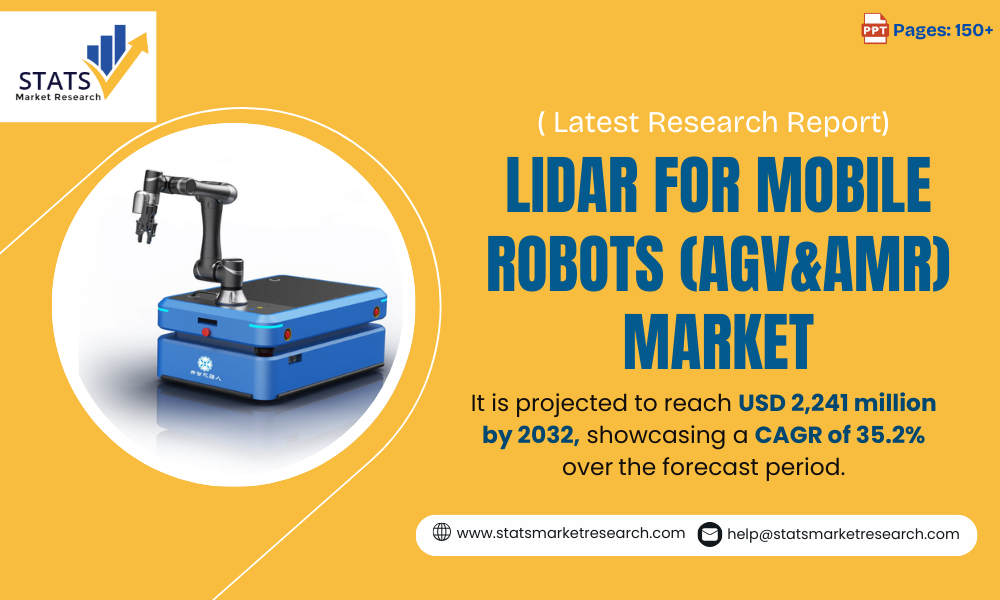
Global LiDAR for Mobile Robots (AGV & AMR) market was valued at USD 284 million in 2024. Forecasts project growth from USD 392 million in 2025 to USD 2,241 million by 2032, reflecting a CAGR of 35.2% during the period.
Download FREE Sample of this Report @ https://www.statsmarketresearch.com/download-free-sample/8061371/global-lidar-for-mobile-robots-forecast-market
Historical and Forecast Trends
- 2020–2024: The market saw moderate growth, primarily driven by early adoption in large warehouses and automotive factories. High costs of multi-line LiDAR limited widespread deployment among small-to-medium enterprises (SMEs).
- 2025–2032: Accelerated adoption is anticipated due to e-commerce expansion, labor cost optimization, and technological advancements in solid-state LiDAR. The proliferation of AGVs and AMRs, coupled with AI-driven navigation systems, will further drive market penetration.
Key statistics include:
- Europe, North America, and China collectively dominate the market, accounting for more than 70% of global revenue share.
- The top five vendors captured 56% of the market in 2024, highlighting high market concentration.
- Solid-state LiDAR solutions have lowered sensor costs by approximately 65% since 2020, expanding adoption beyond high-volume industrial operations.
Market Dynamics (Drivers, Restraints, Opportunities, and Challenges)
Drivers
Automation Boom in Logistics and Manufacturing
The surge in automated material handling is driving LiDAR adoption in warehouses and factories. E-commerce order volumes are growing 15-20% annually, necessitating the deployment of AGVs and AMRs to improve throughput. LiDAR’s millimeter-level precision enables precise pallet handling and real-time navigation, leading to operational efficiency gains of 30-50% in modern fulfillment centers.
Technological Advancements in Solid-State LiDAR
Innovations in MEMS-based and chip-scale LiDAR have improved reliability by 200% and reduced costs by 65%. Solid-state LiDAR enables AMRs to perform 3D mapping at refresh rates exceeding 20Hz, expanding applications from basic floor-following AGVs to complex autonomous operations.
Stringent Safety Regulations
Industrial safety standards now require collision avoidance systems in human-shared environments. LiDAR is often combined with cameras or ultrasonic sensors to achieve SIL-2/PLe safety ratings, ensuring secure autonomous navigation. In 2024, 85% of new AGV/AMR deployments incorporated multi-sensor architectures.
Restraints
High Implementation Costs
Despite cost reductions, complete LiDAR navigation systems account for 20-35% of robot costs, making adoption challenging for SMEs. Integration costs, including calibration, SLAM software licensing, and maintenance, can exceed $15,000 per unit, limiting deployment to high-volume operations.
Environmental Sensitivity Issues
Performance deteriorates in dusty or reflective environments, reducing effective range by up to 40% within weeks. Even IP69K-rated housings cannot fully overcome optical limitations, restricting deployment in certain industrial sectors.
Competition from Alternative Technologies
Millimeter-wave radar and event-based vision systems offer lower-cost alternatives with acceptable obstacle detection. For instance, 60GHz radar systems provide comparable ranging accuracy and superior performance in obscurant-filled environments, gaining traction in price-sensitive Asian markets.
Opportunities
Emerging Applications Beyond Material Handling
- Agriculture: Multi-spectral LiDAR enables precision crop monitoring.
- Healthcare: Logistics robots navigate complex hospital layouts with 3D mapping.
- Construction: Sensor-fusion systems allow safe robot-human collaboration, representing a $1.2 billion market by 2027.
AI-driven Perception Algorithms
Machine learning integration with LiDAR enables object classification with 98% accuracy over distances exceeding 30 meters, enhancing navigation and reducing false positives. AI co-processors have reduced detection latency to under 50 milliseconds, improving dynamic decision-making in crowded environments.
Regional Manufacturing Shifts
Nearshoring production in Southeast Asia and Eastern Europe is creating $420 million in incremental LiDAR demand, with local suppliers capturing 40% of this emerging market. This localization supports cost-optimized solutions and faster deployment.
Challenges
Standardization Gaps
The absence of unified communication protocols leads to ecosystem fragmentation, increasing integration complexity. Deployment timelines can stretch to 8-12 weeks, and lack of cross-platform standards inhibits fleet mixing, limiting operational flexibility.
Workforce Skill Shortages
There is a global deficit of approximately 35,000 qualified integration engineers, with vocational programs still focused on traditional automation equipment. This shortage is particularly acute in emerging markets where robotics adoption is rapid.
Intellectual Property Disputes
Patent infringement lawsuits have slowed innovation and led to product withdrawals from certain markets. OEMs increasingly demand IP indemnification clauses in sensor supply agreements, affecting procurement strategies.
Regional Analysis
North America
North America is a leading market, driven by warehouse automation and early adoption of AMRs. High labor costs and stringent safety regulations accelerate LiDAR integration.
Europe
Europe dominates with mature industrial robotics ecosystems. Germany, France, and the UK lead deployments, leveraging experienced sensor manufacturers and regulatory compliance frameworks.
Asia-Pacific
China is rapidly expanding LiDAR adoption, supported by cost-competitive local manufacturers like RoboSense and Slamtec. Southeast Asia is emerging as a nearshoring hub, increasing localized demand.
Rest of the World
Emerging markets in Latin America and the Middle East are slower adopters, constrained by high costs and limited technical expertise. However, infrastructure development in logistics and warehousing offers growth potential.
Get the Complete Report & TOC @ https://www.statsmarketresearch.com/global-lidar-for-mobile-robots-forecast-market-8061371
Competitor Analysis (in brief)
The LiDAR market for mobile robots is competitive, with high concentration among leading players:
- SICK AG (Germany) – Leader in industrial sensors, providing reliable multi-line LiDAR for AGVs.
- Pepperl+Fuchs (Germany) – Focuses on robust LiDAR for factory automation.
- RoboSense (China) – Cost-effective multi-line LiDAR for high-volume AMRs.
- Slamtec (China) – Rapidly growing, specializing in affordable, high-performance LiDAR.
- Velodyne Lidar (U.S.) – High-performance 3D perception, expanding into automotive and industrial sectors.
Emerging players like IBEO, LeddarTech, Neuvition, and Quanegy leverage solid-state designs and niche applications, while traditional suppliers like Leuze and Hokuyo expand portfolios through strategic partnerships and acquisitions.
Global LiDAR for Mobile Robots: Market Segmentation Analysis
This report provides a deep insight into the global LiDAR for Mobile Robots (AGV & AMR) market, covering all its essential aspects. This ranges from a macro overview of the market to micro details of the market size, competitive landscape, development trend, niche market, key market drivers and challenges, SWOT analysis, value chain analysis, etc.
The analysis helps the reader to shape the competition within the industries and strategies for the competitive environment to enhance the potential profit. Furthermore, it provides a simple framework for evaluating and assessing the position of the business organization. The report structure also focuses on the competitive landscape of the Global LiDAR for Mobile Robots (AGV & AMR) market. This report introduces in detail the market share, market performance, product situation, operation situation, etc., of the main players, which helps the readers in the industry to identify the main competitors and deeply understand the competition pattern of the market.
In a word, this report is a must-read for industry players, investors, researchers, consultants, business strategists, and all those who have any kind of stake or are planning to foray into the LiDAR for Mobile Robots (AGV & AMR) market in any manner.
Market Segmentation (by Application)
- Automated Guided Vehicles (AGVs)
- Forklifts
- Tow Vehicles
- Unit Load Carriers
- Autonomous Mobile Robots (AMRs)
- Warehouse Robotics
- Last-Mile Delivery Robots
- Others
Market Segmentation (by Type)
- Single-line LiDAR
- 905nm Wavelength
- 1550nm Wavelength
- Others
- Multi-line LiDAR
- Solid-state LiDAR
- Flash LiDAR
- Others
Key Company
- SICK AG (Germany)
- Pepperl+Fuchs (Germany)
- RoboSense (China)
- Slamtec (China)
- Velodyne Lidar (U.S.)
- IBEO (Germany)
- Hokuyo (Japan)
- Leuze (Germany)
- LeddarTech (Canada)
- Neuvition (China)
- Innoviz (Israel)
- Quanegy (U.S.)
Geographic Segmentation
- North America – High adoption in warehouses and factories.
- Europe – Dominated by Germany, France, UK, mature robotics ecosystem.
- Asia-Pacific – China leads; Southeast Asia emerging as a nearshoring hub.
- Rest of the World – Growing demand in Latin America and the Middle East.
FAQ
- What is the current market size of the LiDAR for Mobile Robots market?
- The market was valued at USD 284 million in 2024 and is expected to reach USD 2,241 million by 2032, growing at a CAGR of 35.2%.
- Which are the key companies operating in the LiDAR for Mobile Robots market?
- SICK AG, Pepperl+Fuchs, RoboSense, Slamtec, Velodyne Lidar, IBEO, Hokuyo, Leuze, LeddarTech, Neuvition, Innoviz, and Quanegy.
- What are the key growth drivers in this market?
- Automation boom in logistics and manufacturing, technological advancements in solid-state LiDAR, and stringent safety regulations.
- Which regions dominate the market?
- Europe, North America, and China collectively dominate due to mature industrial ecosystems and high adoption of AGVs and AMRs.
- What are the emerging trends in the LiDAR for Mobile Robots market?
- AI-driven perception algorithms, solid-state LiDAR adoption, sensor fusion systems, and emerging applications in healthcare, agriculture, and construction.
About Us
☎️ International: +1 (332) 2424 294
📄 Website: www.statsmarketresearch.com
Join us on LinkedIn:- https://www.linkedin.com/company/statsmarketresearch




