
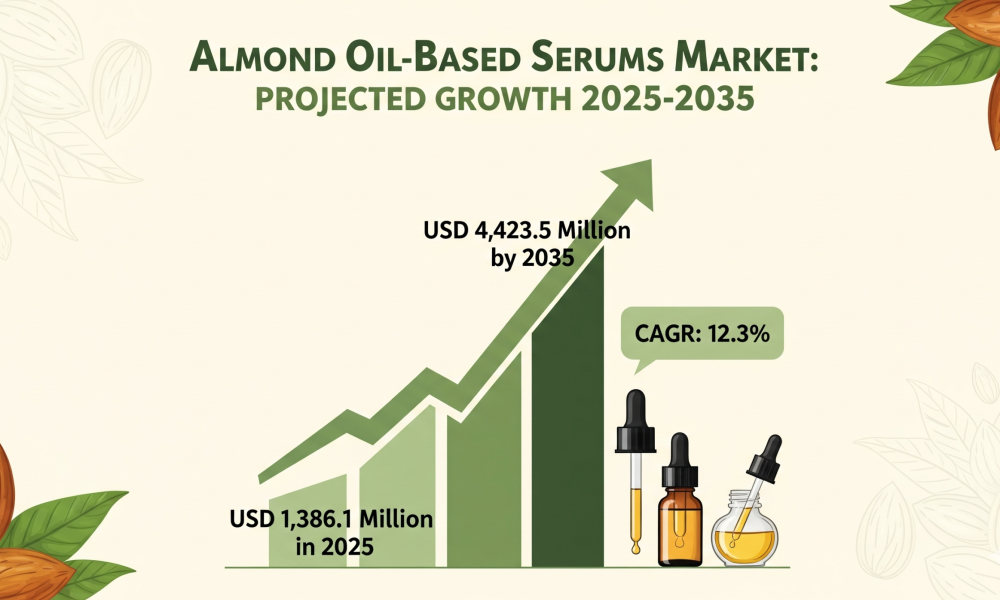
The global Almond Oil-Based Serums Market is on an impressive growth trajectory, expected to record USD 1,386.1 million in 2025 and accelerate to USD 4,423.5 million by 2035. This expansion of USD 3,037.4 million equals a 219% increase over the decade, underlining a compound annual growth rate (CAGR) of 12.3%.
This growth highlights the industry’s resilience and adaptability as consumer demand for natural, clean-label, and multifunctional skincare continues to surge across global regions.
Early Market Foundations (2020–2024)
Between 2020 and 2024, the Almond Oil-Based Serums Market laid its groundwork, led by consumer interest in hydration and brightening. Clean-label positioning dominated, with natural skincare and Ayurvedic brands such as Forest Essentials, Weleda, and Khadi Natural capturing over 70% of revenue.
During this period, brick-and-mortar specialty stores and pharmacies remained the primary sales channels, while digital platforms acted as supplementary avenues. Consumers were drawn to plant-based, ethical, and transparent sourcing practices, setting the stage for broader adoption in the next decade.
Full Market Report available for delivery. For purchase or customization, please request here: https://www.futuremarketinsights.com/reports/sample/rep-gb-25168
Growth Dynamics from 2025 to 2035
First Phase: Steady Expansion (2025–2030)
The first five years will see the market expand from USD 1,386.1 million in 2025 to USD 2,476.2 million in 2030, contributing 36% of the total decade growth. Hydration-focused products will dominate, accounting for 54.5% of the market share in 2025. Brightening serums also maintain strong consumer pull as demand for chemical-free skincare grows.
Digital adoption gains momentum during this stage, with subscription-based beauty boxes, personalized skincare recommendations, and e-commerce expansion gradually reshaping the consumer journey.
Second Phase: Accelerated Adoption (2030–2035)
The second half of the decade will witness sharper growth, adding USD 1,947.3 million and bringing the market to USD 4,423.5 million by 2035. This surge is driven by widespread adoption in Asia-Pacific, where India (23.6% CAGR) and China (23.4% CAGR) lead global expansion.
Key accelerators include e-commerce platforms, influencer-led campaigns, clean-label certifications, and AI-driven personalization tools, which together reshape beauty consumption patterns.
Why Consumers are Choosing Almond Oil-Based Serums
Almond oil’s natural hydrating, brightening, and skin-repairing properties have positioned it as a preferred ingredient for conscious beauty shoppers. Consumers are increasingly leaning toward Ayurvedic and natural solutions that support long-term skin health, moving away from chemical-heavy alternatives.
E-commerce channels, combined with subscription models and trial-size kits, have democratized access to premium serums. Younger demographics, particularly millennials and Gen Z, are embracing personalized and digital-first beauty routines, further driving demand.
Segmental Analysis
By Function: Hydration Takes the Lead
Hydration-focused serums account for 54.5% of revenue in 2025, supported by rising concerns over skin dryness, dullness, and barrier repair. Almond oil’s moisturizing capabilities, coupled with Ayurvedic-inspired claims, strengthen consumer trust and reinforce hydration as the dominant function throughout the forecast period.
By Product Type: Serums Dominate
Serums, valued for their concentrated formulations and fast-absorbing textures, represent 52.5% of the market in 2025. Their ability to layer seamlessly within skincare routines, coupled with multifunctional benefits like anti-aging and repair, makes them the go-to choice across both premium and mass channels.
By Claim: Natural/Organic on Top
Natural and organic claims hold 51.5% share in 2025. These products resonate strongly with eco-conscious consumers seeking safe, sustainable, and plant-based formulations. Transparency in sourcing and eco-friendly packaging add to their appeal, securing their position as the leading claim segment.
Regional Insights
Asia-Pacific: The Global Growth Engine
Asia-Pacific dominates with rapid adoption, fueled by Ayurvedic heritage in India and increasing skincare awareness in China. India is projected to grow at 23.6% CAGR, while China closely follows at 23.4% CAGR. Local heritage brands, digital-first startups, and competitive pricing models are expanding accessibility, particularly in urban middle-class markets.
Europe: Clean-Label Driven Expansion
In Europe, the UK and Germany lead growth with CAGRs of 13.6% and 10.1%, respectively. Regulatory focus on clean-label skincare and sustainable packaging strengthens consumer trust. Premium beauty retailers and pharmacies play a crucial role in expanding shelf presence.
North America: Steady but Mature Growth
The U.S. market is projected to expand at 9.1% CAGR, with hydration-focused serums accounting for 56.3% share in 2025. Premium positioning, dermatologist-tested claims, and e-commerce platforms drive moderate yet consistent growth, supported by the clean beauty movement.
Japan: Tradition Meets Innovation
Japan’s projected CAGR of 16.9% reflects consumer appetite for high-quality formulations that combine traditional beauty rituals with advanced dermocosmetic science.
Request Market Research Draft Report: https://www.futuremarketinsights.com/reports/brochure/rep-gb-25168
Competitive Landscape
The Almond Oil-Based Serums Market is moderately fragmented, with Forest Essentials leading at 7.6% global value share in 2025. Its premium Ayurvedic-inspired portfolio and luxury retail presence position it as a standout player.
Other major competitors include L’Oréal, Clarins, Weleda, and Khadi Natural, each blending natural claims with scientific innovation and multi-channel strategies. Emerging startups such as Kama Ayurveda and Biotique are reshaping competition with digital-first approaches and subscription models, while Western players like The Body Shop and Burt’s Bees continue to strengthen botanical serum portfolios.
Key innovations are increasingly focused on natural/organic certifications, vegan-friendly claims, sustainable packaging, and AI-driven personalization.
Key Developments
- 2024: Forest Essentials expanded its Ayurvedic-inspired almond oil serum range globally, entering luxury retail and Sephora outlets.
- 2025: Khadi Natural launched a clean-label serum range across India’s tier-2 and tier-3 cities, improving affordability and accessibility.
These strategic moves underline how both established and new players are scaling globally while remaining rooted in consumer-centric innovation.
About Future Market Insights (FMI)
Future Market Insights, Inc. (ESOMAR certified, recipient of the Stevie Award, and a member of the Greater New York Chamber of Commerce) offers profound insights into the driving factors that are boosting demand in the market. FMI stands as the leading global provider of market intelligence, advisory services, consulting, and events for the Packaging, Food and Beverage, Consumer Technology, Healthcare, Industrial, and Chemicals markets. With a vast team of over 400 analysts worldwide, FMI provides global, regional, and local expertise on diverse domains and industry trends across more than 110 countries.
Contact Us:
Future Market Insights Inc.
Christiana Corporate, 200 Continental Drive,
Suite 401, Newark, Delaware – 19713, USA
T: +1-347-918-3531
For Sales Enquiries: [email protected]



