
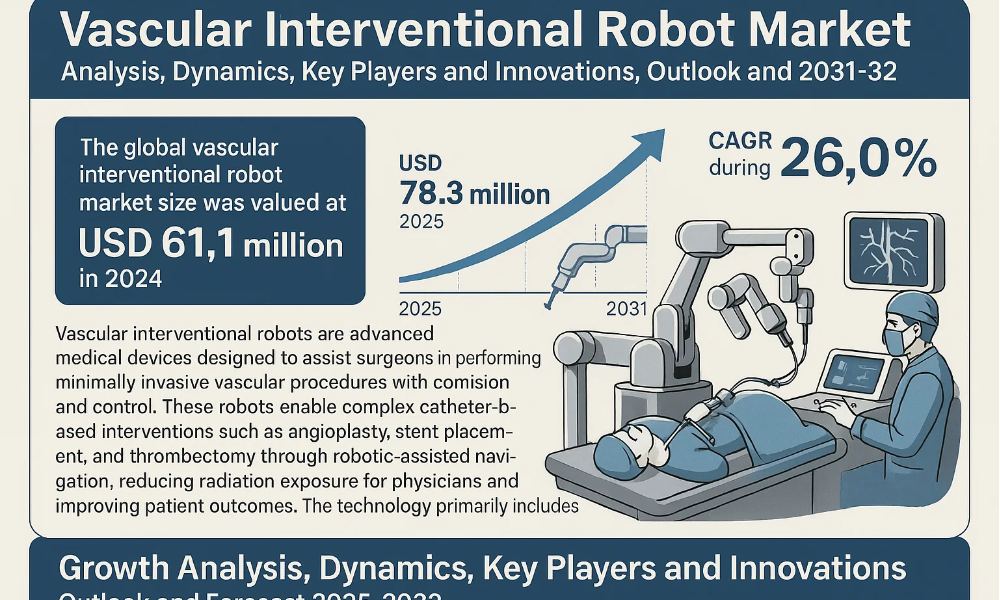
Vascular Interventional Robot Market size was valued at USD 61.1 million in 2024. The market is projected to grow from USD 78.3 million in 2025 to USD 297 million by 2031, exhibiting a CAGR of 26.0% during the forecast period.
Vascular interventional robots are advanced medical devices designed to assist surgeons in performing minimally invasive vascular procedures with precision and control. These robots enable complex catheter-based interventions such as angioplasty, stent placement, and thrombectomy through robotic-assisted navigation, reducing radiation exposure for physicians and improving patient outcomes. The technology primarily includes electromechanical and magnetic control systems that enhance procedural accuracy.
The market growth is driven by increasing demand for minimally invasive surgeries, technological advancements in robotic systems, and rising prevalence of cardiovascular diseases. Furthermore, growing healthcare expenditure and adoption of AI-powered surgical solutions are accelerating market expansion. Leading players like Siemens Healthineers and Corindus Vascular Robotics are actively developing next-generation robotic platforms, contributing to the sector’s rapid evolution.
Claim Your Free Sample Report- https://www.intelmarketresearch.com/download-free-sample/9928/vascular-interventional-robot-market
MARKET DYNAMICS
MARKET DRIVERS
Rising Prevalence of Cardiovascular Diseases to Accelerate Market Expansion
The increasing global burden of cardiovascular diseases (CVDs) is a primary driver for the vascular interventional robot market. CVDs account for nearly 32% of all global deaths annually, with ischemia and stroke being leading causes. As healthcare systems prioritize minimally invasive procedures to reduce recovery times and complications, robotic-assisted vascular interventions offer superior precision in angioplasty, stenting, and thrombectomy procedures. The demand is further amplified by the aging population, with individuals over 65 being three times more likely to require vascular interventions. Robotic systems enhance procedural accuracy while minimizing radiation exposure to physicians a critical advantage given that interventional cardiologists face radiation doses equivalent to 5,000 chest X-rays annually.
Technological Advancements in Robotic Systems Propel Adoption Rates
Recent technological breakthroughs in haptic feedback, 3D imaging integration, and artificial intelligence (AI)-guided navigation are transforming vascular robotics. Modern systems now achieve sub-millimeter precision in catheter manipulation, reducing procedure times by up to 30% compared to manual techniques. For instance, next-generation magnetic navigation robots utilize superconducting magnets for unparalleled instrument control in complex anatomies. Such innovations address critical limitations of traditional methods, including guidewire perforations which occur in approximately 1.2% of manual interventions. The integration of predictive analytics and machine learning further enhances robotic decision-making during procedures, fostering greater clinician trust in automated systems.
Growing Healthcare Infrastructure Investments Create Favorable Ecosystem
Global healthcare expenditure surpassing $8 trillion annually is driving modernization of interventional suites. Hospitals are allocating 12-18% of their capital budgets towards robotic surgical systems, recognizing their potential to improve patient outcomes and operational efficiency. Government initiatives are amplifying this trend for example, recent policies in Europe and Asia provide reimbursement incentives for robotic-assisted vascular procedures. Furthermore, teaching hospitals are increasingly incorporating robotic platforms into training programs, with 68% of new interventional cardiology fellows now receiving mandatory robotic system training. This institutional adoption creates sustainable demand that will persist through the forecast period.
MARKET OPPORTUNITIES
Emerging Markets Present Untapped Growth Potential
While North America and Europe currently dominate the vascular robotics market, the Asia-Pacific region is poised for explosive growth with an anticipated 34% CAGR through 2031. This stems from improving healthcare infrastructure and rising disposable incomes in countries like China and India, where cardiovascular disease rates are escalating rapidly. Governments are implementing favorable policies China’s 14th Five-Year Plan specifically allocates $1.2 billion for advanced medical robotics development. Meanwhile, localized manufacturing is reducing costs, with Asian-produced systems now 25-30% cheaper than Western counterparts. These trends create unprecedented opportunities for market expansion in regions representing over 60% of the global population.
Integration with Hybrid Operating Rooms Opens New Applications
The proliferation of hybrid ORs present in 38% of new hospital construction projects creates ideal environments for vascular robotic systems. These advanced suites combine imaging capabilities with surgical functionality, enabling complex multi-modal procedures. Robotic platforms that integrate seamlessly with hybrid environments allow for real-time fusion of CT/MRI data during interventions, improving outcomes in challenging cases like chronic total occlusions. Industry leaders are actively developing specialized robotic solutions for these settings, with recent prototypes demonstrating the ability to simultaneously control intravascular ultrasound alongside therapeutic instruments. This convergence of technologies will likely define the next generation of vascular interventions.
Segment Analysis:
By Type
- Electromechanical
- Magnetic Control
Electromechanical robots dominate the market due to their precision, widespread adoption in minimally invasive procedures, and compatibility with existing surgical workflows.
By Application
- Coronary Interventions
- Peripheral Interventions
- Neurovascular Interventions
- Others
Coronary Interventions is the leading segment, driven by the rising prevalence of cardiovascular diseases and the demand for robotic-assisted PCI procedures in complex cases.
By End User
- Hospitals
- Ambulatory Surgery Centers
- Specialty Clinics
Hospitals remain the primary end users, benefiting from their advanced infrastructure, trained staff, and ability to handle complex vascular procedures with robotic assistance.
By Product Component
- Robotic Systems
- Accessories
- Software
Robotic Systems represent the most critical component, as they form the core technological platform enabling precise vascular interventions with reduced physician fatigue.
List of Key Vascular Interventional Robot Companies Profiled
- Siemens Healthineers (Germany)
- Robocath (France)
- Hansen Medical (Auris Health) (U.S.)
- Stereotaxis (U.S.)
- Chuangda (China)
- Hengchang Medical (China)
- Corindus Vascular Robotics (U.S.)
- Auris Health (U.S.)
- Cybermedicine (Germany)
- Jianfan Medical (China)
- Cypress Medical (U.S.)
- Jabil Group (U.S.)
The market is witnessing increasing collaboration between robotic platform developers and medical device companies to create integrated solutions. For instance, several players are partnering with stent and catheter manufacturers to optimize device compatibility with their robotic systems. Such partnerships are expected to accelerate market adoption as healthcare providers seek comprehensive workflow solutions rather than standalone robotic platforms.
VASCULAR INTERVENTIONAL ROBOT MARKET TRENDS
Technological Advancements Driving Growth in Vascular Interventional Robotics
The vascular interventional robot market is experiencing rapid growth, fueled by significant advancements in robotic-assisted surgical technologies. The integration of artificial intelligence (AI) and machine learning algorithms has enhanced precision in procedures such as percutaneous coronary interventions (PCI) and endovascular aneurysm repairs. Recent innovations, including real-time imaging guidance and haptic feedback systems, have minimized human error while improving procedural accuracy. The adoption of robotic platforms in complex vascular surgeries has surged, as these systems reduce radiation exposure for physicians and enhance patient safety. Additionally, wireless control and smaller robotic form factors are broadening clinical applicability in catheterization labs worldwide.
Other Trends
Rising Adoption of Minimally Invasive Procedures
The increasing preference for minimally invasive surgeries (MIS) is a major catalyst for the vascular interventional robot market. Hospitals and ambulatory surgical centers are investing in robotic systems to perform precise stent placements, thrombectomies, and angioplasties with reduced patient trauma. Data indicates that robot-assisted vascular procedures can shorten hospital stays by up to 30% compared to traditional methods. Furthermore, the demand for such systems is accelerating due to their ability to treat conditions like peripheral artery disease (PAD) and coronary artery disease (CAD) with fewer complications.
Expansion of Healthcare Infrastructure in Emerging Economies
Emerging markets in Asia, Latin America, and the Middle East are witnessing substantial investments in advanced healthcare infrastructure, opening new avenues for vascular robotic solutions. Government initiatives to modernize hospitals, coupled with increasing healthcare expenditure, are driving the installation of interventional robotic systems. China, India, and Brazil are notable markets where adoption is growing at a rate exceeding 20% annually. The rising prevalence of cardiovascular diseases in these regions further underscores the need for cost-effective robotic interventions. Partnerships between global robotic manufacturers and local healthcare providers are also fostering market expansion, ensuring wider accessibility to advanced procedural solutions.
Claim Your Free Sample Report- https://www.intelmarketresearch.com/download-free-sample/9928/vascular-interventional-robot-market
Recent Developments
- Technological Advancements
- Companies are increasingly integrating AI and machine learning into vascular interventional robots to improve procedural accuracy and reduce operation time.
- Enhanced imaging technologies, such as 3D mapping and real-time fluoroscopy integration, are being incorporated to provide better guidance for catheter navigation.
- New Product Launches
- Leading players like Corindus Vascular Robotics, Medtronic, and Robocath have introduced next-generation robotic systems designed for minimally invasive procedures with higher precision and reduced radiation exposure to surgeons.
- Introduction of compact, modular robotic systems allows for easier adoption in smaller hospitals and clinics.
- Regulatory Approvals
- Several new systems have received CE Marking in Europe and FDA approvals in the U.S., facilitating their adoption in key markets.
- Approvals are also expanding for complex procedures like peripheral vascular interventions and structural heart procedures.
- Strategic Partnerships and Collaborations
- Companies are partnering with hospitals, research institutes, and tech firms to enhance robotic-assisted vascular procedures.
- Collaborations aim to improve software platforms, haptic feedback systems, and remote operation capabilities.
- Market Expansion
- Manufacturers are targeting emerging markets in Asia-Pacific and the Middle East, focusing on regions with rising cardiovascular disease prevalence.
- Initiatives include training programs for interventional cardiologists to drive adoption.
- Focus on Minimally Invasive Procedures
- Emphasis on reducing patient recovery time, hospital stay, and procedural complications is driving the development of more sophisticated robotic systems.
- Integration with telemedicine and remote robotic operation is being explored for future applications.
About Intel Market Research
Intel Market Research delivers actionable insights in technology and infrastructure markets. Our data-driven analysis leverages:
- Real-time infrastructure monitoring
- Techno-economic feasibility studies
Competitive intelligence across 100+ countries
Trusted by Fortune 500 firms, we empower strategic decisions with precision.
International: +1(332) 2424 294 | Asia: +91 9169164321
Website: https://www.intelmarketresearch.com
Follow us on LinkedIn: https://www.linkedin.com/company/intel-market-research




