
Definition
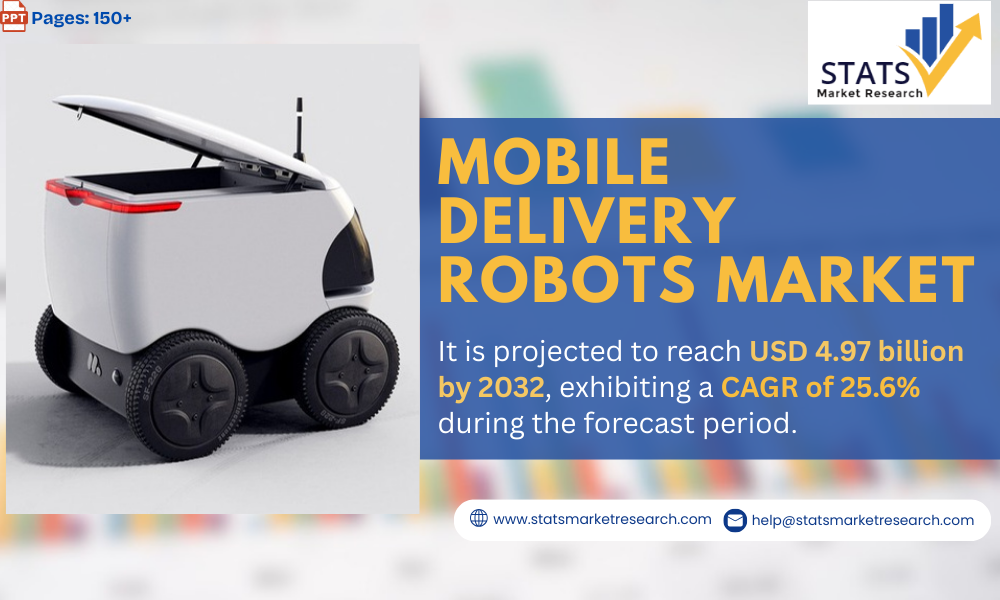
Mobile delivery robots (MDRs) are autonomous robotic vehicles designed primarily for last-mile delivery (LMD) of small goods, groceries, mail, and other lightweight items. These robots operate with minimal human intervention, leveraging advanced navigation systems, including LIDAR, computer vision, GPS, and AI-based algorithms, to move safely through urban and suburban environments.
Mobile delivery robots are categorized by payload capacity:
- Under 10kg – Typically used for food, mail, or small parcels.
- 10kg–50kg – Medium-duty deliveries like multiple grocery items or bulk goods.
- Over 50kg – Heavy-duty applications such as industrial goods or large parcel deliveries.
They find applications across retail, hospitality, healthcare, educational campuses, and smart city initiatives. These robots offer multiple benefits:
- Contactless Delivery: Reducing human contact, particularly post-pandemic.
- 24/7 Operational Capability: Continuous delivery without fatigue.
- Cost Efficiency: Reducing labor dependency and improving on-time delivery rates.
- Technological Integration: Advanced AI and sensor systems enhance navigation and operational safety.
Leading market players like Starship Technologies, Nuro Inc., and Serve Robotics are expanding fleets in airports, university campuses, and smart city environments, further validating the technology’s growth potential.
Market Size
Global mobile delivery robots market was valued at USD 1.05 billion in 2024. The market is projected to reach USD 4.97 billion by 2032, growing at a CAGR of 25.6% during the forecast period.
Download FREE Sample of this Report @ https://www.statsmarketresearch.com/download-free-sample/8061236/global-mobile-delivery-robots-forecast-market
Key trends driving this market growth include:
- Rising Demand for Contactless Delivery: During 2020-2022, last-mile delivery robots experienced a 300% increase in trial deployments, driven by pandemic-induced hygiene concerns. Retailers noted a 28% increase in customer satisfaction for deliveries executed by robots compared to human couriers.
- Labor Shortages in Logistics: Global logistics sectors face 15–20% annual turnover rates in delivery personnel. Mobile delivery robots now handle 30–40% of routine delivery tasks, enhancing operational stability and reliability.
- Technological Advancements: New developments in battery technology, AI-based navigation, and 5G connectivity allow robots to operate efficiently for 20–30 miles per charge in complex urban areas. Dedicated infrastructure in cities, including robot lanes and parking zones, has further accelerated deployment.
For instance, benchmarks show MDRs can complete 80–100 deliveries daily with 99.5% accuracy, outperforming human-only delivery systems, especially during peak periods.
Recent Developments
The mobile delivery robots market is advancing rapidly, driven by significant technological breakthroughs and a shift in business models. A key trend is the move toward adaptive autonomy, with robots increasingly capable of navigating complex and dynamic environments, such as sidewalks and urban streets, using a combination of advanced sensors, AI, and machine learning. Manufacturers are developing more robust and energy-efficient designs, including lightweight composite materials and long-lasting batteries, to extend operational range and reduce maintenance. The Robots-as-a-Service (RaaS) model is also gaining traction, allowing businesses to deploy robotic fleets with minimal upfront capital, which is accelerating adoption in sectors like food delivery, retail, and logistics. This focus on improving efficiency, reducing labor costs, and enhancing contactless delivery is fueling a new wave of innovation in the last-mile delivery ecosystem.
Major Distribution
The distribution of mobile delivery robots is primarily a business-to-business (B2B) process, with a high degree of specialization. The main channels include direct sales from robot manufacturers to large corporations and enterprises, such as major grocery chains, e-commerce giants, and logistics companies. These direct relationships are crucial for providing customized solutions, integration services, and ongoing technical support. Many manufacturers also partner with major food delivery apps, like Uber Eats, to integrate their robots into existing delivery networks. For broader market reach, companies are utilizing specialized automation and robotics distributors who can provide localized sales, installation, and maintenance services to a wider range of businesses, including hotels, hospitals, and universities. The distribution of these robots is a global effort, with a strong presence in regions with well-developed e-commerce and logistics sectors, particularly North America and Asia-Pacific.
Market Dynamics (Drivers, Restraints, Opportunities, and Challenges)
Drivers
Surging Demand for Contactless Delivery
- Consumer preference for automated deliveries persists post-pandemic, with 65% of urban users favoring touchless delivery.
- Retailers benefit from higher customer satisfaction and brand reputation by adopting MDRs.
Labor Shortages Drive Automation
- With over 500,000 unfilled logistics positions in major economies, robots are critical to maintaining operational efficiency.
- Integration of MDRs can improve on-time deliveries by up to 22%, crucial for meeting same-day delivery standards.
Technological Advancements
- LIDAR, AI, and computer vision enable autonomous navigation in dynamic urban environments.
- Improvements in battery life, energy efficiency, and lightweight materials extend operational range and reliability.
Restraints
High Deployment Costs
- Price per fully operational robot ranges from $15,000–$50,000, including fleet management software and charging infrastructure.
- Annual maintenance and software updates add 15–20% operating costs, creating adoption barriers for SMEs.
Regulatory Fragmentation
- Cities enforce inconsistent rules regarding sidewalk operation, speed limits, and pedestrian interaction, complicating national scaling.
Public Space Conflicts
- Safety concerns from pedestrians, including mobility-impaired individuals, may slow deployment in some jurisdictions.
Opportunities
Emerging Markets
- Southeast Asia, including Singapore and Bangkok, shows strong growth potential due to dense urban areas and rising e-commerce adoption.
- MDRs in these regions have demonstrated 40% faster delivery times than traditional methods.
Multi-Use Platforms
- Robots are being adapted for security patrols, waste collection, and infrastructure inspection, increasing asset utilization 2–3x.
- Innovative monetization models, like ad-supported deliveries and data-as-a-service, could reduce delivery costs by 15–25%.
Challenges
Technical Limitations
- Robots still face obstacles in construction zones, temporary events, and inclement weather, requiring human intervention in 5–8% of deliveries.
- Rain and snow reduce reliability by 30–40%, limiting deployment in certain climates.
Cybersecurity Risks
- 45% of commercial robots have unpatched vulnerabilities, exposing them to potential hijacking and data breaches.
Public Acceptance
- 38% of urban consumers remain uneasy about robots sharing pedestrian spaces, citing privacy and job displacement concerns.
Regional Analysis
- North America: High adoption in smart cities and university campuses; regulatory frameworks increasingly supportive.
- Europe: Early adoption in retail and healthcare sectors; government incentives for autonomous technologies.
- Asia-Pacific: Rapid adoption in dense urban centers; projected 35% of new deployments by 2026.
- Latin America: Pilots in e-commerce delivery and university campuses; slower regulatory progress.
- Middle East & Africa: Gradual adoption in high-density cities; infrastructure and regulation still developing.
Get the Complete Report & TOC @ https://www.statsmarketresearch.com/global-mobile-delivery-robots-forecast-market-8061236
Competitor Analysis
The mobile delivery robots market is highly competitive and rapidly evolving. Key players include:
- Starship Technologies (U.S./Estonia) – Over 4 million autonomous deliveries; partnerships with major retailers and restaurants.
- Nuro Inc. (U.S.) – Specialized R2 vehicle for grocery and medical deliveries; strong funding support.
- Serve Robotics (U.S.) – Spun off from Uber’s Postmates; expanding fleet in major cities.
- Segway Robotics (China) – Focused on APAC markets; government-supported smart city initiatives.
- Ottonomy.IO (U.S.) – Proprietary mobility algorithms for complex urban environments.
- Kiwibot (Colombia/U.S.) – Affordable campus and corporate park solutions.
- VT Systems (Singapore) – Regional manufacturing advantages; smart city integration.
- Relay Robotics (U.S.) – Niche deployments and customized software solutions.
- Uber Technologies Inc. (Postmates) (U.S.) – Integrated with UberEats delivery network for robotics trials.
Global Mobile Delivery Robots: Market Segmentation Analysis
This report provides a deep insight into the global Mobile Delivery Robots market, covering all its essential aspects. This ranges from a macro overview of the market to micro details of the market size, competitive landscape, development trend, niche market, key market drivers and challenges, SWOT analysis, value chain analysis, etc.
The analysis helps the reader to shape the competition within the industries and strategies for the competitive environment to enhance the potential profit. Furthermore, it provides a simple framework for evaluating and assessing the position of the business organization. The report structure also focuses on the competitive landscape of the Global Mobile Delivery Robots market. This report introduces in detail the market share, market performance, product situation, operation situation, etc., of the main players, which helps the readers in the industry to identify the main competitors and deeply understand the competition pattern of the market.
In a word, this report is a must-read for industry players, investors, researchers, consultants, business strategists, and all those who have any kind of stake or are planning to foray into the Mobile Delivery Robots market in any manner.
Market Segmentation (by Application)
- School
- Shopping Mall/Supermarket
- Restaurant
- Hotel
Market Segmentation (by Type)
- Under 10kg
- 10kg–50kg
- Over 50kg
Key Company
- Starship Technologies (U.S./Estonia)
- Nuro Inc. (U.S.)
- Segway Robotics (China)
- Serve Robotics Inc. (U.S.)
- Ottonomy.IO (U.S.)
- Relay Robotics (U.S.)
- VT Systems (Singapore)
- Kiwibot (Colombia/U.S.)
- Uber Technologies Inc. (Postmates) (U.S.)
Geographic Segmentation
- North America – U.S., Canada
- Europe – U.K., Germany, France
- Asia-Pacific – China, Singapore, Japan
- Latin America – Colombia, Brazil
- Middle East & Africa – UAE, South Africa
FAQ
Q1: What is the current market size of the Mobile Delivery Robots market?
A1: The market was valued at USD 1.05 billion in 2024 and is projected to reach USD 4.97 billion by 2032, growing at a CAGR of 25.6%.
Q2: Which are the key companies operating in this market?
A2: Key players include Starship Technologies, Nuro Inc., Segway Robotics, Serve Robotics, Ottonomy.IO, Kiwibot, VT Systems, Relay Robotics, and Uber Technologies (Postmates).
Q3: What are the key growth drivers in this market?
A3: Growth is fueled by contactless delivery demand, chronic labor shortages, and advancements in AI navigation, battery, and autonomous technologies.
Q4: Which regions dominate the market?
A4: North America and Europe currently lead adoption, while Asia-Pacific is emerging rapidly, especially in dense urban areas.
Q5: What are the emerging trends in the Mobile Delivery Robots market?
A5: Trends include multi-use robotic platforms, electric propulsion adoption, smart city integration, ad-supported delivery models, and campus-specific deployments.
About Us
☎️ International: +1 (332) 2424 294
📄 Website: www.statsmarketresearch.com
Join us on LinkedIn:- https://www.linkedin.com/company/statsmarketresearch




