

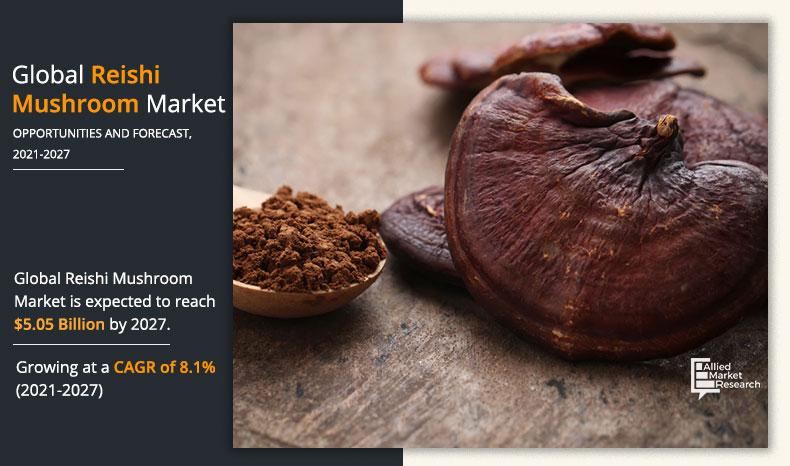
According to a new report published by Allied Market Research, titled, “Reishi Mushroom Market by Form, End Use, and Nature: Opportunity Analysis and Industry Forecast, 2021–2027,” the global reishi mushroom market was valued at $3,097.3 million in 2019, and is projected to reach $5,059.8 million by 2027, registering a CAGR of 8.1% from 2021 to 2027. The market is expected to exhibit an incremental revenue reishi mushroom market opportunity of $1.88 billion from 2021 to 2027. Rise in application of reishi mushroom in healthcare products, dietary supplements, cosmetics & personal care products, as a result of growing health consciousness, are the key factors for reishi mushroom market trends.
There has been a trend and substantial growth in developing natural drugs to prevent and treat several immunological diseases over the last decades. The fruiting bodies of reishi mushroom species have gained popularity as dietary supplements in China, Japan, North America, and other regions of the world. Furthermore, it has been used as a functional food to prevent and treat immunological diseases, owing to its bioactive constituents that are regarded to provide anti-cancer, anti-inflammatory, anti-tumor, anti-oxidant, immunomodulatory, immunodeficiency, and anti-fungal properties. Moreover, the demand for reishi mushrooms as a key ingredient in several personal care products has also gained high traction. This is due to its excellent antioxidant, anti-aging, anti-wrinkle, skin whitening, and moisturizing properties. Consumers are increasingly inclined toward products manufactured using plant-based organic ingredients, instead of synthetically sourced. However, reishi mushrooms products are high priced, and this factor is expected to hinder the reishi mushroom market growth.
Download Sample Report: https://www.alliedmarketresearch.com/request-sample/A10352
Owing to the outspread of COVID-19, the reishi mushroom market has been largely impacted due to lack of availability of workers, which in turn affected the production capacity. Furthermore, due to closures of wholesale markets, producers had to solely rely on supermarkets and e-commerce traders to market the mushroom products. Hence, the market for reishi mushrooms was largely impacted during the pandemic. However, since it is regarded as a therapeutic product, the demand for reishi mushroom is anticipated to gain higher traction in the near future. This is due to increase in consumption of dietary supplements and nutraceutical products by consumers as a means to stay healthier and gain immunity.
On the basis of form, the powder reishi mushroom category accounted for the maximum reishi mushroom market share in 2019. Powdered reishi mushroom has an array of applications owing to its versatile nature. The nutrient composition of powdered mushroom is similar to that of its fresh version; however, with lowered calorie content. Furthermore, it can blend easily in any food & beverage product. Therefore, the powdered reishi mushroom segment accounted for the largest share in 2019. However, the liquid reishi mushroom segment is expected to grow at a higher CAGR during the forecast period. The liquid version of reishi mushroom extract consists of less impurities, which is crucial if a consumer chooses to take reishi mushroom supplements for a particular effect. Furthermore, liquid forms of the extract provide concentrated nutrition version of the mushrooms as compared to powder. It can be easily added to on-the-beverages, which is another significant consumer element.
Buy This Research Report: https://www.alliedmarketresearch.com/reishi-mushroom-market/purchase-options
On the basis of end use, the pharmaceutical, nutraceutical & dietary supplements segment accounted for the maximum share in the global reishi mushroom market in 2019. Reishi mushrooms are regarded to have high medicinal properties and have been formerly consumed for their therapeutic properties. The application of reishi mushrooms in dietary supplements has gained high momentum due to product improvement thorough research & development,. Furthermore, the market for reishi mushroom in this segment experiences growth owing to rise in interest of consumers toward plant-based supplements. However, the cosmetics & personal care reishi mushroom segment is expected to grow at a higher CAGR during the forecast period. The numerous skin-benefitting properties offered by Reishi mushrooms include antioxidant, anti-aging, anti-wrinkle, skin whitening, and moisturizing effects, which make them ideal ingredients for cosmetics products. Therefore, the cosmetics & personal care segment is anticipated to garner the highest traction during the forecast period.
On the basis of nature, the conventional reishi mushroom segment accounted for the maximum share in the global reishi mushroom market in 2019. Mushrooms sourced conventionally are comparatively economical and are widely used in industrial production. Conventional reishi mushrooms provide benefits over its organic counterpart in terms of price and availability.
However, the organic segment is anticipated to grow at the highest CAGR during the reishi mushroom market forecast period. Organic reishi mushrooms products are manufactured using all natural and non-GMO raw materials. Consumers have gradually become well-informed regarding the food they consume and also have knowledge and awareness about the ill effects of synthetic chemicals on their health owing to rise in health consciousness,. Hence, the organic segment is expected to garner a considerable growth rate during the forecast period.
For Purchase Enquiry: https://www.alliedmarketresearch.com/purchase-enquiry/A10352
On the basis of region, Asia-Pacific was the prominent market for reishi mushroom in 2019. Reishi mushroom and its products have experienced tremendous popularity and substantial consumption in the region for centuries. Furthermore, China has been the largest producer and consumer of reishi mushroom products. However, the North America region is expected to witness a significant CAGR. Consumers in this region have been more inclined toward health-conscious products which includes functional food & beverages due to of lifestyle changes. As Thus, the demand for plant-based food supplements is anticipated to gain high traction.
Key findings of the study In Reishi Mushroom Market
- By form, the powder segment was the highest contributor to the reishi mushroom market, with $1886.8 million in 2019, and is estimated to reach $3012.8 million by 2027, at a CAGR of 7.80% during the forecast period.
- By end use, the pharmaceutical, nutraceutical and dietary supplements segment was the highest contributor to the reishi mushroom market size with $1312.8 million in 2019, and is estimated to reach $2051.5 million by 2027, at a CAGR of 7.50% during the forecast period.
- By nature, the conventional segment was the highest contributor to the market, with $1894.2 million in 2019. However, the organic segment is anticipated to grow at the highest CAGR.
- By region, Asia-Pacific was the most prominent market, in 2019; however, North America is expected to grow at a significant CAGR throughout the forecast period.
The key players operating in the reishi mushroom industry include Alphay International, Inc. (China), Bio Botanica, Inc. (U.S.), Bristol Botanicals Limited (UK), Ron Teeguarden Enterprises, Inc. (U.S.), DXN Holdings Bhd. (Malaysia), Shanghai Gubao Edible Mushroom Co., Ltd. (China), Xi’an Greena Biotech Co., Ltd (China), Fujian Xianzhilou Biological Technology Co., Ltd. (China), Hokkaido Reishi Co., Ltd. (Japan), and Nammex (North American Medicinal Mushroom Extracts).




