

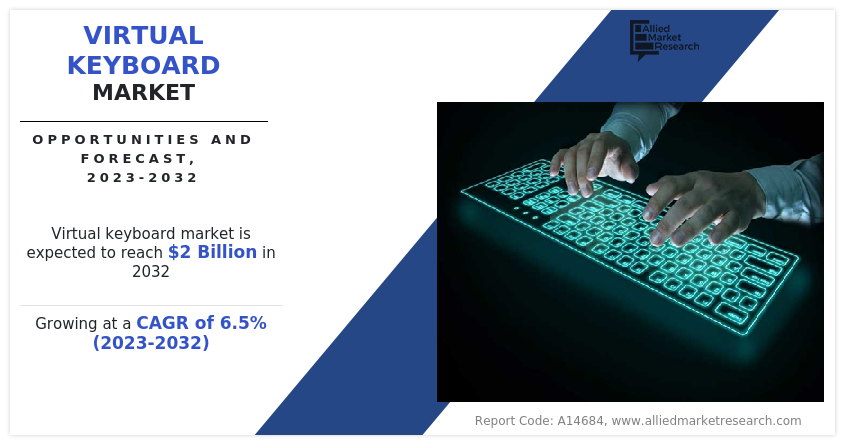
According to a new report published by Allied Market Research, titled, “Virtual Keyboard Market by Technology, Distribution channel, and Connectivity: Global Opportunity Analysis and Industry Forecast, 2023-2032,” The virtual keyboard market was valued at $1.1 billion in 2022, and is estimated to reach $2 billion by 2032, growing at a CAGR of 6.5% from 2023 to 2032.
Request The Sample PDF Of This Report: https://www.alliedmarketresearch.com/request-sample/A14684
A virtual keyboard is a software-driven interface enabling character input without the need for physical keys. Commonly found on touch-sensitive devices such as smartphones, tablets, and touchscreen computers, users engage with the virtual keyboard by tapping the displayed keys on the screen. The device’s touch sensors detect and convert these inputs into characters or commands. In addition, virtual keyboards serve as an accessibility feature for individuals with impairments, offering operation via a mouse or stylus. They provide enhanced security for sensitive activities, such as password entry, by thwarting hardware-based keyloggers from recording keystrokes, making them a preferred option for privacy-conscious tasks.
The integration of virtual keyboards with Internet of Things (IoT) devices is a pivotal driving factor, representing a convergence of technology to enhance connectivity. Virtual keyboards play a crucial role in facilitating user interaction with a variety of IoT devices, including smart home appliances, industrial equipment, and wearable gadgets. As the IoT ecosystem expands, virtual keyboards provide intuitive input solutions, enabling users to control and manage diverse connected devices seamlessly. This integration enhances user convenience as well as contributes to the efficiency and accessibility of IoT applications. Virtual keyboards act as a bridge between users and the expanding world of interconnected devices, fostering a more interconnected and user-friendly IoT experience across various industries and use cases.
However, the dependence of virtual keyboards on touchscreen devices represents a notable restraint in their widespread adoption. While virtual keyboards are ideal for touch-enabled devices like smartphones and tablets, scenarios where touch interfaces are impractical, or undesirable may limit their utility. In environments where physical keyboards are preferred, such as certain industrial settings or for users with specific accessibility needs, the reliance on touchscreen devices may pose challenges. In addition, virtual keyboards may not offer the same level of comfort and precision as physical keyboards in applications where tactile feedback is crucial. This limitation can impact user satisfaction and hinder the seamless integration of virtual keyboards in situations where touch interfaces are not the preferred mode of input.
LIMITED-TIME OFFER – Buy Now & Get Exclusive Discount on this Report@ https://www.alliedmarketresearch.com/checkout-final/e81a4f76fed75dafdf16b8cedd151bae
Moreover, the integration of virtual keyboards in automotive settings represents a compelling growth opportunity. With the increasing prevalence of touch-enabled surfaces in vehicles, virtual keyboards can offer intuitive and space-efficient input solutions for in-car systems, navigation, and entertainment interfaces. As automotive technology advances, the demand for seamless and user-friendly controls rises, and Holographic Keyboard can provide a sophisticated yet accessible means of interaction. This includes touchscreens embedded in dashboards or consoles, where users can input information conveniently. The adoption of virtual keyboards in automobiles aligns with the broader trend toward enhancing the user experience in modern vehicles, offering drivers and passengers a convenient and technology-driven way to interact with in-car systems, contributing to the growth and diversification of the virtual keyboard market analysis.
The virtual keyboard industry is segmented into technology, connectivity, distribution channel, and region. By technology, the Virtual Keyboard Market Segmentation is divided into on-screen keyboards and projected keyboards. In 2022, On-Screen keyboard has highest revenue. By connectivity, the market is bifurcated into Bluetooth, Wi-Fi, USB, and in-built. By distribution channel, the market is classified as online and offline.
By region, Virtual Keyboard Market Share is analyzed across North America (the U.S., Canada, and Mexico), Europe (UK, Germany, France, Italy, and the rest of Europe), Asia-Pacific (China, Japan, India, South Korea, and rest of Asia-Pacific), Latin America (Brazil, Argentina, and Rest of Latin America), and Middle East and Africa (UAE, Saudi Arabia, Qatar, South Africa, and Rest of Middle East and Africa).
Competitive analysis and profiles of the major Virtual keyboard market players, such as ABB, Alphabet Inc. (Google LLC), Apple, Fleksy, Swype, TouchPal, Samsung, iNextStation Virtual, CTX Technologies, and ShowMe are provided in this report. Product launch and acquisition business strategies were adopted by the major market players in 2022.
Inquiry Before Buying @ https://www.alliedmarketresearch.com/purchase-enquiry/A14684
KEY FINDINGS OF THE STUDY
- The virtual keyboard market size is expected to grow significantly in the coming years, driven by the increase in the use of mobile devices.
- The market is highly competitive, with several major players competing for market share. The competition is expected to intensify in the coming years as new players enter the market.
- The Asia-Pacific region is expected to be a major market for Virtual Keyboard Market Growth Projections, owing to rapid technological adoption, economic growth, and digitization trends in the region.
The key players profiled in the virtual keyboard market demand, such as ABB, Alphabet Inc. (Google LLC), Apple, Fleksy, Swype, TouchPal, Samsung, iNextStation Virtual, CTX Technologies, and ShowMe are provided in this report. Product launch and acquisition business strategies were adopted by the major market players in 2022.
About Us
Allied Market Research (AMR) is a full-service market research and business consulting wing of Allied Analytics LLP based in Wilmington, Delaware. Allied Market Research provides end-to-end solutions along with information, education, advocacy, and networking resources to SMEs and early-stage start-ups to bring excellence to their processes. In addition, we offer a nurturing environment required to develop and grow businesses, including business planning; virtual support; market intelligence; acquiring resources; and getting direct access to finance, suppliers, and other experts to boost the growth of businesses and entrepreneurs.
Our bundled and hassle-free business support systems are customized to meet the needs of SME consultants and industry leaders. Moreover, our large network of skilled consultants and experts help start-ups get the business on a roll.
Contact:
David Correa
1209 Orange Street,
Corporation Trust Center,
Wilmington, New Castle,
Delaware 19801 USA.
Int’l: +1-503-894-6022
Toll Free: +1-800-792-5285
Fax: +1-800-792-5285
[email protected]
Web: www.alliedmarketresearch.com
Allied Market Research Blog: https://blog.alliedmarketresearch.com
Follow Us on | Facebook | LinkedIn | YouTube




