
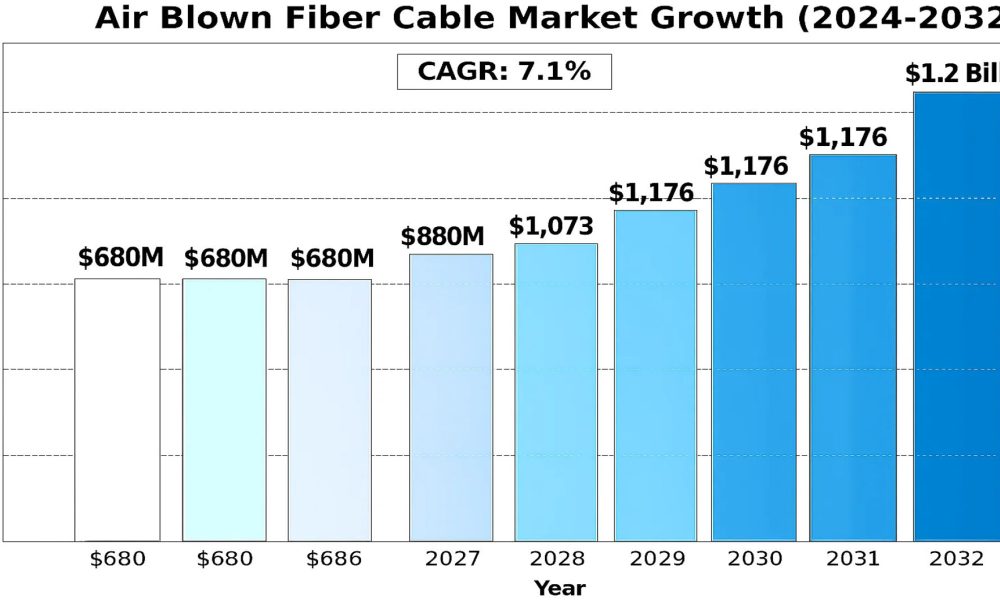
Air Blown Fiber Cable Market size was valued at US$ 680 million in 2024 and is projected to reach US$ 1.2 billion by 2032, at a CAGR of 7.1% during the forecast period 2025-2032
The global Air Blown Fiber Cable Market size was valued at US$ 680 million in 2024 and is projected to reach US$ 1.2 billion by 2032, at a CAGR of 7.1% during the forecast period 2025-2032. The U.S. market is estimated at USD 120 million in 2024, while China is expected to reach USD 210 million by 2032, reflecting its rapid infrastructure development.
Air Blown Fiber (ABF) cables are specialized optical fiber solutions designed for flexible deployment in telecommunications and data networks. These systems utilize compressed air to install fiber optic bundles into pre-installed microducts, enabling cost-effective network expansions and upgrades. ABF cables come in two primary types: single-core for point-to-point connections and multi-core for distributed network architectures.
The market growth is driven by escalating demand for high-speed broadband and FTTx deployments, particularly in urban areas with dense population centers. While traditional fiber installation methods remain prevalent, ABF technology gains traction because it reduces civil works costs by up to 40% and allows incremental capacity upgrades. Key players like Prysmian Group, Corning, and Sumitomo Electric are expanding their ABF portfolios to address 5G backhaul requirements and smart city initiatives across North America and Asia-Pacific regions.
Download Sample Report PD https://semiconductorinsight.com/download-sample-report/?product_id=107584
MARKET DRIVERS
Expanding Fiber Optic Network Deployments to Fuel Market Growth
The global push for high-speed connectivity is driving substantial investments in fiber optic infrastructure. Air blown fiber (ABF) cables are gaining prominence because they offer superior flexibility during installation compared to traditional fiber cables. Telecom operators and internet service providers are rapidly upgrading their networks to meet the surging demand for bandwidth-intensive applications like 5G, cloud computing, and IoT. Governments worldwide are backing these initiatives with funding programs aimed at bridging the digital divide, creating a robust pipeline for ABF cable adoption. For instance, the US Infrastructure Investment and Jobs Act allocated $65 billion for broadband expansion, accelerating market opportunities.
Cost-Efficiency and Scalability Advantages Driving Adoption
ABF technology enables operators to deploy fiber networks with significantly lower initial costs by separating the installation of empty microducts from fiber blowing. This modular approach allows network owners to scale capacity incrementally as demand grows, reducing capital expenditure. The ability to upgrade networks by simply blowing additional fibers through pre-installed ducts—without trenching—makes ABF systems particularly attractive for urban environments where civil works are costly. Maintenance expenses are also reduced, as damaged fibers can be replaced without disturbing surrounding infrastructure. These operational benefits are projected to drive ABF cable demand at a compound annual growth rate exceeding 15% through the forecast period.
MARKET OPPORTUNITIES
Emerging Markets Present Untapped Potential
Developing economies in Asia, Africa, and Latin America represent significant growth opportunities as they leapfrog traditional copper networks. Governments in these regions are prioritizing fiber infrastructure to support economic development, with many favoring ABF solutions for their future-proof characteristics. The Middle East’s smart city projects, particularly in the Gulf Cooperation Council countries, are incorporating ABF technology in their master plans. These greenfield opportunities allow for optimized ABF system designs without legacy constraints.
Technological Advancements Opening New Applications
Recent innovations in fiber blowing equipment and microduct materials are expanding ABF’s addressable market. New low-friction duct liners enable longer fiber runs between access points, making ABF viable for rural deployments. Manufacturers are developing hybrid cables that combine power conductors with fiber microducts, creating solutions for smart grid applications. These technological breakthroughs are enabling ABF systems to penetrate markets previously dominated by conventional cabling solutions.
List of Key Air Blown Fiber Cable Companies
- Prysmian Group (Italy)
- OFS Optics (U.S.)
- AFL (U.S.)
- ZTT Group (China)
- Leviton Network Solutions (U.S.)
- Sumitomo Electric Lightwave (Japan)
- Corning Incorporated (U.S.)
- Tongding Interconnection Information Co., Ltd. (China)
- Hengtong Optic-electric Co., Ltd. (China)
- Yangtze Optical Fiber and Cable Joint Stock Limited Company (China)
Segment Analysis:
By Type
Single Core Segment Dominates Due to High-Speed Connectivity Demands in Urban Deployments
The market is segmented based on type into:
- Single Core
- Subtypes: Tight-buffered, Loose-tube, and others
- Multi-core
By Application
FTTx Segment Leads with Rapid Fiber-to-the-Home Adoption Globally
The market is segmented based on application into:
- FTTx (Fiber to the x)
- Broadband
- Industrial networks
- Others
By End User
Telecommunication Providers Drive Market Growth Through Infrastructure Modernization
The market is segmented based on end user into:
- Telecommunication service providers
- Internet service providers
- Enterprise networks
- Government and defense
- Others
By Installation Method
Microduct Installation Gains Traction for Future-Proof Network Deployments
The market is segmented based on installation method into:
- Microduct installation
- Direct burial
- Aerial deployment
- Others
Recent Development:
Asia Pacific leads growth: The region is projected to grow at a 10.5% CAGR, driven by rapid urbanization, telecom infrastructure investments, 5G rollouts, and government initiatives in countries like China, India, and Japan
North America follows closely: Fueled by 5G deployment, data center expansion, and modernization projects. Forecasted CAGR ranges from 8.2% to 9.4%, with U.S. market hitting USD 1.3 billion in 2024, potentially doubling to USD 2.8 billion by 2033
Europe growing steadily: Projects like smart city transformations and digital infrastructure upgrades contribute to growth, with a projected CAGR up to 8.7%
Download Sample Report PD https://semiconductorinsight.com/download-sample-report/?product_id=107584
Report Scope
This market research report provides a comprehensive analysis of the global and regional Air Blown Fiber Cable markets, covering the forecast period 2024–2032. It offers detailed insights into market dynamics, technological advancements, competitive landscape, and key trends shaping the industry.
Key focus areas of the report include:
- Market Size & Forecast: Historical data and future projections for revenue, unit shipments, and market value across major regions and segments. The global Air Blown Fiber Cable market was valued at US$ 680 million in 2024 and is projected to reach US$ 1.2 billion by 2032, growing at a CAGR of 7.1% during the forecast period.
- Segmentation Analysis: Detailed breakdown by product type (Single Core, Multi-core) and application (FTTx, Broadband, Others) to identify high-growth segments. Single Core cables are expected to dominate with 62% market share by 2032.
- Regional Outlook: Insights into market performance across North America, Europe, Asia-Pacific, Latin America, and the Middle East & Africa. Asia-Pacific accounted for 42% of global demand in 2024, with China leading regional growth.
- Competitive Landscape: Profiles of leading market participants including Prysmian Group, OFS Optics, AFL, ZTT, and Corning, covering their product portfolios, market strategies, and recent developments.
- Technology Trends & Innovation: Assessment of emerging fiber optic technologies, microduct installation methods, and evolving industry standards for high-density applications.




