
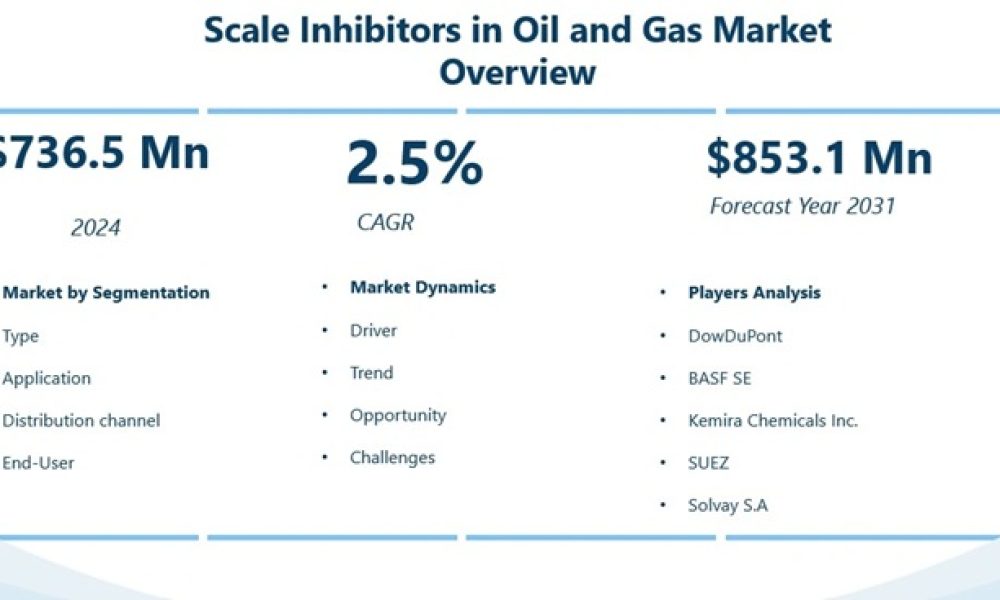
The latest study released on the Global Scale Inhibitors in Oil and Gas Market by HTF MI Research evaluates market size, trend, and forecast to 2031. The Scale Inhibitors in Oil and Gas market study covers significant research data and proofs to be a handy resource document for managers, analysts, industry experts and other key people to have ready-to-access and self-analysed study to help understand market trends, growth drivers, opportunities and upcoming challenges and about the competitors.
Key Players in This Report Include:
DowDuPont , BASF SE , Kemira Chemicals Inc., SUEZ , Solvay S.A , Ecolab , Clariant International Ltd., Arkema SA , Solenis , BWA Water Additives
Download Sample Report PDF (Including Full TOC, Table & Figures) @ https://www.htfmarketintelligence.com/sample-report/global-scale-inhibitors-in-oil-and-gas-market?utm_source=Alefiya_NewsTrail&utm_id=Alefiya
Definition:
In many sectors, scale formation is a significant problem that results in poor operational effectiveness and financial losses. Scale development must be prevented with an effective management technique. A scale in the oilfield can lead to a number of issues that are present throughout the whole process of producing oil and gas. One of the most critical issues in the oil and gas business is scale deposition, which inhibits the flow of liquids and gases through oilfield systems from the moment fluids start to enter producing wellbores until the water is disposed of or pumped into a subterranean zone. There are two types of oilfield scale deposits: organic and inorganic. Calcium sulphate, barium sulphate, and calcium carbonate are examples of inorganic scales that are associated to inorganic deposits. Shales, sand, and clay deposits, as well as inorganic deposits like iron carbonate and iron sulphide, may be byproducts of corrosion or the consequence of scale deposition. Deposits like these can also be a component of the formation rock.
Market Trends:
- Increasing demand for environmentally friendly and sustainable scale inhibitors: The oil and gas industry is under pressure to reduce its environmental footprint and adopt more sustainable practices. As a result, there is increasing demand for scale inhibitors that are environmentally friendly and sustainable. For example, some scale inhibitors are derived from natural sources such as plant extracts, which can reduce the environmental impact of oil and gas production.
Market Drivers:
- Production efficiency: Scale formation can cause reduced production rates, wellbore blockages, and equipment failure. By using scale inhibitors, companies can maintain production rates and reduce downtime due to equipment maintenance.
Market Opportunity:
- Increased production rates: By preventing the formation of scale deposits, scale inhibitors can help maintain the efficiency and productivity of oil and gas wells, resulting in increased production rates.
Major Highlights of the Scale Inhibitors in Oil and Gas Market report released by HTF MI
Global Scale Inhibitors in Oil and Gas Market Breakdown by Application (Direct Sales, Indirect Sales) by Type (Phosphonate Scale Inhibitor, Carboxylate/Acrylic Scale Inhibitor, Sulfonate Scale Inhibitor, Others) and by Geography (North America, South America, Europe, Asia Pacific, MEA)
Global Scale Inhibitors in Oil and Gas market report highlights information regarding the current and future industry trends, growth patterns, as well as it offers business strategies to helps the stakeholders in making sound decisions that may help to ensure the profit trajectory over the forecast years.
Buy Complete Assessment of Scale Inhibitors in Oil and Gas market Now @ https://www.htfmarketintelligence.com/buy-now?format=1&report=374?utm_source=Alefiya_NewsTrail&utm_id=Alefiya
Geographically, the detailed analysis of consumption, revenue, market share, and growth rate of the following regions:
- The Middle East and Africa (South Africa, Saudi Arabia, UAE, Israel, Egypt, etc.)
- North America (United States, Mexico & Canada)
- South America (Brazil, Venezuela, Argentina, Ecuador, Peru, Colombia, etc.)
- Europe (Turkey, Spain, Turkey, Netherlands Denmark, Belgium, Switzerland, Germany, Russia UK, Italy, France, etc.)
- Asia-Pacific (Taiwan, Hong Kong, Singapore, Vietnam, China, Malaysia, Japan, Philippines, Korea, Thailand, India, Indonesia, and Australia).
Objectives of the Report
- To carefully analyze and forecast the size of the Scale Inhibitors in Oil and Gas market by value and volume.
- To estimate the market shares of major segments of the Scale Inhibitors in Oil and Gas
- To showcase the development of the Scale Inhibitors in Oil and Gas market in different parts of the world.
- To analyze and study micro-markets in terms of their contributions to the Scale Inhibitors in Oil and Gas market, their prospects, and individual growth trends.
- To offer precise and useful details about factors affecting the growth of the Scale Inhibitors in Oil and Gas
- To provide a meticulous assessment of crucial business strategies used by leading companies operating in the Scale Inhibitors in Oil and Gas market, which include research and development, collaborations, agreements, partnerships, acquisitions, mergers, new developments, and product launches.
Major highlights from Table of Contents:
Scale Inhibitors in Oil and Gas Market Study Coverage:
- It includes major manufacturers, emerging player’s growth story, and major business segments of Scale Inhibitors in Oil and Gas market, years considered, and research objectives. Additionally, segmentation on the basis of the type of product, application, and technology.
- Scale Inhibitors in Oil and Gas Market Executive Summary: It gives a summary of overall studies, growth rate, available market, competitive landscape, market drivers, trends, and issues, and macroscopic indicators.
- Scale Inhibitors in Oil and Gas Market Production by Region Scale Inhibitors in Oil and Gas Market Profile of Manufacturers-players are studied on the basis of SWOT, their products, production, value, financials, and other vital factors.
- Key Points Covered in Scale Inhibitors in Oil and Gas Market Report:
- Scale Inhibitors in Oil and Gas Overview, Definition and Classification Market drivers and barriers
- Scale Inhibitors in Oil and Gas Market Competition by Manufacturers
- Scale Inhibitors in Oil and Gas Capacity, Production, Revenue (Value) by Region (2025-2031)
- Scale Inhibitors in Oil and Gas Supply (Production), Consumption, Export, Import by Region (2025-2031)
- Scale Inhibitors in Oil and Gas Production, Revenue (Value), Price Trend by Type {Phosphonate Scale Inhibitor, Carboxylate/Acrylic Scale Inhibitor, Sulfonate Scale Inhibitor, Others}
- Scale Inhibitors in Oil and Gas Market Analysis by Application {Direct Sales, Indirect Sales}
- Scale Inhibitors in Oil and Gas Manufacturers Profiles/Analysis Scale Inhibitors in Oil and Gas Manufacturing Cost Analysis, Industrial/Supply Chain Analysis, Sourcing Strategy and Downstream Buyers, Marketing
- Strategy by Key Manufacturers/Players, Connected Distributors/Traders Standardization, Regulatory and collaborative initiatives, Industry road map and value chain Market Effect Factors Analysis.
Have a query? Market an enquiry before purchase @ https://www.htfmarketintelligence.com/enquiry-before-buy/global-scale-inhibitors-in-oil-and-gas-market?utm_source=Alefiya_NewsTrail&utm_id=Alefiya
Key questions answered
- How feasible is Scale Inhibitors in Oil and Gas market for long-term investment?
- What are influencing factors driving the demand for Scale Inhibitors in Oil and Gas near future?
- What is the impact analysis of various factors in the Global Scale Inhibitors in Oil and Gas market growth?
- What are the recent trends in the regional market and how successful they are?
Thanks for reading this article; you can also get individual chapter-wise sections or region-wise report versions like North America, LATAM, Europe, or Southeast Asia.
Contact Us:
Nidhi Bhavsar (PR & Marketing Manager)
HTF Market Intelligence Consulting Private Limited
Phone: +15075562445