
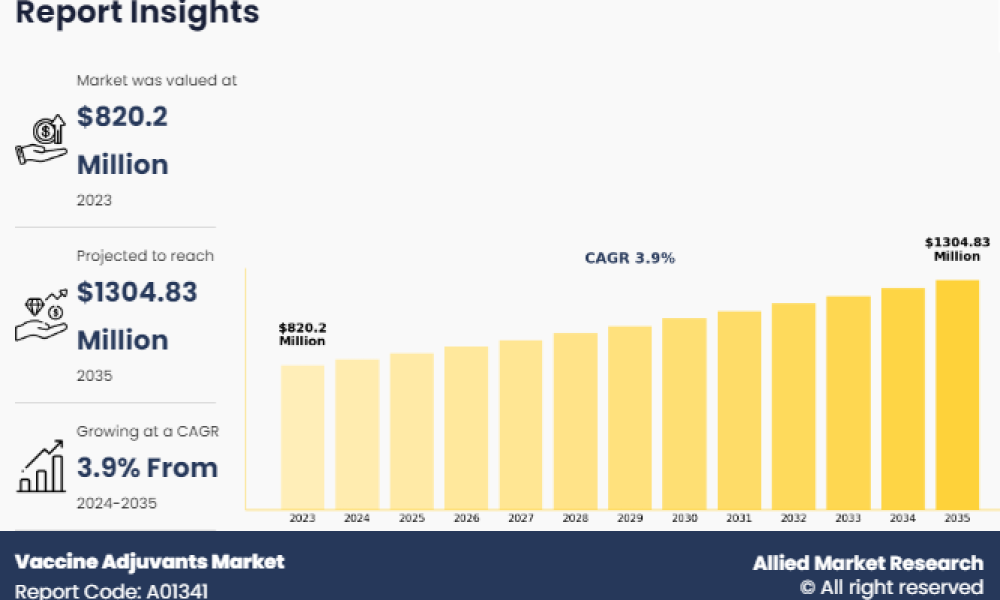
The global vaccine adjuvants market is on a steady growth path, driven by the urgent need for more effective vaccines against infectious diseases, rising global awareness of immunization programs, and advancements in adjuvant technologies. Valued at $820.2 million in 2023, the market is projected to reach $1,304.83 million by 2035, growing at a CAGR of 3.9% from 2024 to 2035, according to the latest industry analysis.
Vaccine adjuvants—substances added to vaccines to enhance the body’s immune response—play a pivotal role in modern immunization strategies. By improving the immune system’s recognition of antigens, adjuvants help reduce the amount of antigen required per dose, extend immunity duration, and, in some cases, enable protection against multiple pathogen strains.
Get a Sample Copy of this Report: https://www.alliedmarketresearch.com/request-sample/1666
Rising Infectious Disease Burden Driving Demand
The persistent prevalence of infectious diseases continues to underscore the critical role of adjuvants in global public health. According to the Centers for Disease Control and Prevention (CDC), during the 2023–2024 influenza season in the U.S., public health laboratories tested 129,638 specimens, identifying 39,885 as influenza positive. Of these, 76.9% were influenza A and 23.1% were influenza B—highlighting the ongoing need for potent vaccines supported by advanced adjuvants.
This growing disease burden, combined with global vaccination initiatives, has created a robust demand for next-generation adjuvants that can improve vaccine efficacy, safety, and accessibility.
Technological Advancements Expanding Applications
The market has seen significant innovation in adjuvant formulations. New-generation adjuvants such as MF59 (an oil-in-water emulsion) and AS04 (aluminum hydroxide combined with a TLR4 agonist) are demonstrating enhanced safety and efficacy in clinical trials. These advancements have expanded the scope of adjuvants to include vaccines for diseases such as COVID-19, malaria, and human papillomavirus (HPV), as well as potential cancer immunotherapies and allergy treatments.
By stimulating more targeted immune responses, these advanced adjuvants are also enabling the development of vaccines for emerging infectious diseases and conditions previously underserved by traditional vaccine approaches.
Government Support and Global Health Initiatives
Public sector backing remains a strong growth driver. Organizations such as Gavi, the Vaccine Alliance, the National Institutes of Health (NIH), and the World Health Organization (WHO) are investing heavily in vaccination programs, particularly in low- and middle-income countries. These initiatives increase vaccine coverage and accelerate the adoption of adjuvant-based formulations, especially in regions facing limited healthcare infrastructure.
In emerging markets like India and China, rapid urbanization, expanding healthcare infrastructure, and increased R&D investment are creating significant opportunities for vaccine adjuvant manufacturers to reach new patient populations.
Market Segmentation Highlights
By Type
Vehicles and mucosal adjuvants dominated the market in 2023 and are projected to grow at the fastest rate. Their ability to improve antigen stability, enhance immune response, and facilitate targeted delivery makes them a preferred choice in vaccine design.
Immunostimulants remain critical for boosting immune system activation and are widely used in vaccines targeting infectious and chronic diseases.
By Disease
Infectious diseases accounted for the largest market share in 2023 and are anticipated to record the highest CAGR. The segment’s growth is supported by increasing vaccination campaigns and technological advancements in pathogen-specific vaccines.
The others category, including cancer and allergy vaccines, is expected to grow steadily as research expands into non-infectious disease immunization.
By Application
The commercial segment led the market in 2023, reflecting large-scale vaccine production for global immunization programs.
Strategic partnerships between vaccine developers and adjuvant manufacturers are boosting production capacity and enabling rapid deployment in response to outbreaks.
By Region
North America held the largest market share in 2023, supported by leading vaccine R&D hubs, established pharmaceutical players, and strong healthcare funding.
Asia-Pacific is projected to grow at the highest CAGR, driven by large population bases, rising healthcare expenditure, and expanded manufacturing capabilities.
Challenges and Opportunities
Despite strong growth potential, the market faces challenges such as high R&D investment costs, stringent regulatory requirements, and safety concerns associated with some adjuvant types. While most adjuvants are well tolerated, side effects like local inflammation or rare allergic reactions can lead to public hesitancy, underscoring the need for transparent communication and post-market surveillance.
However, these challenges also present innovation opportunities. Companies that can develop safer, more effective, and thermally stable adjuvants stand to gain competitive advantages, particularly in regions where vaccine cold-chain logistics remain a barrier.
Competitive Landscape
The global vaccine adjuvants market features both established pharmaceutical giants and specialized biotech firms. Key players include:
GlaxoSmithKline plc – A leader in adjuvant innovation with a portfolio that includes AS01, AS03, and AS04.
Croda International Plc – Partnering with research organizations to expand access to novel adjuvant formulations.
In March 2024, Croda International Plc and the Access to Advanced Health Institute (AAHI) announced a strategic partnership to co-develop adjuvant formulations for global vaccine programs. This collaboration aims to make next-generation, durable vaccines accessible worldwide, particularly in underserved regions.
Future Outlook
The vaccine adjuvants market is set to remain a critical enabler of public health over the next decade. As infectious disease threats persist and the scope of vaccination expands to chronic and non-communicable diseases, demand for more sophisticated adjuvant technologies will only increase.
Innovations that deliver stronger immune responses, fewer doses, and longer-lasting protection will be central to future vaccine success. With the combined efforts of global health organizations, governments, and industry leaders, the vaccine adjuvants market is poised to play a defining role in shaping the next era of immunization.




