
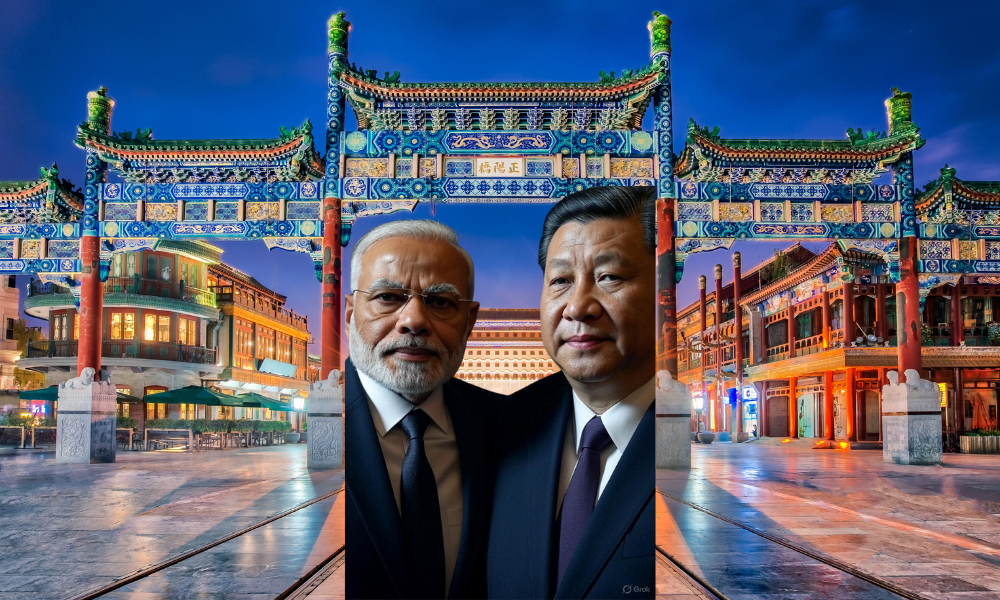
As US-India trade tensions flare and global powers stumble in resolving major conflicts, Indian Prime Minister Narendra Modi is preparing for a trip that may prove more consequential than any press statement or summit speech. He’s going to China.
This will be Modi’s first visit to China in over seven years, a move timed not just around the Shanghai Cooperation Organization (SCO) summit but at a critical inflection point in world affairs. With Trump’s escalating tariffs on Indian exports and his administration’s looming penalties over India’s continued oil trade with Russia, India’s shifting diplomatic gears are becoming impossible to ignore.
While much of the Western world remains preoccupied with the deteriorating situation in Ukraine and with efforts to force a ceasefire faltering, India is charting a path of its own. But to understand what this means, one must move beyond Modi’s carefully-worded speeches and look at his actions. Because in geopolitics, what leaders do is always more telling than what they say.
China and India: The World’s Real Center of Gravity
Modi’s visit to China may look like a pragmatic diplomatic event but symbolically, it’s a thunderclap. India and China together represent more than one third of humanity. In a world increasingly split between old alliances and new tensions, the quiet reengagement between the two most populous nations should be viewed not as a regional development but as a global pivot point.
Their relationship, once fractured by border clashes and political mistrust, is beginning to thaw. After a sideline meeting between Modi and Xi Jinping at the BRICS summit in 2024, ties have slowly warmed, and Modi’s upcoming visit to Tianjin confirms the momentum. In a multipolar world starved of stability, this relationship could become a cornerstone of global balance.
In fact, there is a compelling argument to be made. The relationship between China and India may now be the most important bilateral relationship in the world. Not because of military might or ideological alignment, but because it is the only one with enough demographic and economic weight to rebalance global priorities and calm the chaos.
A Vote of the People, Not Through Ballots but Population
Together, India and China represent not just the largest populations on earth but arguably the strongest collective voice on global matters. In the court of world opinion, where Western powers have long dictated the script, this massive bloc has begun to rewrite it.
India’s presence at the SCO alongside China and Russia, while its relationship with the West enters choppier waters, signals a recalibration of priorities. And unlike Western alliances which often fracture over domestic politics and ideology, this new axis is built on something simpler. Mutual interest in trade, stability, and influence.
The West’s Missed Signals
While New Delhi braces for a 64 billion dollar hit from Trump’s tariff crackdown, it’s not just the money that stings. It’s the message. Washington’s pressure campaign over Russian oil, without an honest reckoning of the underlying drivers of the Ukraine war, has complicated its relations with key Global South nations. India, which has repeatedly called for pragmatic dialogue and a cessation of hostilities, is watching.
Trump’s pledge to end the Ukraine war in 24 hours has so far resulted in neither a ceasefire nor a diplomatic win. On the contrary, attacks have escalated. And in the absence of progress, India is making quiet moves that say more than any rebuke could. It’s doubling down on its strategic autonomy.
National Security Adviser Ajit Doval is already in Moscow to discuss energy and defense issues. Foreign Minister Jaishankar will follow. This flurry of high level diplomacy in Russia and China, while tariffs rain down from the US, says everything.
Why a China-India Axis Deserves Global Attention
Largest combined population: Together, China and India represent over 2.8 billion people — more than one third of the global population — making their shared position the closest thing to a true global majority.
Massive labor force and industrial base: Their combined workforce and manufacturing power outmatch any other region, positioning them as essential drivers of global supply chains and economic stability.
Fastest-growing major economies: India remains one of the fastest-growing economies, while China is the second largest in absolute terms. Any mutual economic policy between them can reshape global trade dynamics.
Cultural and political influence over the Global South: Their non-Western governance models, regional leadership, and diplomatic clout make them natural leaders for many nations outside the US-European axis.
Strategic autonomy from Western blocs: When they align, they provide an alternative center of gravity that is not bound by NATO, G7, or traditional Western institutions — giving voice to a different worldview.
Conflict resolution between them sets precedent: If China and India can resolve historic rivalries and cooperate, it demonstrates the possibility of coexistence even between competitors, creating a model the world urgently needs.
Why a Trump / Putin Deal would benefit the West Now:
The combined GDP of BRICS nations—Brazil, Russia, India, China, and South Africa—now rivals or exceeds that of the G7 in purchasing power terms, making it a formidable economic bloc. As these economies increase cooperation in trade, energy, and finance, any attempt to impose broad sanctions or wage a trade war against BRICS as a group could severely backfire. The results of sanctioning Russia already exposed the failure of Western economic planners: instead of crippling Moscow, it triggered energy crises, inflation, and industrial decline across Europe. Experts who championed these policies underestimated the resilience of alternative alliances and overestimated their own leverage. Doubling down on that same failed logic with BRICS would not only deepen global instability but isolate the West from the very regions driving future growth.
The China-India relationship is arguably the most important in the world today because it brings together the two largest populations, two nuclear powers, and two of the most influential economies outside the Western sphere. Their ability to cooperate or clash will directly impact global trade, regional security, and the future of multilateral institutions. Unlike traditional alliances built on ideology, their engagement is rooted in pragmatism, scale, and a shared interest in redefining global power structures. If these two giants choose stability over rivalry, the ripple effects will be felt in every corner of the world.
Conclusion: Watch the Map, Not the Mic
If the West wants to understand the future, it must stop listening only to speeches and start looking at the map. Modi’s visit to China is not just a trip. It is a statement. One that suggests the old playbook of alliances is no longer adequate.
In a world that desperately needs calm, not escalation, India and China may offer the last remaining path to equilibrium. And in that delicate balance, the most powerful force may not be weapons or money but the combined weight of 2.8 billion people who are slowly but surely redrawing the future.




