
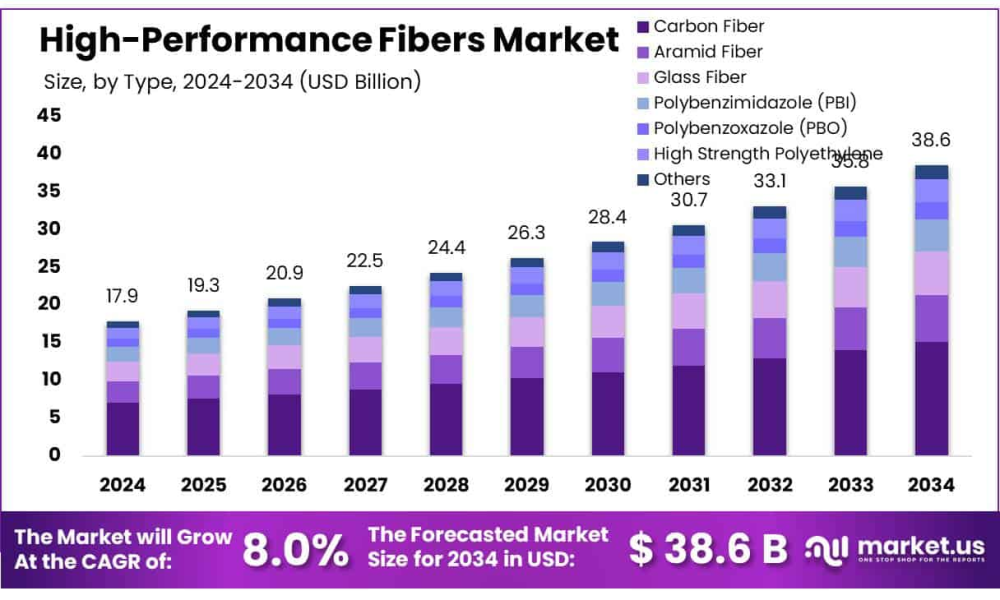
New York, NY – July 15, 2025 – The Global High-Performance Fibers Market is experiencing strong growth, driven by increasing demand across industries like aerospace, defense, automotive, and sports. In 2024, the market was valued at USD 17.9 billion and is projected to reach USD 38.6 billion by 2034, growing at a steady CAGR of 8.0% from 2025 to 2034.
This growth is fueled by the rising need for lightweight, durable, and heat-resistant materials in advanced applications. Industries such as aerospace and automotive are adopting these fibers to improve fuel efficiency and performance, while the defense sector uses them for protective gear and ballistic applications. Additionally, the sports and leisure industry is boosting demand due to the popularity of high-strength, flexible materials in athletic wear and equipment.
According to the Sports & Fitness Industry Association (SFIA), sports participation in the United States hit a record high in 2023, with over 236 million Americans engaging in at least one sport, fitness, or outdoor activity. This surge has driven demand for advanced sports equipment, particularly those incorporating lightweight materials to enhance performance. According to the Sports & Fitness Industry Association (SFIA), sports participation in the United States hit a record high in 2023, with over 236 million Americans engaging in
The U.S. Federal Aviation Administration (FAA) reports that modern commercial aircraft utilize approximately 50% composite materials by weight, such as carbon fiber reinforced polymers. These materials contribute to significant weight reduction, improving fuel efficiency and overall aircraft performance.
Emerging High-Performance Fibers markets in Asia-Pacific and North America present significant opportunities, driven by industrialization and technological advancements. The expansion of renewable energy projects, such as wind turbines requiring strong composite materials, further supports market growth. With increasing investments in research and development, the high-performance fibers market is set to expand, offering lucrative opportunities for manufacturers and suppliers worldwide.
The International Energy Agency (IEA) underscores the importance of lightweight composites in decarbonizing the transportation sector. The adoption of these materials could reduce global CO2 emissions by up to 1 gigaton annually by 2040, supporting global efforts to combat climate change.
The U.S. Department of Energy (DOE) highlights that reducing vehicle weight by 10% can improve fuel economy by 6%-8%. By replacing traditional steel components with lightweight materials like high-performance carbon fiber and composites, vehicle body and chassis weight can be reduced by up to 50%, significantly lowering fuel consumption. For electric vehicles (EVs), the DOE notes that using carbon fiber composites can cut vehicle weight by up to 30%, leading to a 20%-25% improvement in fuel efficiency, which is crucial for enhancing EV performance and range.
Important Revelation
- The global High-Performance Fibers market was valued at USD 17.9 billion in 2024.
- The global high-performance fibers market is projected to grow at a CAGR of 8.0% and is estimated to reach USD 38.6 billion by 2034.
- Among types, carbon fibers accounted for the majority of the High-Performance Fibers market share at 39.2%.
- By category, virgin accounted for the largest High-Performance Fibers market share of 87.3%.
- By end-use, aerospace & defense accounted for the majority of the High-Performance Fibers market share at 46.9%.
- Asia Pacific is estimated largest for the high-performance fibers market with a share of 46.2%.
➤ Download Exclusive Sample Of This Premium Report (Including Full TOC, Table & Figures): https://market.us/report/high-performance-fibers-market/request-sample/
Report Segmentation
By Type
- In 2024, carbon fiber emerged as the leading segment in the high-performance fiber market, accounting for a 39.2% share. This dominance can be attributed to carbon fiber’s outstanding strength-to-weight ratio, superior fatigue resistance, and expanding use across diverse industries including aerospace, automotive, sports equipment, and renewable energy.
- Its capability to reduce overall weight, improve fuel efficiency, and minimize emissions continues to position it as a material of choice in performance-driven applications. Furthermore, advancements in production techniques have lowered manufacturing costs, facilitating their integration into both specialized and mass-market products.
By Category
- Virgin high-performance fibers held a commanding 87.3% share of the market in 2024. This strong preference for virgin materials is largely due to their consistent mechanical performance, structural reliability, and uniform quality, which are crucial for applications in aerospace, automotive, and defense.
- These industries demand precision and durability, standards that are reliably met by virgin fibers. In contrast, recycled fibers often present challenges such as performance inconsistency, contamination risk, and complex processing requirements, factors that limit their suitability for high-spec applications.
By End-use
- Aerospace and defense represented the largest end-use segment in 2024, contributing 46.9% to the global market share. The segment’s dominance is driven by the critical need for lightweight, durable, and heat-resistant materials capable of withstanding extreme conditions. High-performance fibers, particularly carbon and aramid fibers, are widely used in aircraft components, defense equipment, and personal protective gear.
- Their role in enhancing operational safety, fuel economy, and overall system efficiency has solidified their importance in the sector. Additionally, rising defense expenditures and ongoing innovations in aerospace technologies continue to boost demand for advanced fiber materials.
Market Key Segmentation
By Type
- Carbon Fiber
- Ultra-high Modulus
- High Modulus
- Intermediate Modulus
- Low Modulus
- High Tenacity
- Aramid Fiber
- Para-aramid
- Meta-aramid
- Glass Fiber
- Polybenzimidazole (PBI)
- Polybenzoxazole (PBO)
- High Strength Polyethylene
- Others
By Category
- Virgin
- Recycled
By End-use
- Aerospace & Defense
- Automotive & Transportation
- Sporting Goods
- Building & Construction
- Others
Geopolitical Impact Analysis
The high-performance fiber market is increasingly influenced by shifting geopolitical dynamics, which are prompting a global transition toward regional self-sufficiency, localized production, and more resilient supply chains. Escalating tensions between major economies, protectionist trade policies, armed conflicts, and competition over critical raw materials have significantly disrupted traditional supply chain structures.
These disruptions are further intensified by cybersecurity risks and climate-related challenges, contributing to operational uncertainties for manufacturers operating across international borders. Key maritime trade routes have been affected by geopolitical conflicts, leading to delayed deliveries and inconsistent raw material availability for high-performance fibers such as carbon, aramid, and glass fibers. In response, many governments are enacting policies that prioritize domestic manufacturing capabilities and reduce reliance on imported materials.
Additionally, divergent regulatory frameworks are emerging as countries take different approaches to international taxation—some implementing the global minimum tax, while others withdraw from multilateral agreements, creating fragmented regulatory environments that complicate global operations. Environmental regulations are also reshaping industry dynamics. The European Union’s Carbon Border Adjustment Mechanism (CBAM), scheduled for implementation in 2026, will impose a carbon levy on imported goods such as steel, alloys, and potentially carbon fibers.
This mechanism is designed to internalize the cost of embedded carbon emissions, making imported carbon-intensive materials more expensive. As a result, manufacturers are under increasing pressure to decarbonize their operations and align with evolving regulatory requirements. In response, nations such as the United States, China, and India are significantly increasing investments in domestic high-performance fiber production to reduce exposure to foreign regulatory measures and support industrial sovereignty. These trends are accelerating a strategic realignment of supply chains, fostering regional resilience and innovation in fiber technologies.
Regional Analysis
In 2024, the Asia Pacific region held the largest share of the global high-performance fibers market, accounting for approximately 46.2% of total revenue. This regional dominance is primarily driven by rapid industrialization and urban development in countries such as China, India, and Southeast Asian nations. The expanding infrastructure sector in these economies is generating substantial demand for advanced construction materials, including carbon fibers, glass fibers, aramid fibers, and high-strength synthetic materials such as polyethylene and polypropylene.
Urbanization, rising disposable incomes, and a growing middle class have further supported the growth of the construction and transportation sectors, both of which are key consumers of the high-performance fibers market. Additionally, regional governments have introduced stringent regulations to promote the use of sustainable and low-carbon materials, encouraging the adoption of fiber-based alternatives over traditional metals like steel and iron. These regulatory efforts are supported by public infrastructure initiatives, which emphasize energy efficiency, durability, and compliance with environmental standards.
Asia Pacific’s dominance is also underpinned by technological advancements and the availability of diverse fiber products tailored for various end-use industries. In particular, the region’s construction industry is leveraging these materials to enhance structural performance and meet modern design requirements.
High-performance fibers are preferred for their lightweight nature, superior strength, and low environmental impact. With strong government backing, favorable economic conditions, and a focus on green construction and aerospace expansion, Asia Pacific is expected to remain a central hub for the high-performance fiber market in the coming years.
Factors Affecting the Growth of the High-Performance Fibers Market
- Growing Demand from End-Use Industries: High-performance fibers market is increasingly used in aerospace, defense, automotive, and sports industries due to their strength and lightweight properties. These sectors require durable, high-strength materials for applications like aircraft parts, body armor, and sports equipment, driving market growth. The rising popularity of electric vehicles also boosts demand for lightweight fibers to improve fuel efficiency and performance.
- Technological Advancements: Innovations in fiber technology, such as stronger carbon fibers and additive manufacturing, enhance fiber properties like tensile strength and heat resistance. These advancements create new applications in industries like aerospace and electronics. Research and development efforts focus on improving fiber performance, making them more versatile and cost-effective, thus expanding market opportunities.
- High Production Costs: The expensive manufacturing process of high-performance fibers market, like carbon and aramid, limits their adoption in cost-sensitive industries. High raw material costs and complex production methods increase prices, posing challenges for widespread use. This can restrict market growth, especially in developing regions where affordability is a concern.
- Regulatory and Environmental Challenges: Strict regulations on material use, processing, and waste disposal in industries like aerospace affect the market. Compliance with safety and environmental standards increases production costs. Additionally, the non-biodegradable nature of some fibers raises sustainability concerns, pushing manufacturers to explore eco-friendly alternatives to meet regulatory demands.
- Supply Chain Disruptions: The high-performance fibers market relies on complex supply chains for raw materials and distribution. Geopolitical tensions, trade disputes, or natural disasters can cause shortages and delays, impacting production. These disruptions lead to increased costs and longer lead times, affecting market growth and customer satisfaction.
Competitive Landscape
- Toray Industries, Inc.
- Dupont
- Teijin Limited
- TOYOBO MC Corporation
- Kolon Industries, Inc.
- Huvis Corp.
- AGY
- Zoltek
- Owens Corning
- Hexcel Corporation
- KUREHA CORPORATION
- Yantai Tayho Advanced Materials Co.,Ltd
- Mitsubishi Chemical Corporation
- Avient Corporation
- Bally Ribbon Mills
- Honeywell International Inc.
- China Jushi Co., Ltd.
- Solvay S.A.
- Sarla Performance Fibers Limited
- Other Key Players
Get in Touch with Us:
Market.us (Powered By Prudour Pvt. Ltd.)
Address: 420 Lexington Avenue, Suite 300, New York City, NY 10170, United States
Send Email: [email protected]
Refer To More Related Reports:
Carbon Monoxide Market
Marine Omega-3 Market
Aluminium Conductor Steel-reinforced Cable (ACSR) Market



