
Overview
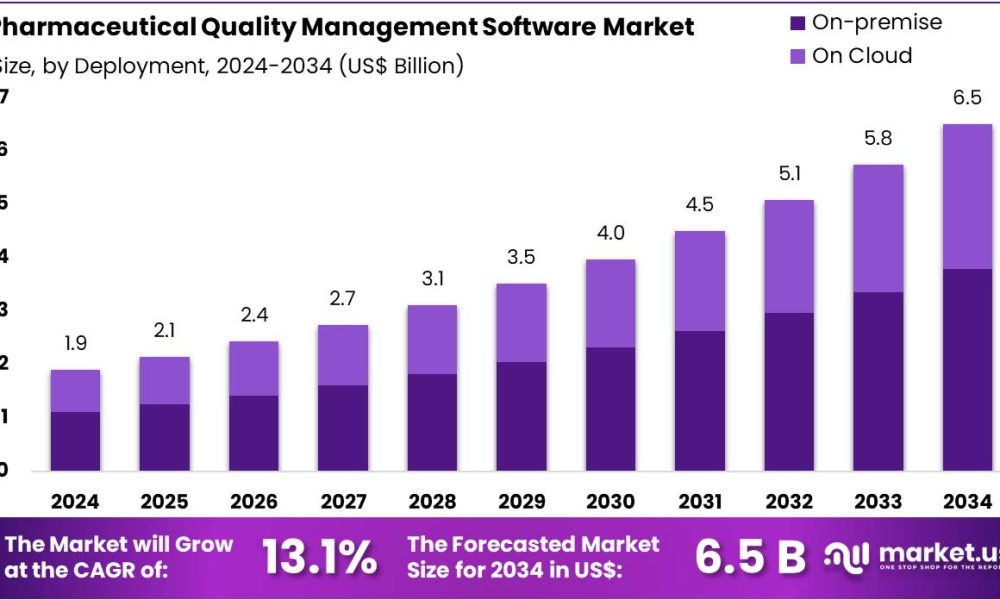
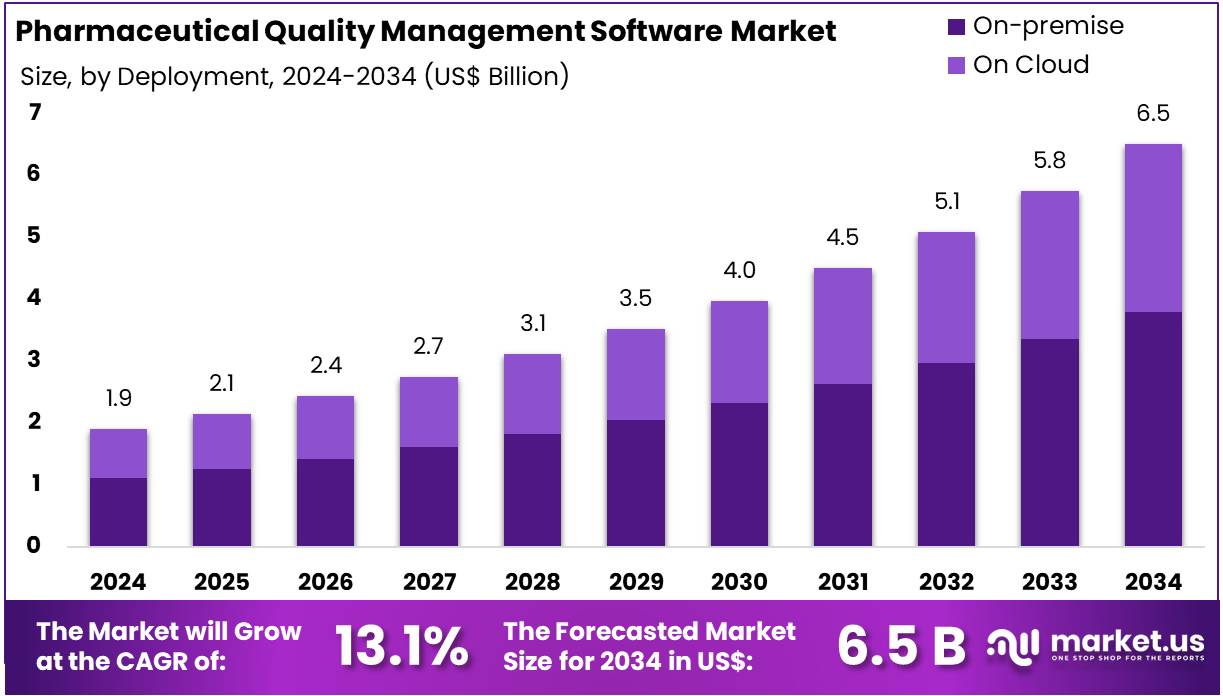
The Global Pharmaceutical Quality Management Software Market is projected to grow significantly, reaching a value of approximately USD 6.5 billion by 2034, up from USD 1.9 billion in 2024. This growth reflects a robust compound annual growth rate (CAGR) of 13.1% during the forecast period from 2025 to 2034. The expansion is mainly driven by increasing regulatory pressures, complex manufacturing processes, and the urgent need for compliance across global pharmaceutical operations.
Stringent regulatory frameworks are a major force behind the demand for quality management software. Agencies such as the U.S. Food and Drug Administration (FDA), European Medicines Agency (EMA), and International Council for Harmonisation (ICH) mandate rigorous quality assurance protocols. In January 2024, the FDA introduced the Quality Management System Regulation (QMSR) to align with international standards. These developments push pharmaceutical firms to adopt digital solutions that ensure compliance with current Good Manufacturing Practices (cGMP) and other global guidelines.
Quality management software (QMS) plays a critical role in improving product quality and operational efficiency. It supports a wide range of functionalities, including document control, audit management, change control, and corrective and preventive actions (CAPA). These features help reduce errors, enhance traceability, and ensure real-time visibility across pharmaceutical value chains. As a result, companies can shorten time-to-market, mitigate risks, and sustain regulatory compliance throughout the drug development lifecycle.
Technological advancements are shaping the future of pharmaceutical QMS. Automation, artificial intelligence (AI), and data analytics are being integrated into modern systems to support predictive quality control and smarter decision-making. In April 2022, Hexagon AB acquired ETQ, a leading provider of SaaS-based QMS and compliance software. This strategic move underscores the growing importance of integrated, cloud-based platforms that offer scalability and real-time monitoring for pharmaceutical companies.
Digital transformation in the pharmaceutical industry creates new opportunities for quality management systems. Increasing investments in biologics, personalized medicine, and vaccine manufacturing demand more sophisticated quality controls. Companies are adopting digital tools to minimize manual interventions, enhance supply chain visibility, and maintain high product standards. These efforts not only boost operational resilience but also reinforce patient safety and trust in pharmaceutical products.
Furthermore, pharmaceutical QMS extends its benefits beyond compliance. It aids in supplier quality assurance, deviation tracking, risk management, and regulatory reporting. The software ensures raw material integrity, supports continuous process improvement, and fosters a culture of accountability. As the pharmaceutical sector continues to evolve, quality management software is becoming a vital enabler of efficient, compliant, and high-quality manufacturing operations across the globe.
Key Takeaways
- In 2024, pharmaceutical quality management software generated US$ 1.9 billion in revenue and is projected to reach US$ 6.5 billion by 2034.
- The market is growing at a compound annual growth rate (CAGR) of 13.1% over the forecast period from 2025 to 2034.
- Among solution types, CAPA (Corrective and Preventive Action) management led the market in 2024, accounting for 32.5% of total revenue share.
- Deployment-wise, on-premise solutions dominated in 2024, contributing 58.4% to the total pharmaceutical quality management software market.
- By enterprise size, large enterprises captured the highest share of 64.3%, indicating greater adoption of QMS tools among bigger organizations.
- Regionally, North America held the largest share of the market in 2024, securing 41.2% of the global revenue.
Get Sample: https://market.us/report/pharmaceutical-quality-management-software-market/request-sample/
Segmentation Analysis
The corrective action preventive action (CAPA) management segment held the highest share of 32.5% in the pharmaceutical quality management software market. This growth is driven by increasing regulatory scrutiny and the urgent need to resolve quality issues quickly. CAPA solutions help reduce product recalls and improve manufacturing practices. Their integration with document control and supplier quality functions enhances their value. Additionally, automation and data analytics boost the efficiency of CAPA systems. As a result, companies increasingly adopt CAPA tools to prevent risks and ensure long-term compliance.
On-premise deployment captured 58.4% of the market share. Many pharmaceutical companies prefer this model due to strict regulatory requirements and the need for secure internal data management. These firms aim to maintain full control over sensitive product and patient information. Legacy system integration is also easier with on-site solutions. Moreover, on-premise deployments allow greater customization and direct software updates. While cloud adoption is growing, the importance of data control keeps on-premise systems relevant, particularly in regulated environments.
Large enterprises accounted for a dominant 64.3% share in the market. These companies deal with complex quality and compliance needs across multiple facilities. As a result, they require robust and scalable software platforms. Investments in advanced features such as real-time analytics and system integration support global operations. Their large budgets also allow early adoption of emerging technologies. This helps improve decision-making and process efficiency. The focus on reducing risks and ensuring consistent product quality positions large enterprises as leading contributors to market growth.
By Solution Type
- Incorrective Action Preventive Action (CAPA) Management
- Training Management
- Supplier Quality Management
- Regulatory and Compliance Management
- Non-Conformances Handling
- Inspection Management
- Document Management
- Complaints Management
- Change Management
- Others
By Deployment
- On-Premise
- On Cloud
By Enterprise Size
- Large Enterprise
- Small and Medium Enterprise (SME)
Regional Analysis
North America held the highest revenue share of 41.2% in 2024. This dominance is attributed to the region’s stringent regulatory framework. The U.S. FDA enforces the Current Good Manufacturing Practice (CGMP) outlined in 21 CFR Parts 210 and 211. These regulations require pharmaceutical manufacturers to implement end-to-end quality management. Companies must ensure detailed documentation, process controls, and regulatory compliance. As a result, firms adopt advanced software to streamline operations and meet FDA requirements, thereby driving strong market demand in this region.
Asia Pacific is projected to register the highest CAGR during the forecast period. Countries such as India and China are rapidly expanding their pharmaceutical manufacturing capabilities. These nations aim to comply with international standards set by agencies like the FDA and EMA. As a result, pharmaceutical firms are investing in digital quality management solutions to enhance compliance and safety. Growing domestic demand for high-quality medicines and increased adoption of cloud and analytics technologies are expected to accelerate the region’s software adoption and fuel robust market growth.
Key Players Analysis
Key players in the pharmaceutical quality management software market are driving growth by adopting advanced technologies. These include artificial intelligence (AI), machine learning, and cloud computing. Such tools help improve compliance and operational efficiency. They also support better data sharing across different healthcare systems. Companies are using strategic partnerships and acquisitions to grow their service offerings. These moves help expand market presence and strengthen competitive positions. In today’s fast-changing digital environment, such initiatives are essential for maintaining leadership and relevance.
The focus on mobile accessibility and user-friendly design is rising. Companies are building systems with intuitive interfaces that meet both regulatory and operational needs. These improvements boost user engagement among patients and caregivers. The growing demand for real-time access to data is making mobile platforms crucial. As a result, decision-making is faster and workflows become more efficient. Firms are also investing in research and development to keep their systems updated. This ensures compliance with the latest industry standards and regulations.
Veeva Systems Inc. stands out as a major player in this field. The company offers cloud-based solutions tailored to pharmaceutical and life sciences firms. Founded in 2007 and based in Pleasanton, California, Veeva provides CRM, content management, and analytics tools. It has expanded operations in China and partnered with six of the top 20 biopharma firms. These efforts aim to improve healthcare professional engagement. Demand for Veeva’s AI-powered services is growing steadily, helping strengthen its position in the global market.
Top Key Players in the Pharmaceutical Quality Management Software Market
- Yokogawa Electric Corporation
- Veeva Systems
- Sparta Systems
- Qualio
- QT9
- ETQ, LLC
- AssurX, Inc
- AmpleLogic
Buy Directly: https://market.us/purchase-report/?report_id=149879
Conclusion
In conclusion, the pharmaceutical quality management software market is expected to grow steadily in the coming years due to rising regulatory demands and the need for improved quality control. As the pharmaceutical industry becomes more complex, companies are turning to digital tools to ensure compliance, reduce risks, and improve efficiency. Modern software solutions now offer better integration, automation, and real-time visibility, which helps manufacturers stay competitive. Both large and small firms are recognizing the value of adopting quality management systems to enhance product safety and streamline operations. With continued investment in innovation and cloud technologies, this market is set to play a vital role in the future of pharmaceutical manufacturing.
Get in Touch with Us:
Market.us (Powered By Prudour Pvt. Ltd.)
Address: 420 Lexington Avenue, Suite 300, New York City, NY 10170, United States.
Contact No: +1 718 874 1545 (International), +91 78878 22626 (Asia).
Email: [email protected]
View More
US Urgent Care Centers Market
US Medical Billing Outsourcing Market



