
Overview
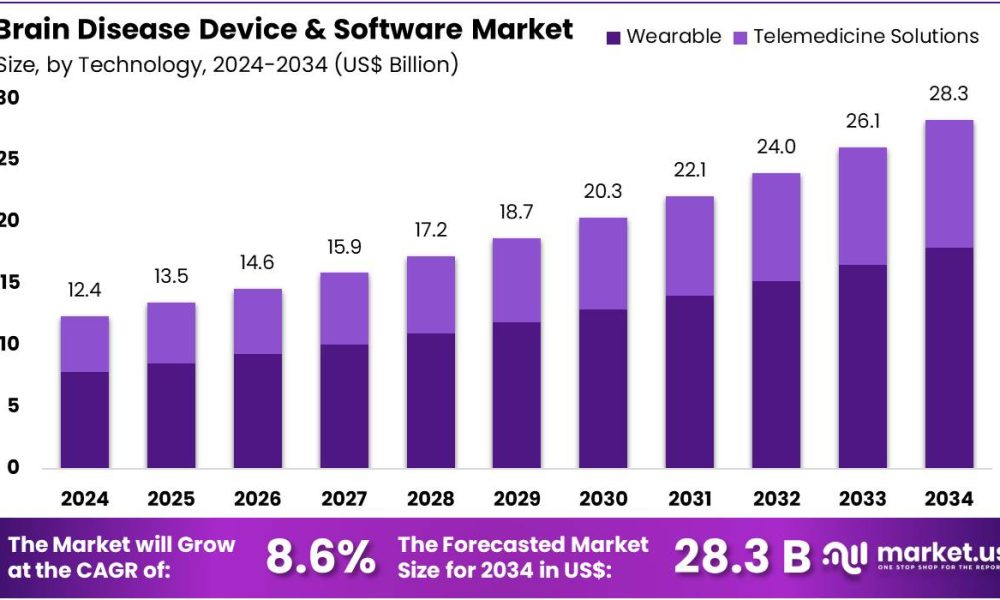
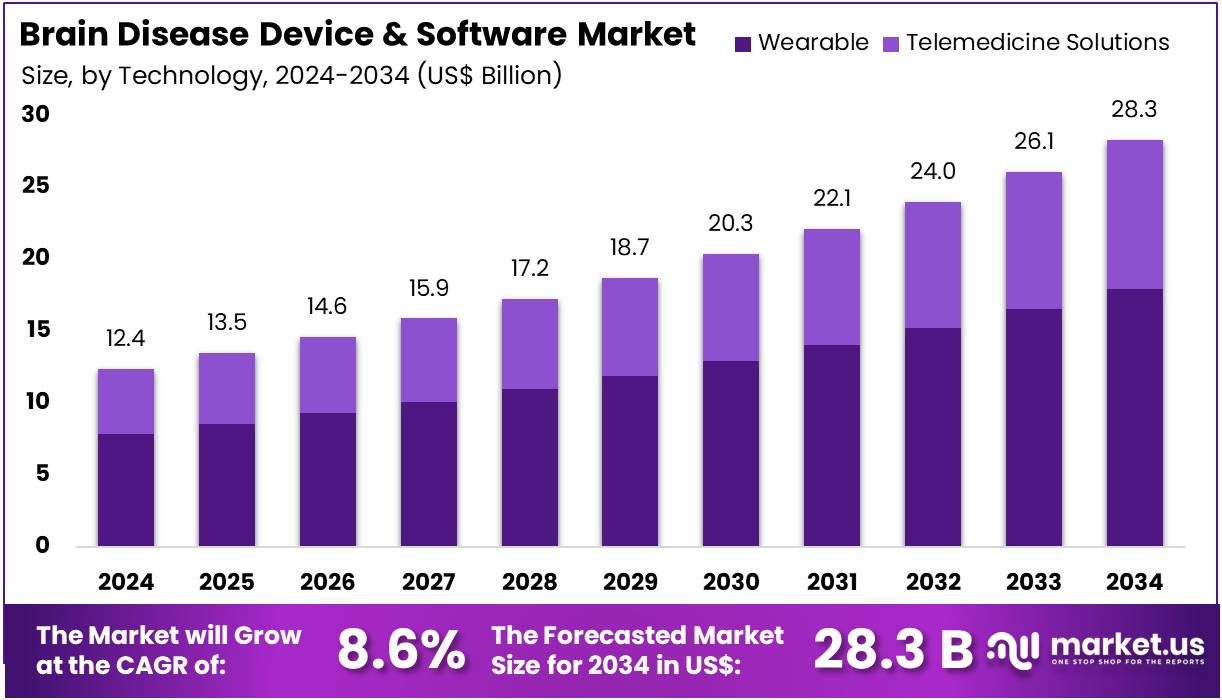
The Brain Disease Device and Software Market is projected to grow from USD 12.4 billion in 2024 to USD 28.3 billion by 2034, at a CAGR of 8.6%. This growth is fueled by the rising prevalence of neurological conditions such as Parkinson’s disease, Alzheimer’s disease, stroke, and epilepsy. These conditions require accurate diagnosis and long-term management. Advanced devices and software are helping improve treatment outcomes. They support early detection, continuous monitoring, and personalized therapies, resulting in better patient care and increased adoption across healthcare systems.
Innovative technologies are transforming brain disease management. Neurostimulation, brain-computer interfaces, and AI-powered software have brought higher precision to therapy delivery. In 2022, Medtronic’s Percept PC neurostimulator received FDA approval, marking a key development. This device is the first to record and stimulate brain activity at the same time. It improves treatment for movement disorders like Parkinson’s disease. Such advancements reflect the market’s shift toward real-time, data-driven therapies that enhance quality of life for affected patients.
Healthcare providers are embracing telehealth and remote monitoring to manage chronic neurological disorders. This trend supports greater use of wearable and minimally invasive devices. Rising investments in R&D are driving the launch of these advanced tools. As a result, the market is expanding its reach across therapeutic, diagnostic, and rehabilitation applications. Partnerships between tech companies and hospitals are also fostering rapid software innovation for disease tracking and data interpretation, creating further market opportunities.
The growing aging population and government-backed brain health initiatives are additional growth factors. For instance, in 2024, the Alzheimer’s Association reported that 6.9 million Americans aged 65 and older live with Alzheimer’s dementia. This reflects a sharp increase from 6.5 million in 2022. As awareness spreads, demand for smarter care tools rises. Big data and machine learning are now essential in delivering advanced neurological care. These technologies are reshaping the future of brain disease diagnosis and treatment globally.
Key Takeaways
- In 2024, the Brain Disease Device and Software market earned US$ 12.4 billion, projected to grow at a CAGR of 8.6% until 2034.
- By 2034, the market size is anticipated to reach US$ 28.3 billion, driven by rising neurological disease prevalence and advanced digital health technologies.
- Among product types, diagnostic devices and software led in 2023, accounting for a 52.4% market share due to growing demand for early diagnosis tools.
- Based on technology, wearable solutions dominated with a 63.5% share, reflecting their effectiveness in real-time brain activity monitoring and patient engagement.
- Alzheimer’s disease held the top spot in the application segment, contributing 44.8% of market revenue due to its increasing global incidence and treatment needs.
- Hospitals and clinics emerged as the dominant end-users, capturing 68.2% of the market owing to high diagnostic rates and infrastructure for advanced brain care.
- Regionally, North America led with a 41.6% market share in 2023, supported by strong healthcare systems and early adoption of brain health technologies.
Get Sample: https://market.us/report/brain-disease-device-and-software-market/request-sample/
Segmentation Analysis
The diagnostic devices and software segment captured a 52.4% market share due to the rising need for early and accurate diagnosis of neurological disorders. Growth is driven by AI-powered tools and imaging technologies that improve diagnostic precision. The rising burden of brain-related diseases compels healthcare providers to adopt such tools. Government initiatives and regulatory approvals further support market expansion. Integration with electronic health records ensures efficient workflows. Increased R&D investment by key industry players strengthens innovation, pushing the segment forward with enhanced diagnostic capabilities and broader clinical adoption.
The wearable technology segment dominated with a 63.5% share, fueled by rising use of portable monitoring devices for neurological tracking. These solutions support continuous, real-time assessments and offer patient mobility. Advances in non-invasive technology and growing awareness of brain health drive adoption. Integration with telemedicine platforms extends accessibility to remote patients. The rise in neurodegenerative cases and aging populations also contributes. Favorable reimbursement policies support use in home and clinical settings. As consumer preference for comfortable and smart monitoring grows, the wearable segment is set for sustained demand.
Alzheimer’s disease held the highest share in application, accounting for 44.8% of revenue. This is due to increasing global cases and the urgent need for early intervention. Development of tools to detect Alzheimer’s biomarkers has improved diagnosis. Governments and health organizations are increasing research funding and awareness. Elderly populations are driving demand for Alzheimer’s-focused devices and care solutions. Integration with cognitive health platforms and caregiver tools also boosts adoption. The market benefits from advances in personalized treatment and data-driven care strategies focused on improving quality of life.
Hospitals and clinics led the end-user segment, capturing 68.2% of total revenue. This is attributed to robust infrastructure and availability of specialized neurological care. More hospital admissions for brain disorders increase demand for facility-based treatment. Investments in staff training and medical technology support clinical expansion. Hospitals benefit from government healthcare programs and policy incentives. Collaborations between hospitals and device manufacturers help integrate new technologies. This ensures smooth implementation of innovative solutions. As the need for multidisciplinary neurological care grows, hospitals and clinics remain central to market development.
Regional Analysis
North America is currently leading the Brain Disease Device and Software Market. In 2024, the region accounted for the largest revenue share of 41.6%. This dominance is primarily due to increased FDA approvals for innovative neurotechnology. Several AI-powered neurology devices received regulatory clearance, as documented in the FDA’s medical device approvals database. These include advanced software designed for early diagnosis and continuous monitoring of neurological disorders. The region’s strong regulatory environment and innovation ecosystem contribute significantly to the early adoption of cutting-edge brain health technologies.
A major driver for North America’s market growth is its aging population. According to the Alzheimer’s Association, around 6.9 million Americans aged 65 and older are living with Alzheimer’s disease in 2024. The rising incidence of neurodegenerative disorders is increasing the need for diagnostic devices and therapeutic monitoring tools. Hospitals and clinics are adopting smart technologies that support non-invasive diagnosis. This trend underlines the market’s shift toward early intervention and real-time patient monitoring through software-integrated medical devices.
The Asia Pacific region is projected to register the fastest compound annual growth rate during the forecast period. This growth is fueled by increasing healthcare investments and a rising burden of neurological disorders. While veterinary telehealth saw notable growth in 2023, this trend also reflects broader regional readiness to adopt digital health technologies for human care. Governments across the region are improving healthcare infrastructure and funding tech-based solutions for brain disease diagnosis and treatment. As a result, demand for AI-powered tools and remote monitoring systems is gaining strong momentum.
Key countries like India and China are advancing strategic healthcare initiatives. These include the integration of advanced medical technologies and public awareness programs on brain health. The growing elderly population and the rising prevalence of conditions such as stroke and Alzheimer’s are driving demand for effective neurological devices. As healthcare access improves, more hospitals and clinics are equipped to adopt these digital tools. These combined factors are expected to support strong and sustained market growth across Asia Pacific.
Key Players Analysis
Key players in the brain disease device and software market are accelerating growth by incorporating advanced technologies such as artificial intelligence (AI), machine learning, and cloud computing into their platforms. These technologies help improve diagnostic accuracy and treatment effectiveness. Innovations in neuroimaging and neuromodulation are also contributing to better outcomes. The focus remains on delivering precise, data-driven care that enhances neurological diagnostics and interventions. As digital health tools evolve, companies strive to create intelligent systems that support timely and personalized treatment strategies for complex brain disorders.
Strategic collaborations and acquisitions play a major role in market expansion. Through these partnerships, firms are able to broaden their product portfolios and reach untapped geographic markets. This allows them to stay competitive and cater to the diverse needs of patients and healthcare providers. Moreover, companies are improving software interfaces to ensure easy use. Mobile accessibility is becoming standard, enabling better engagement from patients and caregivers alike. These efforts support improved care delivery and user satisfaction in clinical and home settings.
Research and development investment remains central to long-term success. Leading players are actively pursuing innovation to remain ahead of the technological curve. This includes developing minimally invasive solutions and advanced monitoring systems. Continuous product enhancements help meet evolving regulatory standards and clinical expectations. The market is highly dynamic, requiring companies to adapt quickly to technological shifts. As the demand for precision neurology solutions grows, R&D continues to drive differentiation and value creation across the competitive landscape.
Medtronic plc stands out as a global leader in this sector. Founded in 1949 and headquartered in Dublin, Ireland, the company specializes in neurological devices and therapeutic solutions. Its product portfolio includes deep brain stimulation (DBS) systems, neurovascular devices, and surgical navigation platforms. Among its key innovations is the Percept PC DBS system, which treats conditions like Parkinson’s disease and essential tremor. This system delivers targeted electrical stimulation to specific brain regions. Medtronic’s strong focus on innovation and quality has solidified its role as a trusted provider in the brain disease device and software market.
- Medtronic
- Boston Scientific
- NeuroPace
- Siemens Healthineers
- Philips Healthcare
- GE Healthcare
- Fujifilm Holdings Corporation
- NeuroSigma
Buy Directly: https://market.us/purchase-report/?report_id=149999
Conclusion
The brain disease device and software market is growing steadily due to rising cases of neurological disorders and increased demand for smarter healthcare tools. New technologies like AI, wearable devices, and neurostimulation systems are helping doctors detect and manage brain conditions more effectively. Hospitals and clinics are leading in the use of these tools, while home-based care is also gaining ground. Companies are working hard to develop user-friendly, high-quality solutions that support both patients and caregivers. As healthcare systems around the world invest in better brain health, this market is expected to grow even more. With strong innovation and collaboration, the future of neurological care looks more connected and efficient.
Get in Touch with Us:
Market.us (Powered By Prudour Pvt. Ltd.)
Address: 420 Lexington Avenue, Suite 300, New York City, NY 10170, United States.
Contact No: +1 718 874 1545 (International), +91 78878 22626 (Asia).
Email: [email protected]
View More



