
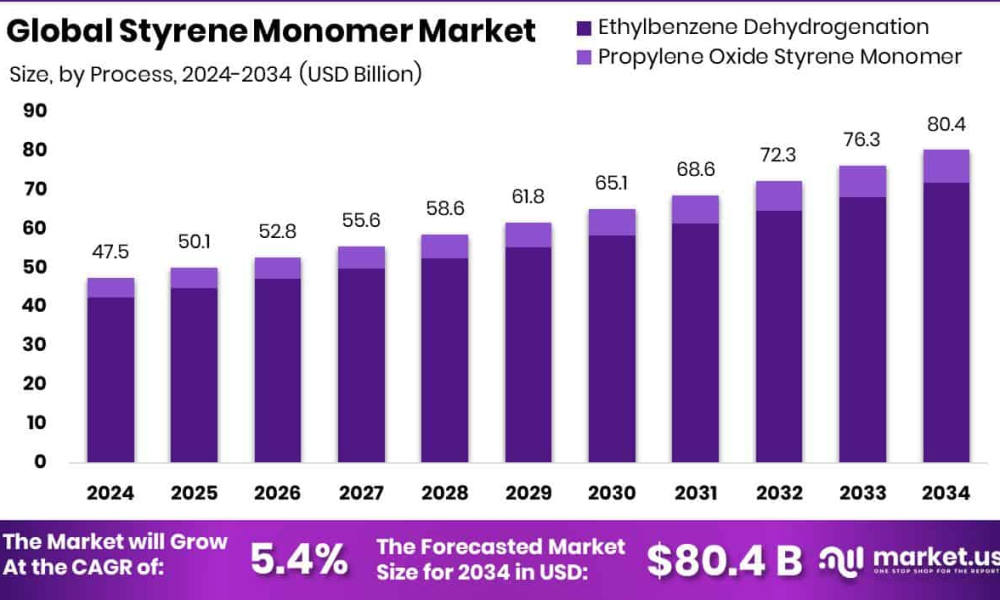
Market Overview:
The global Styrene Monomer market is projected to reach approximately USD 80.4 billion by 2034, rising from USD 47.5 billion in 2024, with a compound annual growth rate (CAGR) of 5.4% between 2025 and 2034. Asia-Pacific leads the market, holding a dominant 47.5% share, driven by robust demand from the manufacturing and packaging sectors.
Styrene Monomer, a key raw material in the production of various plastics and synthetic rubbers, is widely used across industries such as automotive, construction, packaging, and consumer goods. The increasing demand for lightweight, durable, and cost-effective materials in these sectors has fueled the market’s expansion. Additionally, technological advancements in polymer manufacturing and the rising adoption of polystyrene and its derivatives are strengthening the consumption of styrene monomer globally.
Asia-Pacific remains the leading region in this market, commanding a significant 47.5% share. This regional dominance is largely due to robust industrial infrastructure, expanding urbanization, and high manufacturing activity, especially in countries with fast-growing economies. The demand for styrene-based products in applications such as insulation, electronics, and packaging is particularly strong in this region.
Governments across Asia-Pacific are also supporting infrastructure development and industrial production, which directly boosts styrene monomer usage. Meanwhile, other regions such as North America and Europe are contributing steadily to market growth, with increasing interest in sustainable materials and recycling practices expected to shape future demand patterns.
Important Revelation:
- The global Styrene Monomer Market is projected to reach approximately USD 80.4 billion by 2034, increasing from USD 47.5 billion in 2024, with a CAGR of 5.4% from 2025 to 2034.
- Ethylbenzene dehydrogenation is the leading production method, accounting for 89.6% of global styrene monomer production.
- Polystyrene is the dominant application, holding a 42.9% share of total styrene monomer usage.
- The packaging industry represents the largest end-use segment, consuming 27.1% of the global styrene monomer demand.
- The Asia-Pacific region recorded a styrene monomer market value of USD 22.5 billion, making it the top regional market.
Download Exclusive Sample Of This Premium Report (Including Full TOC, Table & Figures):
https://market.us/report/global-styrene-monomer-market/free-sample/
Factors Affecting the Growth of the Styrene Monomer Market
Rising Demand from Packaging and Consumer Goods Sectors: The increasing use of styrene-based products in packaging especially for food, beverages, and personal care items is a major growth driver. Polystyrene’s lightweight and cost-effective nature make it ideal for single-use and protective packaging, boosting overall styrene monomer consumption.
Expansion of the Construction and Automotive Industries: Styrene-derived materials like expanded polystyrene (EPS) and acrylonitrile butadiene styrene (ABS) are widely used for insulation and molded parts. With growing infrastructure development and automotive production in emerging markets, the demand for these applications continues to rise, fueling market growth.
Technological Advancements in Production Processes: Improvements in dehydrogenation technology and catalysts have enhanced the efficiency and output of styrene monomer production. These innovations reduce by-products and operational costs, making production more viable and scalable, especially for high-volume manufacturing.
Economic Growth in Emerging Regions: Rapid urbanization, rising disposable incomes, and industrial expansion in regions such as Asia-Pacific are significantly contributing to increased styrene monomer usage. These factors create a favorable environment for market growth across multiple end-use industries.
Environmental Regulations and Sustainability Trends: Although styrene-based products offer versatility, increasing regulatory pressure and environmental concerns over plastic waste are influencing market dynamics. These factors are pushing innovation in recycling technologies and sustainable alternatives, which may impact production and application trends over time.
Report Segmentation:
Process Analysis: Ethylbenzene dehydrogenation remains the leading production method in the Styrene Monomer Market, capturing a commanding 89.6% share as of 2024. This reflects the industry’s strong dependence on this well-established process, known for its cost-effectiveness, scalability, and seamless integration into existing petrochemical infrastructures.
The method serves as the cornerstone of global styrene production, primarily because it aligns well with large-scale operations and takes advantage of the widespread availability of ethylbenzene feedstock. Its ability to deliver high output volumes at relatively low production costs makes it the preferred choice to meet the increasing demand for end-use products such as polystyrene, ABS, and styrene-butadiene rubber.
Continuous advancements in catalyst technology and process efficiency have reinforced the competitiveness of ethylbenzene dehydrogenation. These improvements help boost conversion rates while minimizing waste and by-products. Although newer, more sustainable alternatives are emerging aiming to reduce emissions or use renewable resources ethylbenzene dehydrogenation maintains its stronghold due to its economic viability and industry familiarity.
Application Analysis: In 2024, Polystyrene (PS) emerged as the leading application in the global Styrene Monomer Market, accounting for 42.9% of total consumption. This substantial share highlights polystyrene’s widespread adoption across key industries such as packaging, electronics, construction, and consumer goods. Its lightweight nature, durability, and cost-efficiency make it particularly popular for disposable packaging products, especially within the food and beverage sector.
The construction industry remains a major consumer as well, primarily for expanded polystyrene (EPS) used in insulation and structural solutions. In the automotive sector, polystyrene finds demand in parts that require impact resistance and ease of molding.
Manufacturers continue to favor PS for its processing convenience and recyclability, which has helped sustain its dominant market position. The 42.9% share reinforces polystyrene’s critical role in driving global styrene monomer demand, particularly in regions with high production and industrial activity.
End-Use Analysis: In 2024, the packaging industry emerged as the leading end-use segment in the Styrene Monomer Market, capturing a 27.1% market share. This strong position is largely attributed to the increasing global need for lightweight, durable, and cost-efficient packaging solutions, particularly in sectors like food, beverages, and consumer goods.
Materials derived from styrene, such as polystyrene and expanded polystyrene (EPS), remain widely used in packaging due to their superior insulation, moisture resistance, and cushioning properties. This 27.1% share reflects the significant consumption of styrene monomer in the production of items like foam trays, takeaway containers, and protective packaging. The rise of e-commerce and food delivery services, especially in densely populated and emerging markets, has further fueled this demand.
Moreover, the medical and pharmaceutical industries are increasingly adopting styrene-based packaging solutions for their sterility, lightweight nature, and reliability. While environmental concerns have prompted closer scrutiny of plastic usage, the packaging sector continues to lead due to its functional advantages and low production costs. Some companies are also turning to recycled and biodegradable alternatives to balance performance needs with sustainability goals, helping the segment maintain its dominant position.
To Purchase this Premium Report@https://market.us/purchase-report/?report_id=146594
Market Key Segmentation:
By Process
- Ethylbenzene Dehydrogenation
- Propylene Oxide Styrene Monomer
By Application
- Polystyrene (PS)
- Acrylonitrile Butadiene Styrene (ABS)
- Acrylonitrile Styrene Acrylate (ASA)
- Styrene-acrylonitrile (SAN)
- Styrene Butadiene Rubber (SBR)
- Others
By End-use
- Packaging
- Electronics
- Healthcare
- Household
- Automotive
- Construction
- Others
Regional Analysis:
As of 2024, the Asia-Pacific region emerged as the frontrunner in the global Styrene Monomer Market, capturing a substantial 47.5% share, with a total market value of USD 22.5 billion. This dominant position is largely driven by robust demand from key sectors such as packaging, construction, and automotive, particularly in fast-developing countries like China and India. The region’s rapid pace of industrialization and the strong growth of downstream applications continue to boost styrene monomer consumption.
North America and Europe also represent important markets, supported by established industrial infrastructures and consistent use of styrene-based products across various applications. However, their growth rates are comparatively moderate.
In contrast, regions such as Latin America and the Middle East & Africa are witnessing emerging opportunities, particularly due to expanding consumer markets and infrastructure development. Despite this, these areas still contribute a smaller portion to the global market when compared to Asia-Pacific.
Competitive Landscape:
- SABIC
- INEOS
- Shell plc
- KR Chemicals
- Qingdao Haiwan Group Co.,Ltd
- Denka Company Limited
- Chevron Phillips Chemical Company LLC
- KH Chemicals
- LOTTE Chemical CORPORATION
- Repsol
- Hanwha TotalEnergies Petrochemical Co Ltd
- Americas Styrenics LLC
- Westlake Corporation
- Equate Petrochemical Company
- The Kuwait Styrene Company
- Other Key Players
Get in Touch with Us:
Market.us (Powered By Prudour Pvt. Ltd.)
Address: 420 Lexington Avenue, Suite 300 New York City, NY 10170, United States
Send Email: [email protected]



