
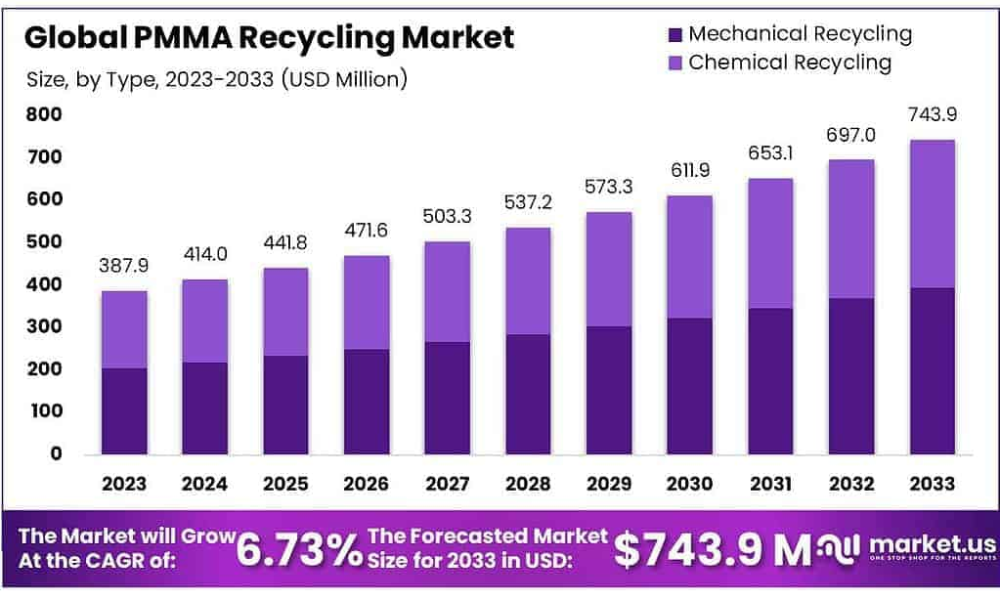
According to market.us, The global PMMA recycling market is projected to reach approximately USD 743.94 million by 2033, rising from USD 387.86 million in 2023, and is expected to grow at a compound annual growth rate (CAGR) of 6.73% during the forecast period from 2023 to 2033. The PMMA recycling market involves the collection, processing, and repurposing of Poly(methyl methacrylate), commonly known as PMMA or acrylic—a transparent thermoplastic widely used as a lightweight and shatter-resistant alternative to glass. PMMA is commonly found in products such as signage, sales displays, lenses, screens, and other clear, durable materials.
The recycling process includes the collection of discarded PMMA items, followed by separation and cleaning, and then either mechanical recycling—where the material is ground and re-melted—or chemical recycling, which breaks the polymer down into its monomers for repolymerization. The core aim of this market is to convert waste PMMA into usable raw materials for the production of new PMMA products or alternative materials, thus contributing to sustainable resource use.
Growth in this market is primarily driven by increasing environmental awareness and the global push to minimize landfill waste and promote resource conservation. Recycling PMMA supports the circular economy by extending the life cycle of the material and reducing the environmental impact of plastic disposal. Additionally, evolving regulations that promote recycling, advancements in recycling technologies, and improved economic feasibility are further supporting the expansion of the PMMA recycling market worldwide.
Key Takeaways
- Market Growth: PMMA Recycling Market is to reach USD 743.94 Million by 2033, from USD 387.86 Million in 2023, with a CAGR of 6.73%.
- Mechanical Recycling held a dominant market position in the PMMA recycling industry, capturing more than 69.3%
- Pyrolysis held a dominant market position in the PMMA recycling industry, capturing more than a 74.1% share.
- Automotive held a dominant market position in the PMMA recycling market, capturing more than a 28.3% share.
- North America leads the global PMMA Recycling Market, holding a significant share of 44.5%.
Access a Complimentary Sample of This Premium Report: https://market.us/report/pmma-recycling-market/free-sample/
Factors Affecting the Growth of the PMMA Recycling Market
- Rising Environmental Awareness and Sustainability Goals: Growing concerns over plastic waste and its impact on the environment have led to increased emphasis on recycling. PMMA, being a non-biodegradable thermoplastic, contributes to long-term waste if not properly managed. The push toward reducing plastic pollution and lowering carbon footprints has led to a higher demand for recycling solutions, positioning PMMA recycling as a critical component of sustainable materials management.
- Growth of the Circular Economy: The shift from a linear “take-make-dispose” model to a circular economy is significantly driving the PMMA recycling market. Recycling PMMA helps keep valuable materials in circulation, reducing the need for virgin polymer production. This aligns with corporate sustainability initiatives and government frameworks aiming to promote material reuse and lifecycle optimization.
- Increasing Regulatory Support and Waste Management Policies: Stringent environmental regulations and recycling mandates across regions such as the European Union, North America, and parts of Asia are encouraging the development of PMMA recycling infrastructure. Policies that require manufacturers to use recycled content, reduce plastic waste, or participate in extended producer responsibility (EPR) schemes are positively influencing market growth.
- Advancements in Recycling Technologies: Technological improvements in both mechanical and chemical recycling methods are making PMMA recycling more efficient and cost-effective. Innovations such as solvent-based depolymerization and purification techniques enable higher-quality recovery of PMMA monomers, which can be reused in new products. These advancements are enhancing the viability of recycled PMMA as a substitute for virgin materials.
- Economic Benefits and Cost Efficiency: As raw material prices for virgin PMMA fluctuate, recycled alternatives offer a more stable and cost-effective option for manufacturers. The ability to reduce production costs while meeting environmental targets makes recycled PMMA an attractive choice for industries such as automotive, construction, signage, and electronics, where acrylic is widely used.
- Expanding Applications and End-Use Industries: The growing use of PMMA in various applications—including optical lenses, medical devices, automotive components, and construction materials—is leading to increased generation of PMMA waste. This creates both a challenge and an opportunity, as greater volumes of recoverable PMMA feed into recycling systems, supporting market growth.
Report Segmentation:
By Type: In 2023, mechanical recycling dominated the PMMA recycling market, accounting for over 69.3% of the total market share. This method is widely adopted due to its cost-efficiency and simplicity, involving the physical processing of waste PMMA into reusable forms without altering its chemical composition. Mechanical recycling is particularly favored in applications where maintaining the original properties of PMMA is sufficient, making it an ideal choice for products that do not require ultra-high material purity. Its lower energy consumption compared to other recycling methods also adds to its appeal, especially for large-scale operations.
By Recycling Process: Pyrolysis emerged as the leading recycling process in 2023, capturing more than 74.1% of the PMMA recycling market. This technique involves the thermal decomposition of PMMA in an oxygen-free environment, converting it into monomers that can be reused in the production of new PMMA. Pyrolysis is highly efficient for processing large quantities of waste and is particularly effective in industrial-scale operations. Its ability to recover high-quality raw materials makes it an essential part of sustainable recycling strategies in the plastics industry.
By End Use: The automotive sector led the PMMA recycling market in 2023, holding a 28.3% share. Recycled PMMA is widely used in the manufacturing of vehicle light covers, instrument panels, and interior trim, offering durability and clarity. The automotive industry’s growing emphasis on sustainability and lightweight materials has fueled the adoption of recycled PMMA, helping manufacturers lower their environmental impact while reducing production costs.
To Purchase this Premium Report@ https://market.us/purchase-report/?report_id=119282
Key Market Segments
By Type
- Mechanical Recycling
- Chemical Recycling
Recycling Process
- Pyrolysis
- Depolymerization
End-Use
- Consumer Goods
- Automotive
- Electronics
- Construction
- Furniture
- Others
Regional Analysis
The Asia Pacific region has emerged as a key player in the global PMMA recycling market, accounting for a substantial 37.5% share. The market in this region is projected to reach a valuation of USD 151.0 million during the forecast period, driven by strong adoption across major sectors such as consumer goods, automotive, and electronics. Countries including China, India, Japan, and Australia are at the forefront of this growth, showing a marked increase in PMMA recycling activities. This regional momentum reflects a broader commitment to sustainable and environmentally responsible recycling practices, as industries seek innovative ways to reduce plastic waste and promote circular economy principles.
In North America, the PMMA recycling market is also witnessing steady growth. The rise in demand for eco-friendly products made from recycled PMMA is fueling this expansion, particularly across sectors that prioritize sustainability. The region benefits from a well-established industrial base and ongoing advancements in recycling technologies, which are playing a critical role in encouraging the use of recycled materials and reducing environmental impact.
Market Key Players
- Vanden Global Ltd.
- Renov8
- Heathland B.V.
- Sumitomo Chemical Co., Ltd.
- Plastic Expert
- Trinseo
- Lucite International Alpha B.V.
- Starlinger
- Pekutherm Kunststoffe GmbH
- Mitsubishi
Refer More Related Reports:
Perovskite Solar Cell Module Market
Get in Touch with Us:
Market.us (Powered By Prudour Pvt. Ltd.)
Address: 420 Lexington Avenue, Suite 300, New York City, NY 10170, United States.
Contact No: +1 718 874 1545 (International), +91 78878 22626 (Asia).
Email: [email protected]



