
Market Overview:
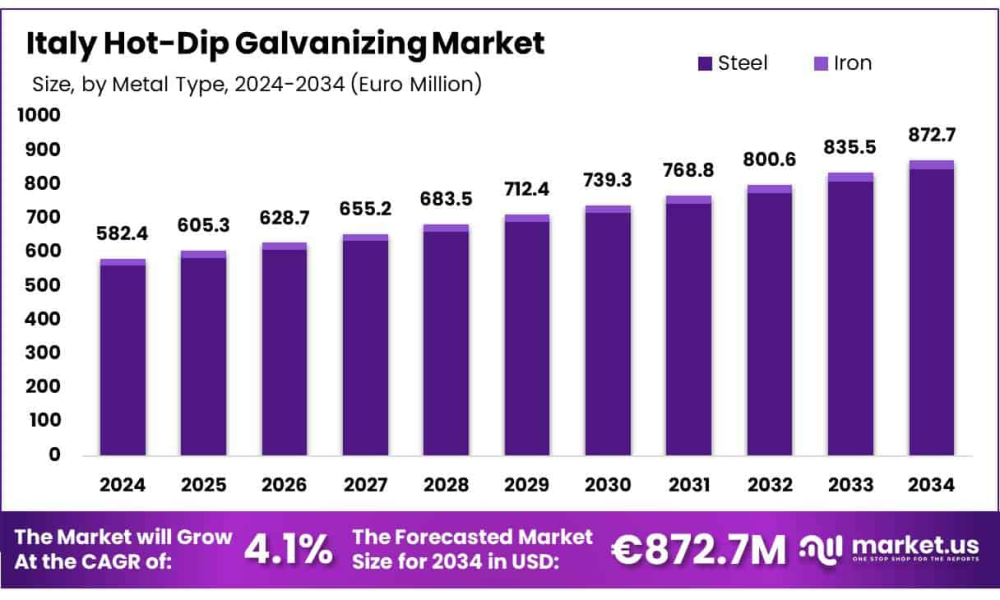
The Italy Hot Dip Galvanizing Market is projected to grow from EUR 582.4 million in 2024 to approximately EUR 872.7 million by 2034, registering a compound annual growth rate (CAGR) of 4.1% over the forecast period from 2025 to 2034.
Italy Hot Dip Galvanizing Market where steel or iron parts are immersed in molten zinc at roughly 450 °C continues to be a go‑to method for safeguarding metal against corrosion. This well‑established process produces a durable, metallurgical bond, ensuring long‑term protection from environmental degradation.
In 2024, Italy’s construction sector contributes 4.23% to GDP, with a projected decline to 3.98% by 2028. The sector saw strong post-pandemic growth, supported by the EU-funded National Resilience and Recovery Plan (NRRP), which allocates €108 billion for construction through 2026.
Meanwhile, Italy’s steel and HDG industries remain electricity-intensive, with 85% of steel produced via electric arc furnaces, facing high power costs of over €110/MWh—much higher than Germany’s €65/MWh. Zinc prices also remain volatile, ranging between $2,600 and $3,200 per ton. Hot-dip galvanizing plays a key role in protecting steel structures used in renewable energy projects, as Italy’s solar PV capacity surpassed 26.1 GW in 2023, with 4.7 GW added that year, according to GSE.
Important Revelation:
- The Italy Hot Dip Galvanizing Market is expected to grow from EUR 582.4 million in 2024 to approximately EUR 872.7 million by 2034, registering a CAGR of 4.1% during the forecast period.
- Among the different hot-dip galvanizing processes, the batch type held the largest share of the revenue at 58.9%.
- In terms of metal type, steel dominated the market, accounting for 96.6% of the total share.
- The construction sector emerged as the leading end-use industry, contributing 36.1% of the overall market share.
Download Exclusive Sample Of This Premium Report (Including Full TOC, Table & Figures):
https://market.us/report/italy-hot-dip-galvanizing-market/free-sample/
Factors Affecting the Growth of the Italy Hot-Dip Galvanizing Market
- Infrastructure Development: Continued investments in infrastructure, including roads, bridges, and transportation networks, boost demand for durable and visible traffic markings, thereby driving the coatings market.
- Environmental Regulations: Stricter environmental norms and safety standards are encouraging the adoption of eco-friendly and long-lasting road marking materials, enhancing market growth.
- Urbanization and Road Safety Initiatives: Rising urbanization and growing emphasis on traffic management and road safety lead to increased application of marking coatings for better visibility and regulation.
- Technological Advancements in Coatings: Innovation in coating materials, such as thermoplastics and long-life paints, which offer better reflectivity and durability, is influencing market expansion.
- Government Spending and Policies: Supportive government policies and funding for road maintenance and smart city projects contribute significantly to the demand for advanced road marking solutions.
Report Segmentation:
Process Analysis
Batch Galvanizing Leads Due to Its Versatility and Broad Applicability
The Italy hot-dip galvanizing market is segmented by process into batch and continuous methods. In 2024, the batch galvanizing process dominated, accounting for 58.9% of the total revenue share. This dominance is attributed to its high degree of flexibility and ability to accommodate various component sizes and shapes, making it particularly suitable for customized and complex applications. Unlike the continuous method, which is best suited for high-speed treatment of steel strips and coils, batch galvanizing is ideal for irregular, heavy, or fabricated steel elements like beams, railings, and structural parts.
This process is widely used in Italy’s construction and infrastructure sectors, especially in older city areas where structural variety and restoration needs are more common. Batch galvanizing offers the benefit of full immersion, providing even coating across edges, welds, and internal surfaces crucial for preventing corrosion in coastal and industrial regions. It’s also well-suited for small to medium production volumes, making it a cost-effective choice for contractors and manufacturers working on tailored steel projects.
Metal Type Analysis
Steel Leads the Italy Hot-Dip Galvanizing Market
In terms of metal type, the Italy hot-dip galvanizing market is primarily segmented into steel and iron. Steel emerged as the dominant material, capturing 96.6% of the market share, largely due to its broad industrial application, mechanical strength, and high compatibility with the galvanizing process.
Widely used across construction, transportation, automotive, and manufacturing sectors, steel’s strength-to-weight ratio, flexibility, and cost-efficiency make it an ideal choice for galvanizing especially when long-lasting corrosion protection is essential. The hot-dip galvanizing process creates a strong metallurgical bond between zinc and steel, ensuring excellent resistance to rust and wear, which is particularly important in Italy’s coastal and heavily industrialized areas.
End-Use Analysis
Construction Sector Leads Italy’s Hot-Dip Galvanizing Market
The Italy hot-dip galvanizing market is segmented into several end-use sectors, including construction, automotive, street and outdoor furniture, agriculture, renewable energy, power and utilities, industrial machinery, transport infrastructure, consumer goods, and others. Among these, the construction sector emerged as the dominant end-user in 2024, holding 36.1% of the total market share.
This leadership is largely driven by Italy’s ongoing investments in residential, commercial, and public infrastructure, where durability, structural reliability, and corrosion protection are essential. Galvanized steel plays a critical role in these developments, widely used in components such as beams, columns, staircases, balconies, roofing structures, and framework. Its long lifespan and minimal maintenance requirements make it a cost-effective choice for builders and contractors.
Geopolitical Impact Analysis:
Trade Tensions Have Disrupted Growth in Italy’s Hot-Dip Galvanizing Market
The introduction of U.S. Section 232 tariffs had a significant impact on Italy’s hot-dip galvanizing industry. These tariffs, which imposed a 25% duty on all steel imports including galvanized steel from Italy were aimed at protecting U.S. national security and domestic steel production. However, the move dealt a major blow to Italian exporters, particularly those specializing in high-quality, corrosion-resistant galvanized steel used in sectors like automotive and infrastructure.
Before the tariffs, the United States served as a crucial export market for Italian steel producers, especially for precision galvanized sheets and custom pre-coated components used in high-speed rail systems and industrial equipment. Once the tariffs were in place, Italian manufacturers found themselves priced out of the U.S. market.
Exports of galvanized steel to the U.S. reportedly fell by over 30% in the first year alone. This sudden decline forced many Italian galvanizing companies especially mid-sized firms to grapple with lost revenue and excess production capacity.
To Purchase this Premium Report@ https://market.us/purchase-report/?report_id=150003
Market Key Segmentation:
By Process
- Batch
- Continuous
By Metal Type
- Steel
- Iron
By End-Use
- Construction
- Automotive
- Street & Outdoor Furniture
- Agriculture
- Renewable Energy
- Solar
- Wind
- Others
- Power & Utilities
- Industrial Machinery
- Transport Infrastructure
- Consumer Goods
- Others
Competitive Landscape:
- Bordignon Giuseppe S.P.A.
- Del Carlo Group
- AMMA S.p.a.
- Giambarini Group
- Sati Italia SpA
- Zincogam S.p.a
- Irpinia Zinco s.r.l.
- BISOL S.p.A.
- GM Zincatura
- Zimetal S.r.l.
- Nuova Elettromeccanica Sud SpA
- Other Key Players
Get in Touch with Us:
Market.us (Powered By Prudour Pvt. Ltd.)
Address: 420 Lexington Avenue, Suite 300 New York City, NY 10170, United States
Send Email: [email protected]
Refer More Reports
2-Fluoro-4-Methylphenol Market



