
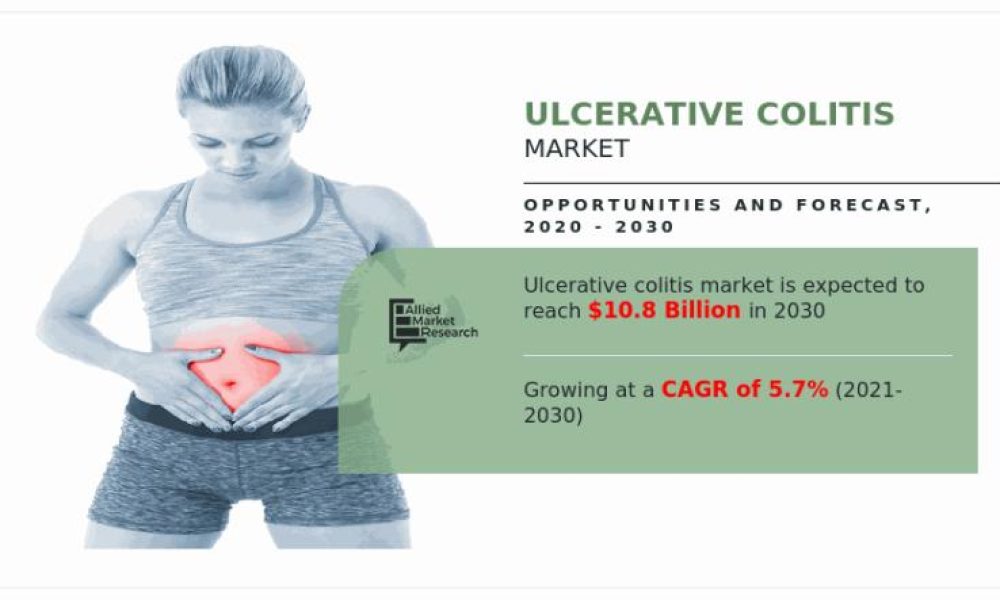
The global ulcerative colitis market was valued at $6.2 billion in 2020 and is projected to reach $10.8 billion by 2030, growing at a CAGR of 5.7% from 2021 to 2030. Ulcerative colitis (UC), one of the most common forms of inflammatory bowel disease (IBD), has become a growing global health concern, particularly in developed nations. The increasing incidence of the disease, combined with ongoing innovations in treatment approaches, is driving robust market expansion.
What is Ulcerative Colitis?
Ulcerative colitis is a chronic, inflammatory condition of the gastrointestinal tract that primarily affects the innermost lining of the large intestine (colon) and rectum. The disease leads to the formation of ulcers and can trigger symptoms such as abdominal pain, persistent diarrhea, rectal bleeding, and fatigue. UC most commonly develops between the ages of 15 and 30, but it can occur at any age.
Market Drivers
1. Rising Global Prevalence of IBD
The global rise in inflammatory gastrointestinal disorders has significantly contributed to the demand for ulcerative colitis treatments. According to Marc D Basson’s 2019 study, over 1 million people in the U.S. alone were living with ulcerative colitis. Globally, the burden of UC is increasing, especially in Western nations, which has heightened the need for effective, long-term treatment strategies.
2. Drug Innovation and Regulatory Approvals
The development of novel therapeutics, including biologics and small molecule drugs, is expanding treatment options. In May 2021, the U.S. FDA approved Zeposia (ozanimod), developed by Bristol Myers Squibb, for treating moderate-to-severe UC in adults. Such regulatory approvals not only increase accessibility but also encourage competition and R&D among key players.
3. Increased R&D and Pharmaceutical Investment
Leading pharmaceutical companies are heavily investing in clinical trials and drug development to address unmet needs in the UC space. New formulations and targeted therapies offer improved efficacy with fewer side effects, which in turn drives demand.
Market Challenges
Despite market growth, there are challenges that need to be addressed:
High cost of biologics limits access in low-income regions.
Long-term side effects of immunosuppressive treatments can deter patient compliance.
Lack of awareness in certain populations still delays diagnosis and treatment initiation.
However, the expansion of healthcare infrastructure in emerging economies and improved public awareness campaigns are helping to overcome these barriers.
Market Segmentation
By Route of Administration
Oral
Injectables
The oral segment dominated the market in 2020, driven by ease of administration and high patient compliance. However, injectables are projected to grow at a faster CAGR of 6.4%, due to the increasing availability of biologic therapies, many of which are administered via injection.
By Disease Type
Mild Ulcerative Colitis
Moderate Ulcerative Colitis
Severe Ulcerative Colitis
The mild UC segment held the largest share in 2020 due to early-stage diagnosis and broad treatment availability. However, the moderate UC segment is expected to exhibit notable growth, attributed to rising cases of ulcerative proctitis and the development of new mid-severity-targeted drugs.
By Molecule Type
Small Molecules
Biologics
Small molecules dominated the market in 2020, reflecting a large number of approved and widely available drugs. These include corticosteroids, aminosalicylates, and immunomodulators. However, biologics are expected to see faster growth, supported by increasing adoption for moderate to severe UC and ongoing clinical advancements in targeted therapies.
The small molecule segment is expected to grow at a CAGR of 6.2%, while biologics are steadily gaining traction due to their effectiveness in reducing flare-ups and inducing long-term remission.
Regional Insights
North America
Largest market in 2020, with dominance expected to continue due to:
High disease burden
Advanced healthcare infrastructure
Presence of key players such as Pfizer, Johnson & Johnson, and AbbVie
Rapid adoption of FDA-approved biologics
Asia-Pacific
Expected to register the highest CAGR of 6.5% from 2021 to 2030
Key drivers include:
Increasing awareness of UC symptoms
Expansion of healthcare access
Rising incidence of IBD in countries like China and India
Government efforts to boost pharmaceutical R&D
Europe and LAMEA
Europe remains a strong market due to high diagnosis rates and public healthcare reimbursement systems.
LAMEA (Latin America, Middle East, and Africa) is still an emerging market, with opportunities for growth due to improvements in medical infrastructure and increasing prevalence of gastrointestinal conditions.
Key Companies in the Market
The global ulcerative colitis market features several prominent players involved in the development, manufacturing, and distribution of both generic and branded therapies:
Abbott Laboratories
Ajinomoto Co. Inc.
AstraZeneca plc
Eli Lilly and Company
GlaxoSmithKline plc
Index Pharmaceuticals Holdings AB
Johnson & Johnson
Merck & Co., Inc.
Pfizer Inc.
Sanofi S.A.
These companies are focusing on expanding their product pipelines, seeking regulatory approvals, and entering strategic partnerships to enhance their global footprint in the ulcerative colitis market.
Future Outlook and Opportunities
The future of the ulcerative colitis market lies in personalized medicine, biologic therapy advancements, and early diagnostics. With ongoing research into microbiome modulation, gene therapy, and new small molecule drugs, the treatment landscape is expected to shift toward more targeted and patient-friendly solutions.
Other key opportunities include:
Increased adoption of biosimilars, which offer more affordable treatment options
Telemedicine and digital therapeutics, improving patient monitoring and compliance
Collaborations between pharmaceutical companies and academic institutions to accelerate drug discovery
Conclusion
The global ulcerative colitis market is on a strong growth trajectory, supported by increasing disease burden, rising healthcare investments, and a growing pipeline of effective therapies. As awareness grows and treatment options become more personalized and accessible, the market is expected to see sustained growth and innovation through 2030 and beyond.




