

Global Suction Excavator Market Analysis (2023-2032)
Suction Excavator Market Overview
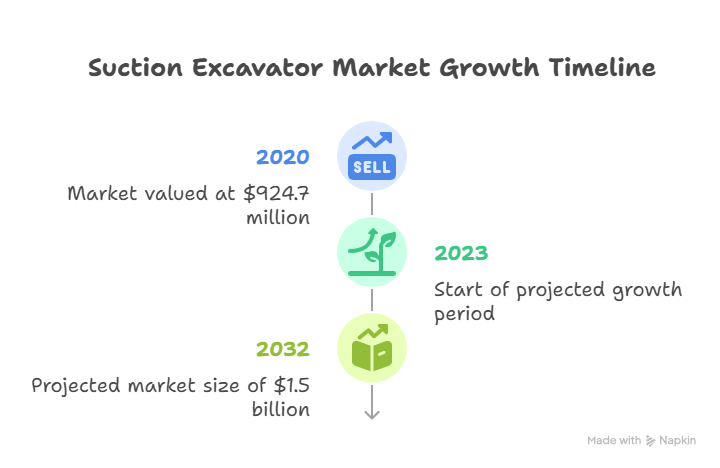
The global suction excavator market, valued at $924.7 million in 2020, is projected to reach $1.5 billion by 2032, growing at a compound annual growth rate (CAGR) of 4.2% from 2023 to 2032. Suction excavators, also known as vacuum excavators, are specialized construction machines designed for non-destructive digging, material removal, and utility location tasks. Equipped with high-powered vacuum systems, these machines extract soil and debris while minimizing damage to underground utilities, such as cables, pipes, and water mains. Their precision and safety features make them essential for urban construction, utility maintenance, and infrastructure projects.
The market’s growth is driven by the advantages of suction excavators, increasing infrastructure development, and their extensive use by utility providers. Technological advancements, such as enhanced vacuum systems and remote-control capabilities, further bolster their appeal, positioning suction excavators as critical tools for safe and efficient excavation.
𝐃𝐨𝐰𝐧𝐥𝐨𝐚𝐝 𝐏𝐃𝐅 𝐒𝐚𝐦𝐩𝐥𝐞@ https://www.alliedmarketresearch.com/request-sample/A12455
Suction Excavator Market Drivers
Several factors propel the suction excavator market. The primary driver is the non-destructive excavation capability of suction excavators. Using vacuum systems to break down and extract materials like soil, these machines significantly reduce the risk of damaging underground utilities, making them ideal for utility maintenance and urban construction. Their ability to locate and expose water lines, gas pipes, and electrical cables without causing accidental damage enhances their value in sensitive environments.
The rise in infrastructure projects globally, particularly in urbanizing regions, fuels demand. Suction excavators are faster and more efficient for precision excavation tasks compared to traditional excavators, exerting less ground pressure and minimizing surface damage. This efficiency is critical for projects like road repairs, bridge construction, and urban redevelopment, where minimizing disruption is a priority.
Utility providers extensively use suction excavators to verify the location of underground utility lines before construction or maintenance work, preventing costly damage to critical infrastructure. They are also employed in trenchless technology for installing or repairing utility lines without open-cut excavation, further increasing demand in the utility sector. The growing adoption of suction excavators in applications like cable and pipeline installation underscores their versatility.
Technological advancements enhance market growth. Modern suction excavators feature powerful vacuum systems with variable flow control, allowing operators to adjust suction force for specific tasks. Remote-control technologies, such as those offered by Force One Ltd’s remote nozzles, improve operator safety in hazardous environments, driving adoption in high-risk projects.
𝐄𝐧𝐪𝐮𝐢𝐫𝐞 𝐁𝐞𝐟𝐨𝐫𝐞 𝐁𝐮𝐲𝐢𝐧𝐠@ https://www.alliedmarketresearch.com/purchase-enquiry/A12455
Suction Excavator Market Challenges
Despite their advantages, suction excavators face limitations. They are less effective for deep excavation compared to traditional mechanical excavators, with a shallower reach that restricts their use in large-scale projects. Additionally, suction excavators struggle with compacted, rocky, or frozen soils, performing best in loose or granular soil types, which limits their applicability on diverse terrains.
The excavation rate of suction excavators is slower than that of larger mechanical excavators, impacting efficiency in high-volume projects. The process of separating excavated material from air or water, particularly in hydro suction excavators, can be labor-intensive and time-consuming. High maintenance costs, including regular servicing of vacuum systems, also pose a challenge, potentially deterring smaller operators or budget-constrained projects.
Economic factors, such as inflation driven by the Ukraine-Russia conflict and lingering effects of the COVID-19 pandemic, have introduced volatility in raw material prices, increasing manufacturing costs. These economic challenges may slow market growth, particularly in regions sensitive to price fluctuations.
Suction Excavator Market Opportunities
The suction excavator market offers significant opportunities, particularly through technological innovation. The demand for enhanced machinery performance has spurred developments like more powerful vacuum systems and variable flow controls, improving excavation speed and efficiency. Integration of remote-control and IoT-enabled technologies enhances safety and precision, appealing to industries prioritizing worker safety and operational efficiency.
The rise in utility maintenance projects in urban areas presents lucrative opportunities, especially for air-based suction excavators, which allow debris reuse and minimize environmental impact. The growing adoption of trenchless technology, which reduces surface disruption, aligns with suction excavators’ capabilities, creating demand in utility and infrastructure sectors.
Emerging markets, particularly in Asia-Pacific, offer substantial growth potential. Rapid urbanization and population growth in countries like China and India necessitate extensive underground utility networks, driving demand for suction excavators for maintenance and installation tasks. Government initiatives promoting sustainable construction practices further support market expansion.
Impact of COVID-19
The COVID-19 pandemic disrupted the suction excavator market, with global lockdowns reducing industrial activities and utility maintenance projects. Supply chain interruptions and labor shortages delayed manufacturing and project timelines. However, as the pandemic subsided, major manufacturers recovered in 2023. Economic slowdowns, exacerbated by inflation and geopolitical tensions, remain a challenge, but markets like India and China show resilience, supporting steady growth prospects.
Suction Excavator Market Segmentation
The market is segmented by type, drive type, application, and region.
By Type
The market is divided into air suction and hydro suction excavators. In 2020, hydro suction excavators held the largest share due to their effectiveness in wet conditions. Air suction excavators are expected to grow at a higher CAGR, driven by their ability to reuse debris and suitability for sensitive sites.
By Drive Type
The market includes wheel-mounted and track-mounted excavators. Wheel-mounted models dominated in 2020 for their mobility on urban sites, while track-mounted excavators, offering stability on rough terrains, are projected to grow faster, supported by construction growth in developing economies.
By Application
The market is categorized into construction and utility maintenance. Utility maintenance led in 2020, driven by extensive use in locating and repairing underground utilities. This segment is expected to grow at the highest CAGR, fueled by urban utility network expansion.
By Region
North America held the largest share in 2022, supported by advanced infrastructure and regulatory standards. Asia-Pacific is projected to grow at the highest CAGR, driven by rapid urbanization, population growth, and infrastructure development in China and India. Europe and LAMEA show steady growth, supported by utility and construction projects.
Competitive Landscape
Key players include Aerosun Corporation Limited, GapVax, Inc., Federal Signal Corporation, McLaughlin Group, Inc., Sewer Equipment, Cappellotto S.p.A., Heli NV, Ledwell & Son Enterprises, Inc., Amphitec, and Alamo Group Inc. (Vacall Industries). These companies adopt strategies like acquisitions, business expansions, and product launches to strengthen their market position. For instance, Force One Ltd’s remote nozzle innovations highlight the industry’s focus on safety and efficiency.
Suction Excavator Market Dynamics
The market is driven by the non-destructive capabilities of suction excavators, infrastructure growth, and utility sector demand. Technological advancements enhance efficiency, while limitations like shallow reach and high maintenance costs pose challenges. Opportunities lie in urban utility projects, trenchless technology, and emerging markets.
Key Benefits for Stakeholders
- Quantitative Analysis: Insights into segments, trends, and forecasts from 2023 to 2032.
- Porter’s Five Forces Analysis: Evaluates buyer and supplier dynamics for strategic decisions.
- Segmentation Insights: Identifies opportunities across types, drive types, and applications.
- Regional Mapping: Tracks revenue contributions by country.
- Competitive Benchmarking: Assesses key players’ strategies.
- Comprehensive Data: Combines expert inputs and market data for robust analysis.
Future Outlook
The suction excavator market is set for steady growth through 2032, driven by urbanization, infrastructure development, and technological advancements. Air suction excavators and track-mounted models will gain traction, while utility maintenance applications dominate demand. Despite challenges like limited excavation depth and economic volatility, opportunities in emerging markets and trenchless technology will support expansion. As sustainability and safety remain priorities, suction excavators will play a critical role in non-destructive excavation, ensuring long-term market success.




