

Solar Photovoltaic Glass Market Size, Share and Trend Analysis Report : Global Opportunity Analysis and Industry Forecast 2024-2033
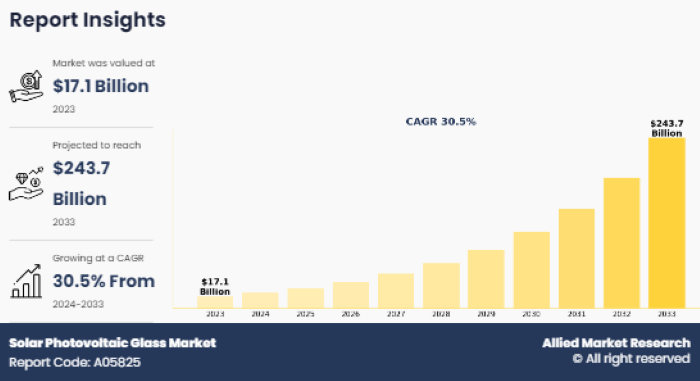
According to a new report published by Allied Market Research, the solar photovoltaic glass market size was valued at $17.1 billion in 2023, and is estimated to reach $243.7 billion by 2033, growing at a CAGR of 30.5% from 2024 to 2033.
Solar Photovoltaic Glass: A Key Component in Solar Energy
Solar photovoltaic (PV) glass is a specialized type of glass used in solar panels to convert sunlight into electricity. This glass serves as both a protective layer for solar cells and a crucial element in maximizing energy capture.
Download PDF Brochure: https://www.alliedmarketresearch.com/request-sample/6190
Flexible and lightweight solar PV glass are used in portable solar chargers for smartphones, tablets, and other electronic devices. Solar PV glass is to be integrated into wearable technology, such as smartwatches, fitness trackers, and clothing, to provide on-the-go power generation.
Asia-Pacific solar photovoltaic glass market garnered a major share in 2023 in terms of revenue.
The key players involved in the global solar photovoltaic glass market are Onyx Solar Group LLC, Shenzhen Topray Solar Co., Ltd., Borosil Glass Works Limited, Trina Solar, Ja Solar Holdings Co. Ltd, Sharp Corporation, Brite Solar, Wuxi Suntech Power Co., Ltd., Gruppo STG and Polysolar.
Supportive government regulations, incentives, policies, and initiatives are essential drivers for the growth of the solar photovoltaic glass market.
Many governments are setting renewable energy targets to reduce carbon emissions and combat climate change. These targets often include specific goals for solar energy deployment, providing a long-term market signal for investment in solar PV technologies.
Governments are also implementing feed-in tariffs, which offer financial incentives to solar PV glass producers and users by guaranteeing a premium rate for the electricity generated from renewable sources, encouraging investments in solar energy projects.
Bifacial solar PV glass is capable of generating electricity from both sides, capturing sunlight reflected off surfaces such as rooftops or the ground, thereby increasing energy production.
Bifacial solar PV glass offers improved efficiency and performance, especially in environments with high albedo (reflectivity), making it a more attractive option for various applications.
Innovations in solar photovoltaic glass are expanding the solar PV glass industry growth opportunities by providing more effective and efficient solutions.
Researchers and manufacturers are developing solar cells that are more transparent and can be customized in terms of color, allowing for greater design flexibility and aesthetic appeal.
Transparent solar cells can be integrated into windows, skylights, and building facades, turning them into power-generating surfaces without obstructing the view or natural light.
According to the Solar Energy Industries Association (SEIA), the government has implemented laws such as net metering and community solar to promote the use of photovoltaic technology to generate electricity. In countries such as the U.S., Spain, and France, consumers can utilize photovoltaic energy for their own electricity needs and sell the remaining solar power that they do not use.
However, International Electrotechnical Commission (IEC) Standards, such as IEC 61215 for crystalline silicon terrestrial photovoltaic (PV) modules and IEC 61730 for PV module safety qualification, are commonly referenced to ensure the safety and reliability of solar PV glass.
Buy This Report (250 Pages PDF with Insights, Charts, Tables, and Figures): https://bit.ly/4ejJV2I
Underwriters Laboratories (UL) Standards, including UL 1703 for flat-plate photovoltaic modules and panels, are widely recognized and used to evaluate the safety and performance of solar PV glass in the U.S. and other regions.
Solar PV glass is used in solar roads and highways to generate electricity from sunlight and provide illuminated road markings or signage.
Solar PV glass canopies or shelters are expected to be installed at bus stops, train stations, and other public transportation hubs to provide shade and power lighting or information displays.
By type, solar photovoltaic glass market for the anti-reflective coated glass segment is projected to be the fastest growing segment in terms of revenue during the forecast period.
- Tempered Glass
- Description: Heat-treated to improve strength and resistance to impact.
- Applications: Commonly used in residential and commercial solar panels.
- Low-Iron Glass
- Description: Contains less iron oxide, resulting in higher transparency and light transmission.
- Applications: Used in high-efficiency solar panels to maximize energy output.
- Bifacial Glass
- Description: Transparent on both sides, allowing sunlight to be captured from both the front and back.
- Applications: Used in bifacial solar panels that can generate more electricity.
Based on solar photovoltaic glass market analysis, depending on end-use industry, the utility scale segment contributed to the highest market share in the global solar photovoltaic glass market in 2023.
Applications
- Solar Panels: The primary use of PV glass is in the manufacture of solar panels for residential, commercial, and utility-scale applications.
- Building-Integrated Photovoltaics (BIPV): PV glass can be incorporated into building materials like windows and facades for energy generation.
Future Trends
- Technology Advancements: Ongoing research is focused on improving the efficiency and durability of PV glass.
- Recycling Initiatives: Increasing emphasis on recycling PV glass to reduce waste and promote sustainability.
- Integration with Smart Technologies: Development of smart glass technologies that can adjust transparency and energy efficiency.
Conclusion
Solar photovoltaic glass is an essential component of solar energy systems, contributing to the efficiency and durability of solar panels. As technology advances and the demand for renewable energy grows, PV glass will continue to play a critical role in the transition to sustainable energy solutions.
Other Trending Reports:-
Concentrated Solar Power Market
About Us:
Allied Market Research (AMR) is a market research and business-consulting firm of Allied Analytics LLP, based in Portland, Oregon. AMR offers market research reports, business solutions, consulting services, and insights on markets across 11 industry verticals. Adopting extensive research methodologies, AMR is instrumental in helping its clients to make strategic business decisions and achieve sustainable growth in their market domains. We are equipped with skilled analysts and experts and have a wide experience of working with many Fortune 500 companies and small & medium enterprises.
Pawan Kumar, the CEO of Allied Market Research, is leading the organization toward providing high-quality data and insights. We are in professional corporate relations with various companies. This helps us dig out market data that helps us generate accurate research data tables and confirm utmost accuracy in our market forecasting. Every data company in the domain is concerned. Our secondary data procurement methodology includes deep presented in the reports published by us is extracted through primary interviews with top officials from leading online and offline research and discussion with knowledgeable professionals and analysts in the industry.




