
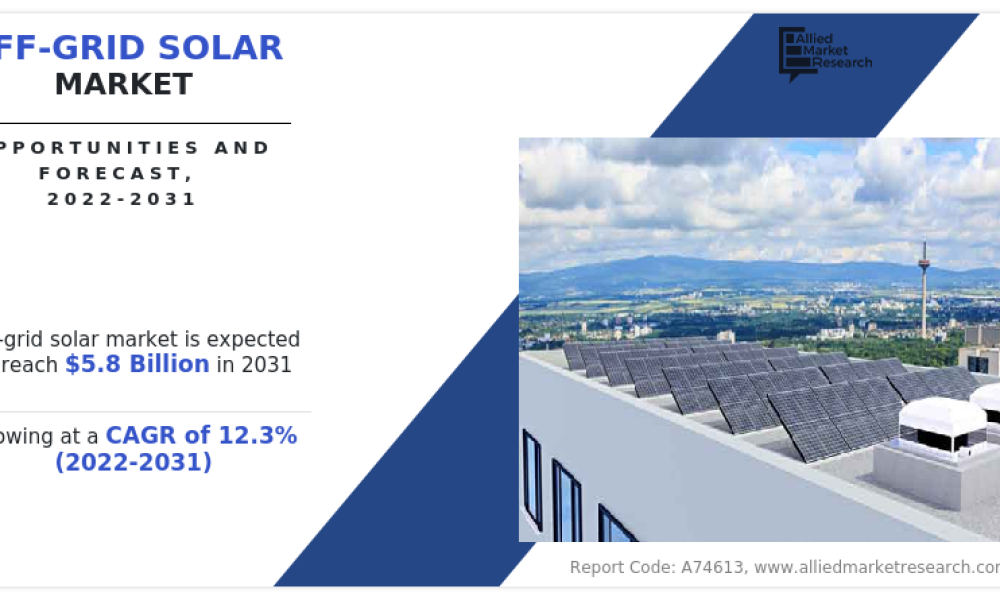
According to a new report published by Allied Market Research, titled, “OFF-Grid Solar Market,” The off-grid solar market size was valued at $1.9 billion in 2021, and is estimated to reach $5.8 billion by 2031, growing at a CAGR of 12.3% from 2022 to 2031.
The off-grid solar market refers to the industry focused on the development, production, and deployment of solar power systems that operate independently of the traditional centralized electricity grid. These systems typically include solar panels, batteries for energy storage, inverters, and power management components designed to provide electricity in remote or underserved areas where grid connectivity is unavailable, unreliable, or too costly to implement. Off-grid solar solutions enable decentralized energy generation, offering an effective alternative for rural electrification, disaster relief, and small-scale commercial or residential power needs.
Driven by advancements in solar technology, battery storage, and power electronics, the off-grid solar market has seen rapid growth as it addresses energy access challenges in both developing and developed regions. These systems provide reliable, sustainable, and cost-effective power that supports economic development, reduces dependence on fossil fuels, and enhances energy resilience. As the demand for clean and affordable energy continues to rise globally, the off-grid solar market is expected to expand significantly, playing a vital role in achieving universal energy access and supporting global sustainability goals.
Download PDF Brochure: https://www.alliedmarketresearch.com/request-sample/A74613
The prices of off-grid solar systems have decreased significantly over time, driven by technological advancements and economies of scale. These systems offer a more cost-effective alternative to extending traditional grid infrastructure in remote areas, where building transmission and distribution networks can be prohibitively expensive. Off-grid solar enables decentralized electricity generation, making power supply more economical by eliminating the need for extensive grid connections. Improvements in solar panel efficiency, battery technology, and power electronics—such as inverters—have contributed to increased energy output, enhanced storage capacity, greater durability, and better power management, all of which have helped lower the overall system costs. These factors are expected to fuel growth in the off-grid solar market throughout the forecast period.
However, limited energy storage capacity remains a key challenge for the off-grid solar market. Since these systems rely heavily on batteries to store energy for use during nighttime or cloudy conditions, constraints related to battery lifespan and storage capability can affect the consistent availability of electricity. During extended periods of poor weather or times of peak demand, battery capacity may be insufficient, leading to power shortages. These limitations pose a potential restraint on market expansion, highlighting the need for continued innovation in energy storage solutions.
Off-grid solar systems support decentralized energy generation, reducing reliance on centralized power plants and long transmission lines. This approach enhances energy resilience by lowering the risk of power outages, particularly in regions vulnerable to natural disasters or with unreliable grid infrastructure. Additionally, off-grid solar power enables small-scale economic activities such as agricultural processing, small businesses, and cottage industries, which benefit from reliable electricity access. This improved energy availability can boost productivity, income generation, and overall socio-economic development in off-grid communities.
Furthermore, the off-grid solar market drives innovation in solar photovoltaic (PV) technology, energy storage, and energy management systems. Continuous research and development efforts are focused on enhancing system efficiency, durability, and affordability, creating opportunities for new technological breakthroughs and business models. The decentralized nature of off-grid solar solutions not only supports sustainable energy access but also strengthens energy security, positioning the market for significant growth in the coming years.
For Purchase Inquiry: https://www.alliedmarketresearch.com/purchase-enquiry/A74613
The off-grid solar market share is segmented on the basis of application and region. By application, it is classified into residential, commercial, and industrial. By region, the market is analyzed across North America, Europe, Asia-Pacific, and LAMEA.
The report offers a comprehensive analysis of the global off-grid solar market trends by thoroughly studying different aspects of the market including major segments, market statistics, market dynamics, regional market outlook, investment opportunities, and top players working towards the growth of the market. The report also highlights the present scenario and upcoming trends & developments that are contributing toward the growth of the market. Moreover, restraints and challenges that hold power to obstruct the market growth are also profiled in the report along with the Porter’s five forces analysis of the market to elucidate factors such as competitive landscape, bargaining power of buyers and suppliers, threats of new players, and emergence of substitutes in the market.
The off-grid solar market shows strong regional variation driven by differing levels of grid infrastructure, economic development, and government support. Africa and Asia-Pacific are leading markets due to their large rural populations with limited or no access to centralized electricity grids. In regions such as Sub-Saharan Africa and parts of South Asia, off-grid solar systems offer a practical solution to energy access challenges, helping to electrify remote communities and support local economic activities. Governments and international organizations are actively promoting off-grid solar through subsidies, financing schemes, and partnerships, which further accelerates market growth. Additionally, the decreasing costs of solar panels and batteries have made off-grid solar more affordable and scalable in these regions.
In contrast, developed regions like North America and Europe have comparatively smaller off-grid solar markets due to well-established grid infrastructure. However, these markets are gradually adopting off-grid solutions for niche applications such as backup power, remote industrial sites, and recreational use. There is also increasing interest in off-grid solar as part of sustainability and resilience strategies, particularly in areas prone to natural disasters or grid instability. Meanwhile, regions in Latin America and the Middle East are witnessing moderate growth, driven by government initiatives to expand rural electrification and harness abundant solar resources. Overall, regional disparities in infrastructure, policy, and economic factors shape the diverse landscape of the global off-grid solar market.
The key players profiled in the off-grid solar market analysis report include ABB Ltd., Schneider Electric SE, Canadian Solar, Engie, SMA Solar Technology ag, Jinko Solar Holding Co. Ltd, SunPower Corporation, Delta Electronics, Greenlight Plant, and Hanwha Group.




